

The largest Russian winter attack against Ukraine so far took place on February 3, involving 450 drones and 71 missiles of various types. This time, Russian forces deliberately targeted Ukraine’s thermal power plants in an attempt to deprive Ukrainians of heating during extreme winter conditions, with temperatures dropping to –25°C and even –30°C in some regions.
For Russia, this represents a window of opportunity aimed at destabilizing Ukrainian society by forcing civilians to endure prolonged outages of heating, electricity, and hot water, often lasting more than 10 hours at a time. While Ukraine’s air defences successfully intercepted a large number of incoming targets, the damage caused by the missiles and drones that penetrated defences remains significant.
In this edition:
Starlink Issue Resolved. New Challenges Ahead;
Effectiveness of Mobile Fire Groups in Ukraine;
A Realistic Assessment of a War of Attrition: How to Approach the War with Russia;
Ukraine Opens Drone Exports;
10+ additional developments in Ukraine and Russia.
Thank you for reading and supporting my work!
I am resuming my fundraising campaign to purchase a vehicle for my friend Volodymyr, who is serving in the Armed Forces of Ukraine. We have only 14 days left, and for several reasons, I was not actively promoting this campaign earlier, which was my mistake.
I’d appreciate it if you consider donating to PayPal.
In 2025, here on Substack, we raised funds to purchase three Mavic drones for recon purposes for another friend of mine serving in the army.
Starlink Issue Resolved. New Challenges Ahead
On February 1, Ukraine’s government adopted a resolution introducing a Starlink “whitelist.” This initiative will be implemented by the MoD in cooperation with SpaceX.
The introduction of the “whitelist” is a response to Russia's use of Starlink terminals on drones. These drones are difficult to shoot down, fly at low altitudes, are resistant to electronic warfare, and are controlled by an operator in real time, even over long distances.
The Starlink registration procedure differs depending on who owns the terminal.
Military personnel can register their data in the Army+ application. Chiefs of communications or authorized personnel can enter the data into DELTA.
Businesses and civil servants can submit an application through the Diia portal. After receiving a verification notification, they may use Starlink without restrictions.
Civilians should visit an Administrative Service Centre (ASC or CNAP - Ukr.) and register the terminals with their passport and taxpayer card. If they have more than one terminal, they must bring those with them - this is a security requirement to protect communications and prevent misuse.
Serhiy FLASH Beskrestnov, advisor to the Minister of Defense, mentioned that the requirement to bring more than one Starlink terminal to an ASC is driven by the risk that Russian forces could exploit Ukrainian citizens sympathetic to them across Ukraine, who might register Starlink terminals through Diia.
In an interview with Radio NV on February 5, Serhiy FLASH confirmed that after Russian Starlink terminals were disabled, Ukrainian intelligence reported “total panic among the Russians,” and on many axes, Russian assault operations were halted.
“We generally understood that they were using Starlink technology, but the scale of its use came as a surprise even to us. […] At this point, none of the Russians’ command-and-control channels are functioning on the front lines. This affects FPV drone operators, electronic warfare units, signals intelligence, communications with forward positions, and other areas,” Beskrestnov said.
According to him, Russian forces are now trying to “quickly find alternative solutions, but everyone understands how difficult that is, because Starlink was an extremely simple and ideal technology.”
Immediately after the introduction of these measures, a wave of discontent emerged among some Ukrainian military personnel.
A well-known activist and a military figure in Ukraine, Marusia Zvirobiy, wrote that disabled Starlink terminals have crippled her unit's operations. She added that 80% of Starlink terminals are provided by volunteers, and even those submitted by her unit for registration never reached the authorities due to bureaucratic delays.
FLASH clarified that issues with Starlink terminals used by Ukrainian forces—particularly those that were not registered in time—will be quickly resolved, and that new “whitelists” are being submitted to SpaceX daily.
Former Mufti of the Spiritual Administration of Muslims of Ukraine and now
Lieutenant of the 57th Separate Motorized Infantry Brigade, Said Ismahilov shared the following observations: “The overall trend appears to be the following: we are more creative and are the first to invent and deploy new high-tech solutions (such as “Starlink drones”), but the enemy steals our ideas, rapidly scales them to industrial levels, and then begins using them against us on a mass scale.
Disabling the unauthorized (“grey”) Starlink terminals that the enemy was using against us in our occupied territories had only a temporary effect. War is a dynamic process, and they will soon be forced either to come up with an alternative technological solution or to register Starlink terminals under the names of their agents holding Ukrainian passports.
By exploiting an extensive network of Moscow-centric religious organizations operating across the country, the enemy could hypothetically recruit thousands of people to register Starlink terminals in their own names. I assume these could include elderly individuals who may not even understand what has been registered”.
As of February 7, Russians deployed an entire network to search for Ukrainian citizens willing to register Starlink terminals in their own names through ASCs, and offer them up to 10,000 hryvnias ($230). Other ideas involve using a shell company or removing a Starlink terminal from a captured (trophy) drone, and so on.
Ukrainians found guilty of assisting the enemy face 15 years’ imprisonment or life imprisonment if Starlink is used in a way that leads to the deaths of people.
Additionally, the Russians do the following:
Scaling up the use of Wi-Fi bridges
Attempts to use LTE in various ways
Attempts to return to satellite internet via the Yamal and Express satellite systems.
Russians initially planned to use Starlink actively to support their strike UAV operations, but are now forced to rapidly adapt or seek alternative technical solutions.
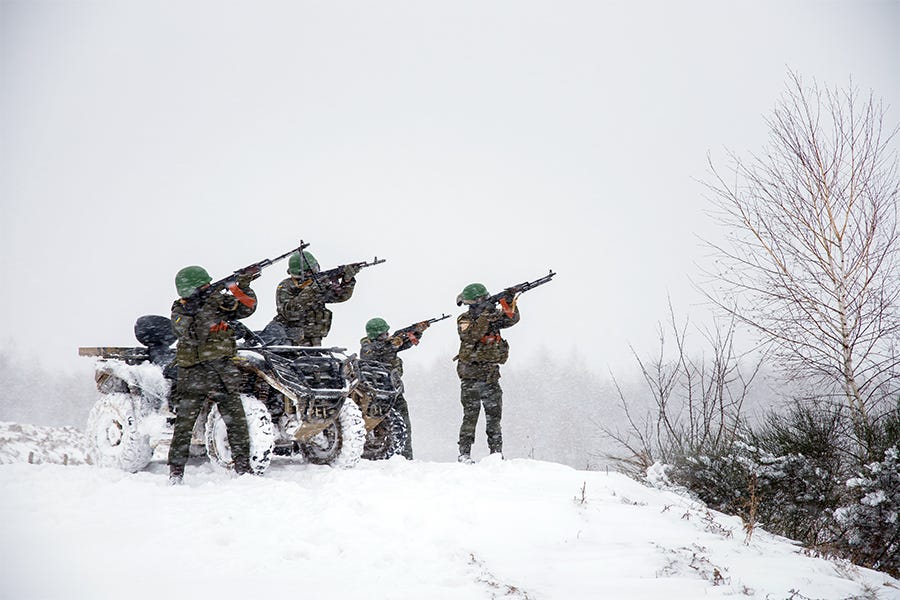
Effectiveness of Mobile Fire Groups in Ukraine
On Feb. 7, President Volodymyr Zelenskyy said that during the daily coordination call, he had a “rather tough conversation” regarding the performance of mobile fire groups.