

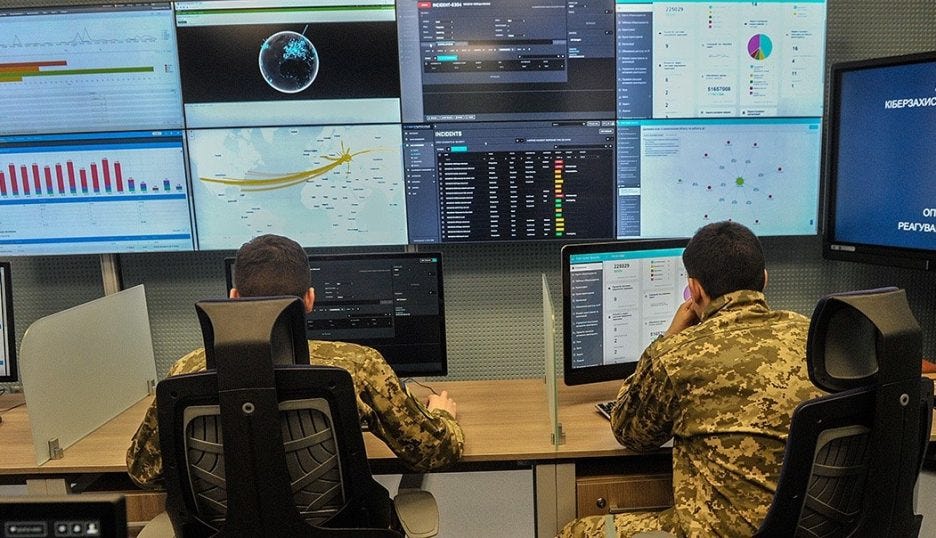
Russian cyberattacks are increasingly targeting civilian services, such as Ukraine’s Air Raid Alert app, as well as some of the most influential Ukrainian media. These are the attacks ordinary Ukrainians notice, while the SBU has dealt with thousands more behind the scenes since the full-scale invasion began.
In this edition:
How Russia Is Intensifying Cyberattacks Against Ukraine;
Ukrainian EW System Lima Makes Russian Missiles Break Apart in the Air;
Why Ukraine’s Arms Exports Haven’t Taken Off Yet;
And 10+ additional developments in Ukraine and Russia.
This is an entirely reader-supported publication, so your paid subscription makes a real difference. Consider teaming up with friends or colleagues: group subscriptions for two or more readers give you 20% off both the regular paid tier and the VIP tier, which includes the Saturday Ukraine Drone Brief.
How Russia Is Intensifying Cyberattacks Against Ukraine
Russia has been stepping up cyberattacks against Ukraine’s security and defence infrastructure, aiming to affect civilians and create a sense of panic. Recently, Ukraine’s Air Raid Alert app, a warning system widely used by Ukrainians, was hacked and sent false notifications about radiation, chemical and other threats.
According to the Security Service of Ukraine (SBU), almost 17,000 cyberattacks have been recorded since the start of the full-scale invasion. Many of them were highly sophisticated, but most were stopped at an early stage.
On 1 November, the Air Raid Alert app was hit by a cyberattack. False notifications warned of chemical and radiation threats, as well as street fighting. According to the developers, Ajax Systems and Stfalcon, the attackers accessed the duty operator’s workstation and sent the messages from there. The attack did not affect street sirens.
Ukraine’s Center for Countering Disinformation stated the attack aimed to undermine trust in the warning system and create a sense of insecurity. Overall, Ukrainians reacted calmly, but such tactics can have a stronger impact on older people, who are more vulnerable to this kind of warfare.
Later in the week, hackers targeted the email newsletters of Ukrainian media, sending fake emails in the name of two of Ukraine’s leading independent outlets, Ukrainska Pravda and The Kyiv Independent.
The SBU and more than 300 Ukrainian arms manufacturers have agreed to strengthen cooperation against hostile intelligence services under the Forpost programme that covers three areas:
Deliberate insider threats: identifying people whom Russian intelligence services are trying to recruit or are already using.
Unintentional leaks: preventing employees from unknowingly becoming sources of information for the enemy, for example by disclosing sensitive details in interviews, at industry events or on social media.
Cybersecurity: preventive measures to protect companies’ information systems, warnings about current cyber threats, and SBU help with recovery and investigations after attacks.
The SBU will also give companies security recommendations and clear procedures to follow when threats are detected, drawing on its experience countering Russian intelligence operations.
Ukraine is working on a law to establish Cyber Forces, which already exist in practice but not yet on paper.
Beyond Ukraine, cyberattacks on supermarket refrigeration systems have been recorded in at least 11 European countries in recent days, though no link to Russia has yet been confirmed. The attacks caused refrigeration equipment to fail, forcing stores to dispose of spoiled food. According to AFP, the EU has warned of a threat to the food supply chain and begun coordinating a joint response. Peskov, the Kremlin’s spokesman, denied any involvement in the cyberattacks affecting supermarket refrigerators.
The Kremlin views cyberspace as a central battlefield of modern conflict. In 2021, Putin denied that Russia was waging war in cyberspace but warned that if NATO treated it as a battlefield, “we will do the same thing.”
Ivana Stradner, a Research Fellow at the Foundation for Defense of Democracies, points out that Moscow has also been positioning itself as a champion of global cyber rules and wants a seat at the table where the rules of cyberspace are written. In December 2024, the UN General Assembly adopted a cybercrime convention that Russia had long championed, and it opened for signature in October 2025. Moscow is now pushing for a new international treaty on information security through the UN.
Ukrainian EW System Lima Makes Russian Missiles Break Apart in the Air
Ukraine’s Defence Forces use the Ukrainian EW system Lima to neutralize Russian ballistic missiles. It is not a full replacement for Patriot interceptor missiles, but it costs much less and has already proven results. Given the global shortage of PAC-3 interceptors, Ukraine’s allies should take note of this alternative approach.