

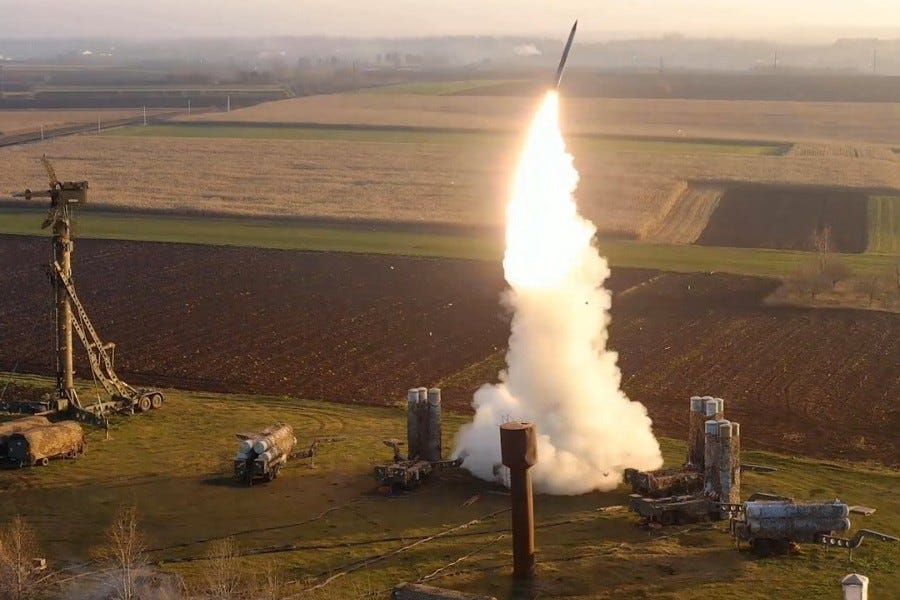
Just a few years ago, Ukraine’s offers of cooperation in air defence and counter-drone warfare were rejected by Israel and the United States. Now they are searching for that very expertise. But Ukraine’s strengths are not limited to interceptor drones. The country has been scaling up the production of cruise and ballistic missiles, as well as surface-to-air missiles — capabilities that have now attracted interest from the Middle East. This situation demonstrates how underestimated the potential of Ukraine’s defence industry has been, and how much Ukraine could have achieved if it had received the necessary assistance on time and in sufficient quantities.
In this edition:
Lessons from Ukraine for Defending Gulf Airspace from Shaheds;
Ukraine Produces Three Flamingo Missiles a Day;
Drone Warfare in Ukraine: Key Updates;
Why Drone Operators Will Be in High Demand in Civilian Life;
and 20+ additional developments in Ukraine and Russia.
In the next three weeks, due to business travel to Poland and Ukraine and a busy schedule, I won’t be able to publish a separate Drone Warfare in Ukraine edition and will instead include drone-related updates within the Monday digest.
Thank you for reading and supporting my work!
Lessons from Ukraine for Defending Gulf Airspace from Shaheds
This is a summary of the article by the Ukrainian soldier and lessons learned analyst at Ukraine’s 413th Unmanned Systems Regiment “RAID”, Dimko Zhluktenko, for War on the Rocks.
Ukraine’s battlefield experience shows that large-scale attacks involving hundreds or thousands of drones and missiles can overwhelm traditional air defence architectures.
In response to Russia’s mass attacks, sometimes involving over 800 drones and missiles, Ukraine has developed a layered, resilient, and sustainable air defence ecosystem that has proven capable of operating effectively over months and even years of continuous attacks.
Ukraine’s point-defence model functions as an interconnected ecosystem. Different tools cover different altitudes, geographic zones, and cost levels, all linked through reporting, cueing, and rapid operational adaptation.
Interceptor drones, mobile fire groups, radars, digital situational awareness platforms, conventional air defence systems, command posts, and a large pool of trained personnel work together in an integrated framework aimed at protecting Ukrainian airspace.
Interceptor drones have recently become an important layer in Ukraine’s counter-drone architecture, particularly against Shahed-type loitering munitions and reconnaissance UAVs.
Operating across a battlespace roughly comparable to the size of Texas, Ukrainian forces rely on a radar network for detection, with information fed into digital situational awareness systems accessible to air defence units.
Air defence commanders coordinate engagements based on this data. Interceptor teams then launch FPV or fixed-wing drones, piloting them manually through analog or digital video feeds to visually track and pursue enemy UAVs.
Engagement typically occurs through kinetic impact or the remote detonation of about 500 grams of C4.
These drones are relatively inexpensive—generally between $800 and $3,000 per unit—making them suitable for repeated use against mass-produced threats such as Shaheds or ISR drones.
Field observations suggest interception rates of roughly 50 percent or higher for well-trained crews.
The training issue is often misunderstood in Western discussions. Ukrainian operators frequently adapt quickly because many already have experience with drones, allowing them to master interceptor systems faster than most conventional air-defence specialties. This has allowed Ukraine to scale its interceptor units rapidly.
Ukrainian experience indicates that a single interceptor unit can cover an engagement zone of approximately 40 kilometers when integrated with advanced digital situational awareness systems that aggregate information from a broader sensor network.
With interception probabilities around 50 percent and the ability to fly thousands of sorties per month, these units can significantly reduce the threat posed by Shahed drones. Importantly, they also serve as a cost-effective supplementary layer, preventing the rapid depletion of expensive interceptor missiles such as those used by Patriot systems.
Implementing such an approach requires significant adjustments in doctrine, training programs, standard operating procedures, command structures, and operational planning.
It also requires expanded sensor networks, including acoustic sensors, radars, and robust data-processing pipelines capable of feeding digital situational awareness systems in real time. Above all, success depends on sufficiently trained personnel, since complex defence architectures ultimately rely on people to operate and coordinate them effectively.
Last week, Israeli Prime Minister Netanyahu reportedly asked Ukraine to arrange a conversation with President Zelensky to discuss cooperation on intercepting Iranian drones. Ukraine’s ambassador to Israel, Yevhen Korniychuk, confirmed that the request had been made. He noted that the conversation has not yet taken place due to scheduling constraints, but expressed hope that it will occur soon.
Militarnyi noted that back in October 2022, Ukraine officially approached Israel to begin cooperation on missiles and air defence. Netanyahu said in an interview with The Wall Street Journal that he had rejected requests from the United States and Ukraine to supply weapons to the Ukrainian army. According to him, Israel feared that the weapons could be captured in Ukraine and transferred to Iran.
Read my earlier reports on this topic:
Ukrainian Drone Interceptors Are Becoming a Global Currency;
Drone warfare in Ukraine: war in the Middle East and Ukraine’s expertise.
And here is the complete list of my articles on Air Defence and Counter-UAS.
Ukraine Produces Three Flamingo Missiles a Day
Ukraine is currently producing about three “Flamingo” cruise missiles per day. Production will increase to meet demand once the company Fire Point finalizes its own engine, said Denys Shtilerman, co-founder and chief designer of the defence company.