

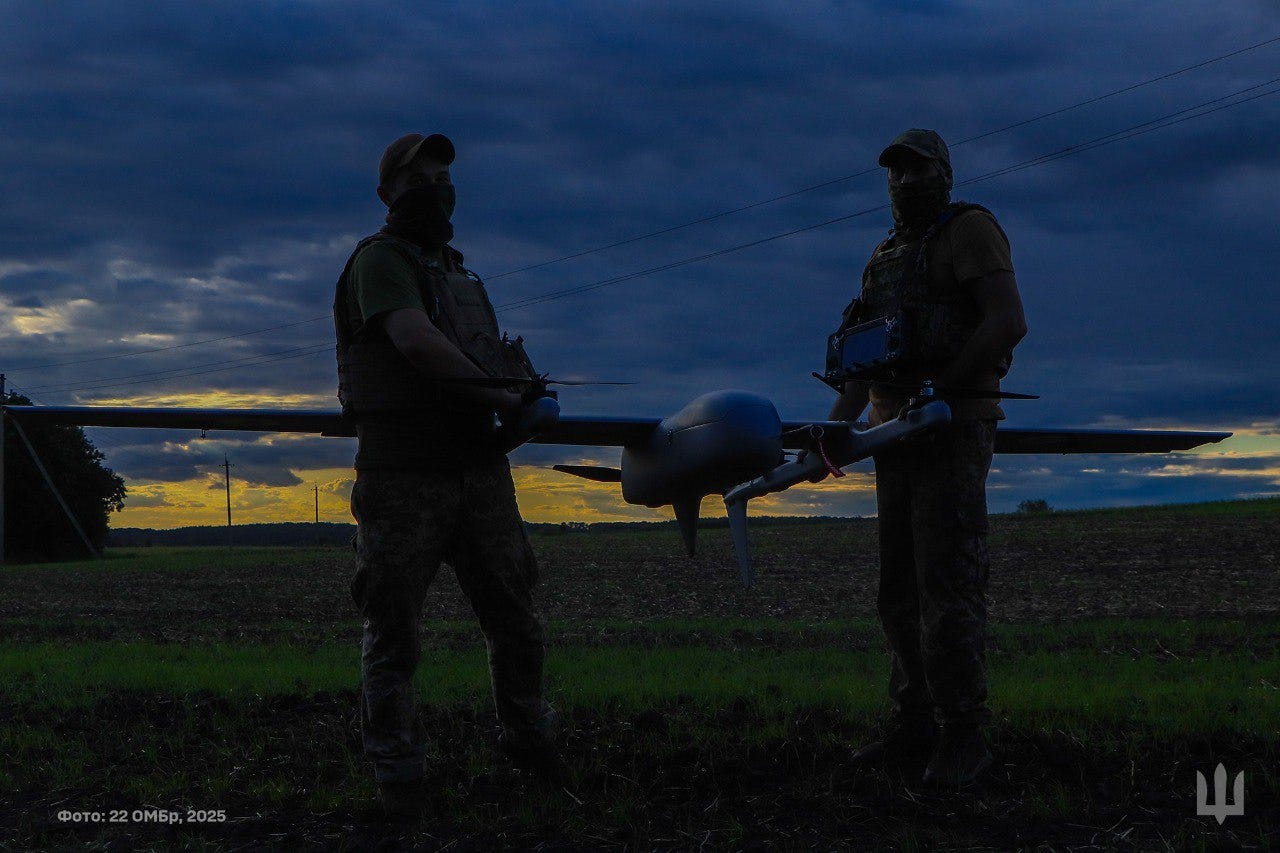
Ukraine’s Armed Forces struck around 50 fuel and military-industrial facilities in Russia this autumn alone, marking an unprecedented tempo of successful attacks.
In total, in 2025, Ukraine carried out more than 160 strikes on Russian oil extraction and refining sites — a sector that remains the Kremlin’s primary source of revenue and a key financial engine of its war.
Looking ahead, Ukraine’s long-range strike capabilities will remain a top priority, especially as Kyiv continues launching joint production facilities with European partners.
In this edition:
Australia considers transferring Tiger helicopters to Ukraine;
Ukraine doubles down on weapons-component production;
Ukraine and the Netherlands to launch joint drone manufacturing;
20+ additional developments from Ukraine and Russia.
Thank you for reading and supporting my work!
Military Transfers to Ukraine
🇦🇺 Australia is considering the possibility of transferring its Tiger attack helicopters to Ukraine, as the Australian Army is phasing this type out in favour of the US-made AH-64E Apache.
The government is currently assessing the options and feasibility of such deliveries in response to Ukraine’s request for helicopters.
Pressure on the Australian government has increased due to outrage within the local Ukrainian diaspora over the refusal to supply MRH-90 Taipan transport helicopters, which were instead buried for disposal. According to ABC, the discussion concerns 22 Tiger attack helicopters that are scheduled to be withdrawn from service by 2028.
However, Defence Express noted that not everything appears to be working well with these helicopters. The public government audit published in 2016 revealed that the Full Operational Capability (FOC) of Tiger helicopters came with major caveats across nine areas, including electronic warfare systems, identification-friend-or-foe, communications, and command and control.
The audit also recorded that the Tiger had 76 deficiencies, 60 of which were classified as critical.
In June 2014, during flights in different parts of the world, both a German and an Australian Tiger helicopter lost their launchers for unguided rockets. The causes were never identified, but Australia’s Ministry of Defence subsequently prohibited Tiger helicopters from flying over populated areas.
The audit also noted a deficiency in the optical targeting system, which does not allow the use of precision-guided weapons beyond man-portable air-defence system (MANPADS) range.
Additional developments:
🇳🇱 The Netherlands will allocate an additional €250 million under the PURL initiative for the purchase of air defense systems and ammunition for F-16 fighter jets for the needs of the Ukrainian Armed Forces.
🇨🇦 Canada pledged another $200 million on military equipment for the PURL initiative. Canada’s overall contribution to PURL amounts to $890 million.
🇮🇪 Ireland announced an additional €125 million in assistance for Ukraine, which will be directed toward non-lethal military support and strengthening the country’s energy system.
🇩🇪 Reportedly, within just a few days of operation, the IRIS-T SLS system recently delivered by Germany to Ukraine intercepted nine Russian targets, including five Kh-101 cruise missiles, two Iskander-K missiles, and two Shahed-131/136 UAVs.
🇪🇺 The initiative by the EU High Representative for Foreign Affairs and Security Policy, Kaja Kallas, to provide Ukraine with 2 million rounds of ammunition in 2025 has not been implemented. Kallas herself stated this following the conclusion of the EU Foreign Affairs Council meeting at the level of defence ministers.
🇸🇪 Sweden will phase out development aid to five countries (Zimbabwe, Tanzania, Mozambique, Liberia and Bolivia) in the coming years and use the money to increase support for Ukraine. The government said the measures would free up more than 2 billion crowns over the next two years that could be diverted to Ukraine, to be used in such projects as rebuilding the country’s energy infrastructure. It was not specified whether this funding will go to Ukraine’s military needs.
🇩🇰 In 2026, Denmark plans to allocate 9.4 billion kroner (€1.26 billion) in military aid to Ukraine, compared with 16.5 billion kroner (€2.21 billion) in 2025 and nearly 19 billion kroner (€2.54 billion) in 2024.
According to the Kiel Institute, Denmark is the country providing Ukraine with the highest level of support as a share of GDP. Therefore, according to Defence Committee member Simon Kollerup, “it is natural that we now see a stabilisation in the level of support being provided.”
Production of Weapons Components
Ukraine’s Brave1 government cluster announced the launch of a new grant program for manufacturers of components used in Ukrainian weapons.