

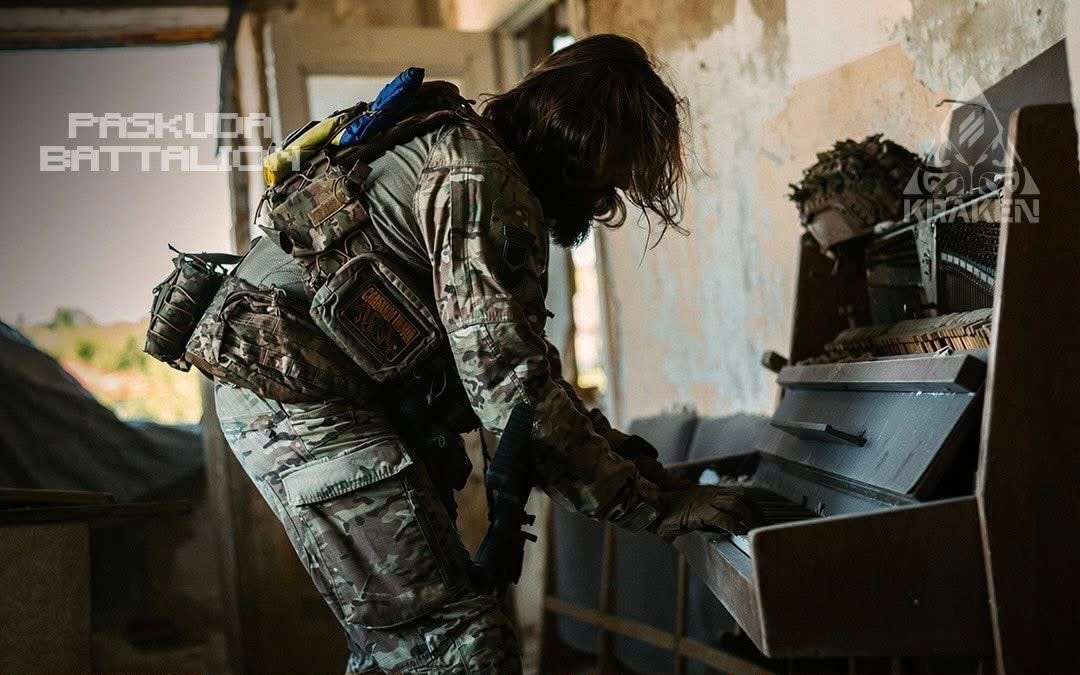
Last week brought positive news from Ukraine. The Third Army Corps, together with other military formations, completed another phase of the counteroffensive Operation Vivaldi, regaining control of 125 square kilometres of Ukrainian territory and destroying thousands of Russian targets in one of the hottest areas of the frontline.
In this edition:
Vivaldi: Ukraine’s Counteroffensive Operation;
Assault Soldier on the Experience in Operation Vivaldi;
Russia’s “Dark Plant” for Automated Containerized FPV Drone Production;
and 10+ additional developments in Ukraine and Russia.
If you don’t want to just wait for Ukraine’s successes but want to help, consider donating to my fundraiser. I’m trying to raise C$5,000 for a drone (or perhaps two, if we’re lucky) for the unit in the Ukrainian Armed Forces where my friend serves.
He is not with one of the elite formations that receive a lot of media attention and often attract more support from the state and volunteers. For units like his, donations can make a real difference.
This is already my sixth fundraiser for my friend’s unit, and I’ve already purchased six Mavic 3T drones: PayPal.
Thank you for reading and supporting my work!
Vivaldi: Ukraine’s Counteroffensive Operation
Operation Vivaldi is a Ukrainian counteroffensive in northern Donetsk Oblast. It is a joint operation involving several Ukrainian formations. Commander of the 3rd Army Corps Andrii Biletskyi publicly announced the operation on September 15, although its first phase, or “season,” as the Corps calls it, began in May–June under strict information silence. The second season has now also been completed, although further details are likely to emerge later.
Overall, Ukrainian forces regained control of 125 square kilometres of territory during Operation Vivaldi, including 50 square kilometres liberated from Russian occupation, according to the commander.
At the first stage of the operation, Ukrainian forces reported Russian losses of around 1,500 personnel, more than 12,000 drones, and hundreds of armoured vehicles, artillery systems, and other vehicles. Ukrainian units also disrupted Russian logistics and forced Russian forces to move fuel supply points farther from the frontline. Russia’s elite Rubikon drone unit was also withdrawn from the Lyman–Borova sector after suffering heavy losses.
Current Russian losses from the operation are estimated at around 3,000 personnel.
Some of its key components include:
Blinding the enemy: degrading Russian drone reconnaissance capabilities;
Establishing a protective “dome”: clearing the low-altitude airspace;
Targeting enemy logistics with medium-range strike drones;
Employing “iron soldiers”: replacing some infantry tasks with UGVs.
Blinding the enemy: degrading Russian drone reconnaissance capabilities
According to ISW, Ukrainian forces targeted Russian drone operators and launch sites, established dedicated air-defence and electronic-warfare coverage, and disrupted Russian logistics before the counteroffensive.
Russian air defence has become more numerous, professional, and effective, the Third Corps says. The main objective — to systematically destroy Russian reconnaissance drones — was achieved, helping ensure the safer advance of Ukrainian assault groups. As a result, Russian forces lost situational awareness and up-to-date information about developments along the line of contact, while personnel became disoriented, reducing their overall effectiveness.
ISW argues that Operation Vivaldi illustrates progress toward restoring tactical manoeuvre on a battlefield dominated by drones. It had previously assessed that larger-scale manoeuvre would require neutralizing Russia’s tactical reconnaissance-strike complex — the network of reconnaissance and strike drones, artillery and layered defences that makes concentrations of forces highly vulnerable.
Establishing a protective “dome”: clearing the low-altitude airspace
As Russia has doubled its use of strike drones since the beginning of the year, the Corps combined the capabilities of its electronic-warfare units, equipped UGVs with EW systems, and created what it described as a protective “dome” over the area of operations. According to the Corps, its EW forces disrupted more than 20,000 Russian drone missions during Operation Vivaldi.
The protective “dome” relies on a unified network of EW personnel — from operators deployed in the field to those working at command centres. The system is built around people, horizontal coordination, and rapid information-sharing.
During Operation Vivaldi, this network prevented Russian forces from detecting Ukrainian units in time, while Ukrainian EW operators identified enemy systems and quickly passed targeting information to other elements of the Corps, including air-defence units.
As a result, protection of the low-altitude airspace became a layered system combining large radars and even EW equipment mounted on UGVs. The Corps says most attempts to strike these UGVs have failed.
Radar, visual, acoustic, and electronic intelligence are all integrated at the air-defence command post, providing a comprehensive picture of hostile UAV activity in the airspace. A unified radar picture also supplies brigades with situational awareness and targeting data for effective engagements.
The 3rd Army Corps has introduced the role of a “battle captain” within its air-defence system. The battle captain manages engagements in real time, allowing unit commanders to focus on planning subsequent operations rather than directly controlling each engagement.
The Corps has placed significant emphasis on developing its own defence solutions. While the cycle from identifying a problem to fielding a solution can take years in Western countries, this process takes months or even weeks in Ukraine. More than 90% of the equipment used by the Third Army Corps is Ukrainian-made.
Targeting enemy logistics with medium-range strike drones
During Operation Vivaldi, unmanned systems units of the 3rd Army Corps carried out 36,000 strike missions targeting Russian logistics. Drones isolated the battlefield to a depth of up to 50 km and later expanded the strike zone to as far as 120 km.
This created significant problems for the Russian logistics system, with frontline units experiencing disruptions in the supply of fuel, ammunition, and provisions.
At the same time, 3rd Army Corps drones targeted command posts, communications nodes, and supply vehicles, further complicating Russian logistics and forcing Russian forces to reorganize their supply routes.
“Modern warfare is fundamentally about energy. UAV batteries require power, and electronic-warfare systems require power as well. When we systematically target the energy component, the capabilities of enemy forces in critical areas decline sharply.
Drone operators become less effective, fuel shortages emerge, and units can no longer reliably run diesel generators. Without power, they lose the ability to charge and operate many of their systems,” said commander Biletskii.
Employing “iron soldiers”: replacing some infantry tasks with UGVs
The 3rd Army Corps began a new phase of the operation by deploying UGVs behind Russian lines, with heavy bomber drones carrying kamikaze ground robots into the enemy rear - 10 km behind the line of contact.
As the Corps put it, infantry still wins wars, but Ukrainian forces aim to preserve their soldiers by sending robots forward first.
“In Ukraine, a service member is priceless. First come drones and artillery, then maximum analysis, efforts to exhaust the enemy, and only after full confidence is established does the advance begin”, said one of the commanders.
Assault Soldier on the Experience in Operation Vivaldi
A Ukrainian assault soldier serving with Artan, the special unit of Ukraine’s Military Intelligence (HUR), described his experience during Operation Vivaldi in northern Donetsk Oblast.