

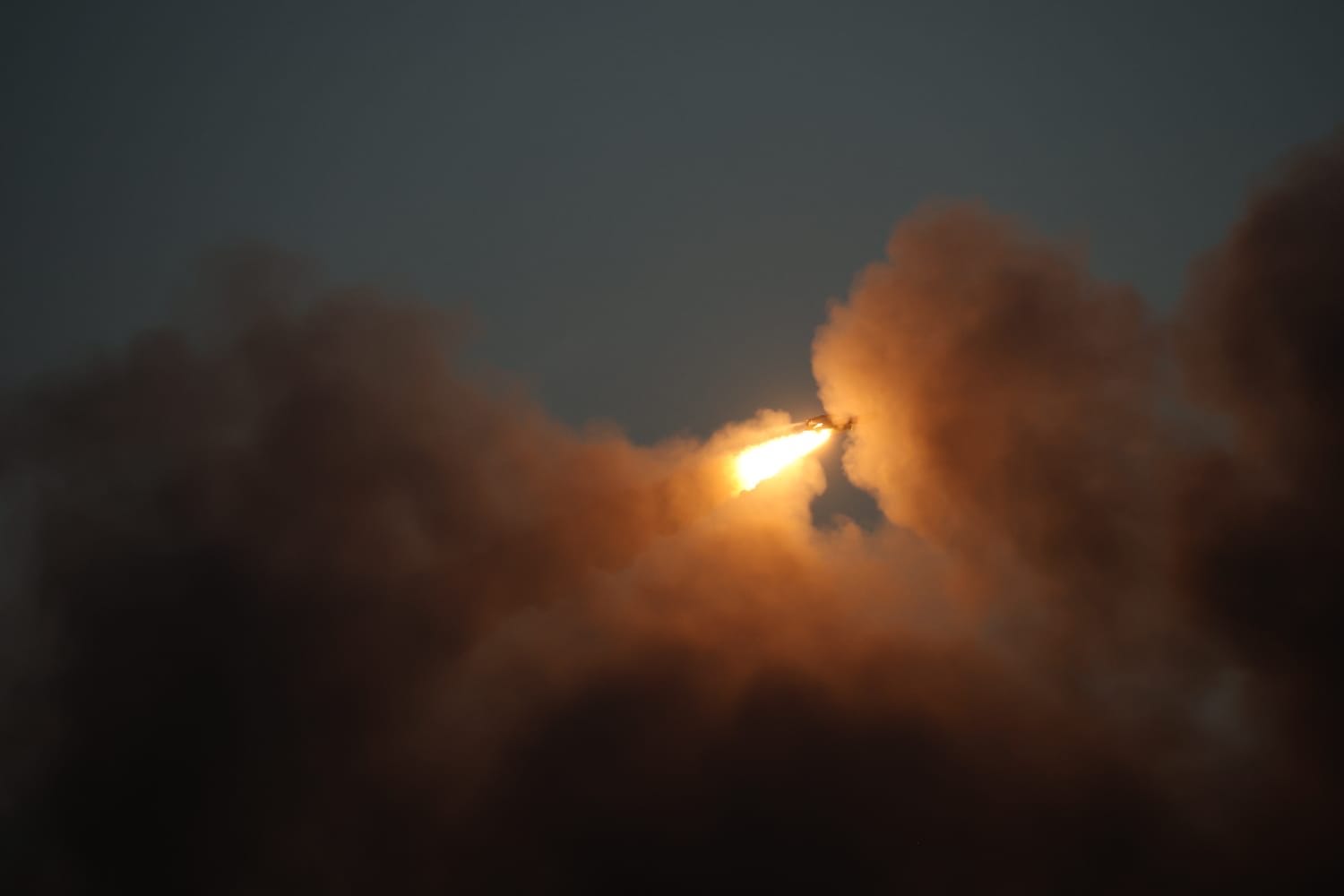
Last week, there were multiple updates on the development of deep-strike and air defence capabilities in Ukraine. Ukraine is seeking a licence to produce interceptors for Patriots, and the U.S. has signalled a tentative readiness to consider the idea, though experts remain sceptical about how realistic this scenario is.
At the same time, Ukraine’s private initiatives to produce air defence systems, interceptor missiles for them, and ballistic strike missiles are taking shape and finding European partners ready to fill in the missing pieces.
Unsurprisingly, this week’s report turned out to be very missile-focused.
In this edition:
Ukraine’s Largest Attack on Moscow: What Systems Were Used?
Ukraine’s Domestic Missile and Air Defence Development;
Ukraine is Moving Closer to a Missile Breakthrough — But Major Gaps Remain;
and 10+ additional developments in Ukraine and Russia.
Last week, I shared some of my thoughts on Ukraine’s missile-related innovation with The New York Times for their article: A Missing Ingredient in Ukraine’s Barrages on Russia: Ballistic Missiles.
Thank you for reading and supporting my work!
Ukraine’s Largest Attack on Moscow: What Systems Were Used?
On June 18, Ukrainian drones carried out a large-scale attack on Moscow and the Moscow region. The strikes, combined with Russian air-defence activity, caused multiple fires, including at the Moscow Oil Refinery, which supplied around 35% of the Russian capital’s fuel needs. It was one of Ukraine’s most successful missions, particularly in terms of penetrating Russian air defences.
Russian sources claimed that more than 190 Ukrainian drones were shot down over Moscow.
During the attack, several types of Ukrainian long-range strike systems were publicly recorded: Bars, Sichen, FP-1, Liutyi, and Morok. Russian milbloggers also noted the use of UJ-26 Bober drones and, reportedly, long-range tactical cruise missiles Peklo.
Sichen
Estimated range: up to 1,400 km;
Warhead: up to 40 kg;
Speed: up to 200 km/h.
According to open-source data, the pre-flight preparation takes no more than 15 minutes. The drone is capable of operating under active EW conditions and conducting missions in the operational-tactical depth, both day and night.
FP-1
In its earlier version, FP-1 was designed to strike strategic targets at ranges of up to 1,600 km and could carry a warhead weighing up to 113 kg. In its updated version, its operational range has increased, and Russian sources cite the following characteristics:
Flight range: up to 2,600 km;
Maximum speed: up to 205 km/h;
Cruising speed: 140–180 km/h;
Maximum payload: up to 60 kg.
Recently, Ukraine’s Fire Point unveiled upgraded versions of its FP-1 and FP-2 drones - check my Ukraine Drone Brief for more details.
Liutyi
Range: up to 2,000 km;
Warhead: 50–75 kg;
Speed: up to 160 km/h.
Morok
Range: up to 800 km;
Warhead: around 30 kg;
Speed: around 300 km/h.
Russian reports claim that Morok is developed by Ramzay based on the 2021 RZ-60 UAV. It might be launched from an inclined ground platform with a solid-fuel booster, similar to a cruise missile. Russian sources also claim that the two-cylinder version carries around 10 litres of fuel and has a 15 hp engine, while a more powerful four-cylinder version may increase flight endurance if fitted with a larger fuel tank and lighter warhead.
Bars
Estimated range: around 700–800 km;
Warhead: estimated at up to 100 kg.
During Eurosatory 2026 in Paris on June 15–19, Ukraine displayed the Bars RS missile-drone, which may have been used in mass strikes on Moscow on May 17 and June 18, 2026. The manufacturer’s name remains classified for operational security reasons. The Bars RS variant has a larger fuel tank, higher maximum take-off weight, and a heavier warhead. Reported specifications: 22 kg warhead, 135 kg maximum take-off weight, and a 95-litre fuel tank. The Bars missile family has conducted around 7,000 launches.
During these launches, the confirmed cruising speed was 400–450 km/h, with a maximum flight speed of 620 km/h.
Bober (Beaver)
Estimated range: 800–1,000 km; up to 1,400 km in certain configurations;
Warhead: about 20 kg, a KZ-6 shaped charge;
Speeds: up to 200 km/h;
Endurance: up to 7 hours.
The drone is launched from a catapult, and the latest modifications include a thermal imager and manual operator control, similar to FPV drones. This allows it to strike not only strategic facilities, but also tactical targets, including air defence systems, radars, and aircraft at airfields.
Peklo (Hell)
Peklo is described as an unmanned aerial system designed to engage stationary targets at operational depth. Launch is performed using a solid-fuel booster from a mobile platform, without reliance on fixed infrastructure.
After launch, the system transitions to cruise flight mode. It has a range of 700 km, a speed of 700 km/h, and carries a 23 kg warhead.
Kremlin spokesperson Peskov claimed on June 19 that Russian air defences were performing well “despite everything”. Both Peskov and Foreign Minister Lavrov also stated that Russia would continue carrying out regular strikes against Ukraine.
Russian milblogger Leviev said in his YouTube video that Russian air defence performed relatively well, arguing that the number of Ukrainian drones that reached their targets was limited compared with the large scale of the attack, with Ukrainian drones allegedly numbering in the hundreds.
He also stressed that no country can provide 100% protection against mass drone attacks, calling this a technological challenge for all modern armies.
At the same time, he noted that even successfully intercepted drones can cause additional damage on the ground. For example, the Sadovod market fire was caused by the explosion of a drone that had been intercepted but then detonated after falling to the ground.
According to Leviev, this poses a new engineering challenge: air-defence systems must ensure that intercepted drones are destroyed in the air rather than falling intact or semi-intact into urban areas.
He also pointed to problems with Russia’s point-defence systems, especially the Pantsir. Leviev argued that the system needs to be modernized because, when it was designed in Soviet times, its developers did not expect it to be used in populated areas. Some Pantsir missiles use detachable booster sections, which can fall into residential areas after launch. He said such missile variants are still being used, including during the attack on Moscow.
Ukraine’s Domestic Missile and Air Defence Development
Ukraine’s Anti-Ballistic Shield
Fire Point’s Chief Engineer, Denys Shtilierman, said the company’s “anti-ballistic shield” is not yet a complete operational system, even though the missile itself is ready.