

Although Ukraine continues to deplete Russia’s resources, intelligence agencies across several countries warn that Russia could launch an offensive against a NATO member within a few years—or possibly even within months.
European partners have been studying Ukraine’s experience for several years, yet they still appear to lack comprehensive systems to protect themselves against these threats.
In this edition:
Five Steps to Protect a Country From Russia;
Space Domain of the Russia-Ukraine War: Communication Satellites;
FPV Drone Production: The One-Piece Flow Model at Vyriy Industries;
and 10+ additional developments in Ukraine and Russia.
Many of the drone-related developments I publish in my weekly Ukraine Drone Brief.
Thank you for reading and supporting my work!
Five Steps to Protect a Country From Russia
Last week, media reports indicated that British intelligence assessed NATO could face a direct challenge from Russia “within months,” aimed at testing the Alliance’s resolve. Also, Russia may seek to exploit any perceived weakening of the United Kingdom’s resolve following a change of prime minister.
Recently, US intelligence warned Poland that Moscow is planning an armed "provocation" in Poland. Poland's prime minister said the country was preparing for "various" scenarios.
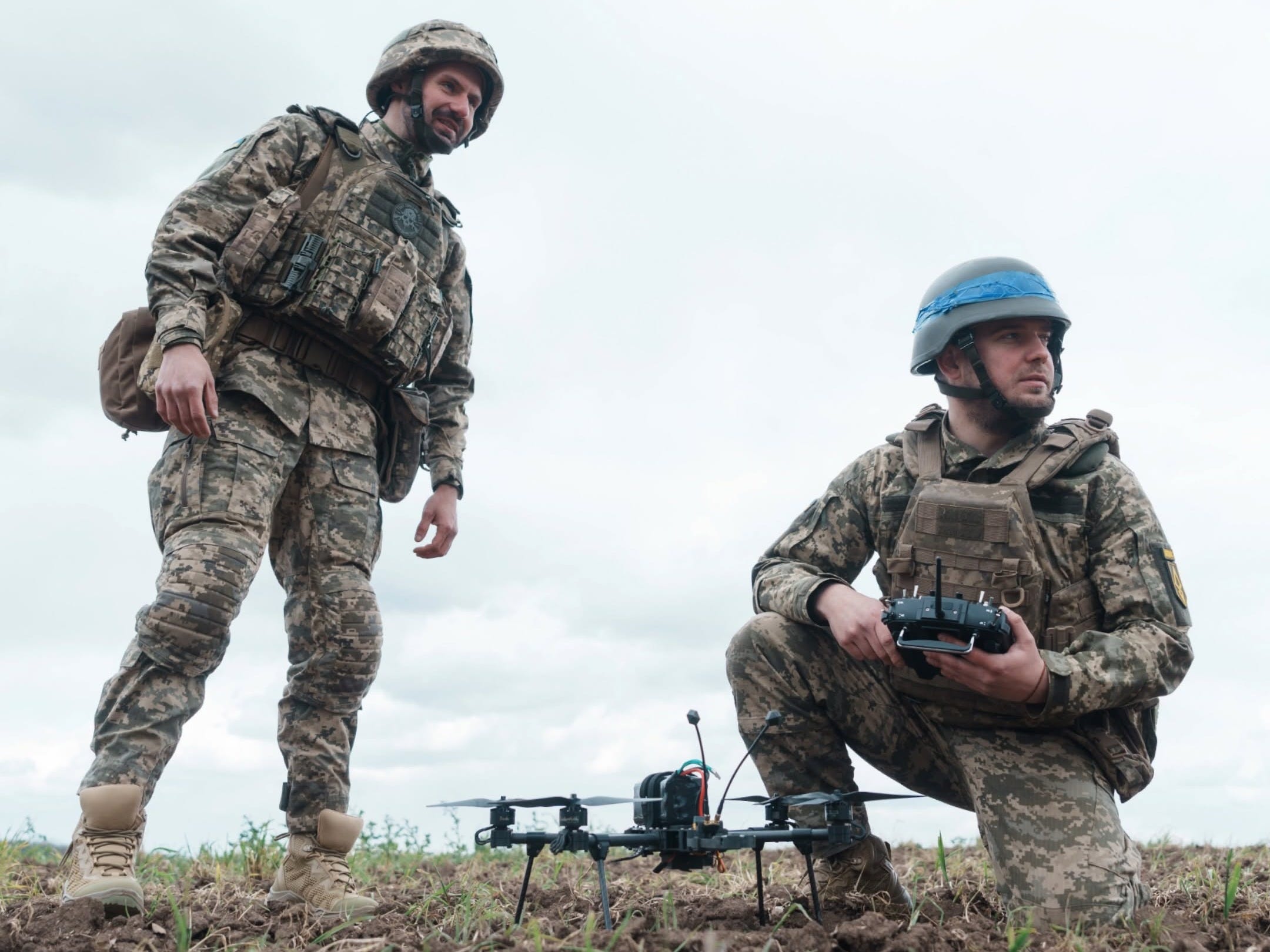
Robert “Madyar” Brovdi, commander of Ukraine’s Unmanned Systems Forces, in an interview with journalist Caolan Robertson, outlined five steps that could help NATO states effectively stop a potential Russian offensive.
Create a buffer zone along the Russian border.
Brovdi called for the immediate establishment of a buffer zone 2–5 kilometres wide. According to him, this is an effective distance for the dense deployment of drones capable of preventing enemy movement.This zone could make enemy movement nearly impossible if protected by a comprehensive drone shield capable of detecting and stopping advancing forces.
This would also require clearing vegetation and reshaping parts of the terrain. Such measures should be implemented immediately along the entire border.
Deploy an extensive fibre-optic communications network.
The zone should be equipped with a dense fibre-optic communications network linking drone launch sites to pilots operating from command posts far behind the front line, allowing them to respond immediately.A single remote operator at a command post should be able to control five, ten, or even fifteen drones positioned along the front line.
Earlier, I wrote about how Russia has been deploying fiber-optic “waiting” drones that are capable of remaining in ambush for extended periods and are not affected by electronic warfare systems.
Build specialized mobile counter-drone air-defence.
A mobile air-defence network should be established immediately, with dedicated elements focused exclusively on countering drones—including reconnaissance UAVs and loitering munitions such as Shaheds. Reconnaissance UAVs are considered priority targets on the front line because they collect critical intelligence for subsequent attacks.
Regarding Shaheds, Russia could eventually launch thousands of those per day. Intercepting them with Patriot missiles would be financially unsustainable.
Establish an Unmanned Systems Forces brigade
Every country should urgently establish an unmanned systems brigade with at least 300 crews capable of performing a wide range of missions—from border patrol and deep reconnaissance to FPV strikes, night-bomber operations, mining, logistics, and other tasks.
Expand long-range strike capabilities.
The first 30, 40, or 50 deep-strike crews should also be established rapidly.
According to Brovdi, any NATO member could complete these five steps by the end of the year.
My contact in Ukraine’s Defence Forces commented that for the Eastern European partners, the most important thing is understanding the danger—and understanding whom they are dealing with.
“Everything within 15 kilometres of the border is doomed. Logistics within a 30-kilometre zone face roughly a fifty-fifty chance of survival. They must be prepared to lose people and territory, to look the beast in the eye and not run. Only then does it make sense to discuss technology. As for how to resist, they should come to Ukraine and learn.
Ideally, our headquarters should be filled with military partners, including officers from the Baltic states, observing the war without filters and adapting its lessons to their own realities. Perhaps they will even develop solutions better than ours,” he added.
French OSINT analyst Clément Molin and the authors of the Polish outlet Służby i Obywatel analyzed satellite imagery and sections of the fortifications visible on Google Maps and concluded that Poland and the Baltic states have not established a continuous system of fortifications along their borders with Russia and Belarus. The defensive line remains fragmented and lacks sufficient depth to withstand a potential Russian offensive.
German Armed Forces personnel have joined the implementation of Poland’s East Shield programme. The programme involves constructing a network of engineering obstacles and fortifications along Poland’s borders with Russia and Belarus.
Earlier, I published several reports assessing different types of threats and highlighting the need for stronger protection, including:
Space Domain of the Russia-Ukraine War: Communication Satellites
Communications satellites enable long-distance communication to share information and coordinate action. Militaries can also use communications satellites to pilot drones remotely. Both Ukraine and Russia are seeking to develop domestic satellite constellations for communications purposes, reducing their dependence on foreign commercial providers.