

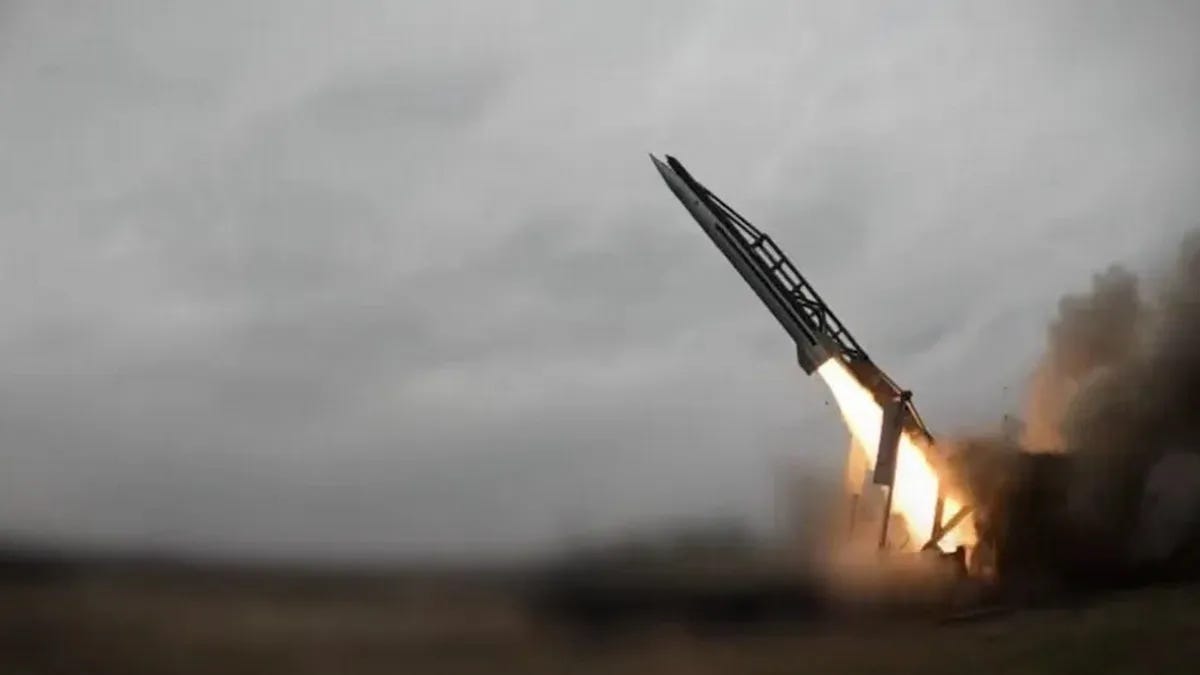
Domestic ballistic missile capabilities are a key priority for Ukraine, as they would significantly enhance its ability to strike high-value enemy targets and maximize damage.
Last week, the Ukrainian company Fire Point — well known for its highly effective FP-1 long-range drones and Flamingo cruise missiles — showcased the launch of its ballistic missile, the FP-7, which is capable of operating at a range of up to 200 km. Its sister missile, the FP-9, is expected to reach targets at distances of over 800 km.
Will 2026 be the year of Ukrainian ballistic missiles?
In this edition:
Anti-Ballistic Solutions in Ukraine;
Ukraine’s Ballistic Missile FP-7;
Build With Ukraine: New Deals Announced;
Modernizing Ukraine’s Shilka and Osa Air Defence Systems;
and 10+ additional developments.
Thank you for reading and supporting my work!
Anti-Ballistic Solutions in Ukraine
Ukraine’s Minister of Defence, Mykhailo Fedorov, stated that the country critically lacks PAC-3 interceptor missiles for air defence to protect against Russian ballistic threats. At the same time, according to him, Ukraine has significant potential to independently develop and produce anti-ballistic systems and missiles. Fedorov discussed with President Zelensky the creation of joint consortia with Ukraine’s partners to accelerate the production of anti-ballistic missiles.
According to Serhii FLASH Beskrestnov, advisor to Minister Fedorov, one of Ukraine’s most pressing challenges remains the enemy’s ballistic missile capability.
“It is no secret that, at present, only the Patriot system can effectively counter ballistic missiles,” he noted. “However, Patriot has a defined interception rate and specific engagement algorithms — several interceptor missiles may be required to neutralize a single incoming target.”
In the context of a long war of attrition, the ballistic threat becomes a question of industrial capacity: Russian missile production versus sustained international support for Ukraine’s supply of Patriot interceptors. Beskrestnov emphasized that the ballistic missiles currently striking Ukraine were manufactured as recently as late 2025 and early 2026 — “fresh from the factory.”
The Iskander missile, he explained, is produced using approximately 90% domestically sourced Russian components, with output reportedly reaching around 60 units per month. In addition, Russia continues to use other systems, including S-300 and S-400 missiles in ground-attack roles.
“Can we realistically expect a permanent and unlimited supply of anti-ballistic interceptors? Probably not. Global military stockpiles are not infinite,” FLASH wrote.
The solution, in his view, must be comprehensive. It includes Ukraine’s participation in the development of anti-ballistic systems — both domestic and joint projects with partner countries — as well as the systematic fortification of critical infrastructure. Key facilities, whether military or civilian, must be hardened to withstand missile strikes. Power plants and 750 kV substations, for example, should be designed or reinforced to survive direct impacts.
Beskrestnov also underscored the economic dimension of the war. Ballistic missile production is expensive, and reducing Russia’s financial resources directly constrains its capacity to manufacture such weapons.
“There are other ideas and plans,” he added, “but I cannot discuss them publicly.”
On February 20, Ukraine targeted the Votkinsk Plant, a strategic enterprise of Russia’s defence industry, with domestic long-range FP-5 Flamingo cruise missiles. This successful strike could potentially suspend Russia’s ability to produce ballistic missiles for up to six months, according to Yevhen Dykyi, a veteran of the Russo-Ukrainian war and former company commander of the Aidar Battalion.
“Ukraine’s ability to shift toward counter-industry targeting to preempt Russian missiles at the industrial base before they can be launched is therefore not an added benefit but a necessity. The fact that Ukraine has not yet been able to do so, partly because its partners have not sufficiently enabled it in this domain, represents a major failure of European and Western policy,” wrote Fabian Hoffman on his Missile Matters Substack.
Ukraine’s Ballistic Missile FP-7
The Ukrainian company Fire Point for the first time showcased the launch of its ballistic missile FP-7, including footage of the launch and the first phase of flight.