

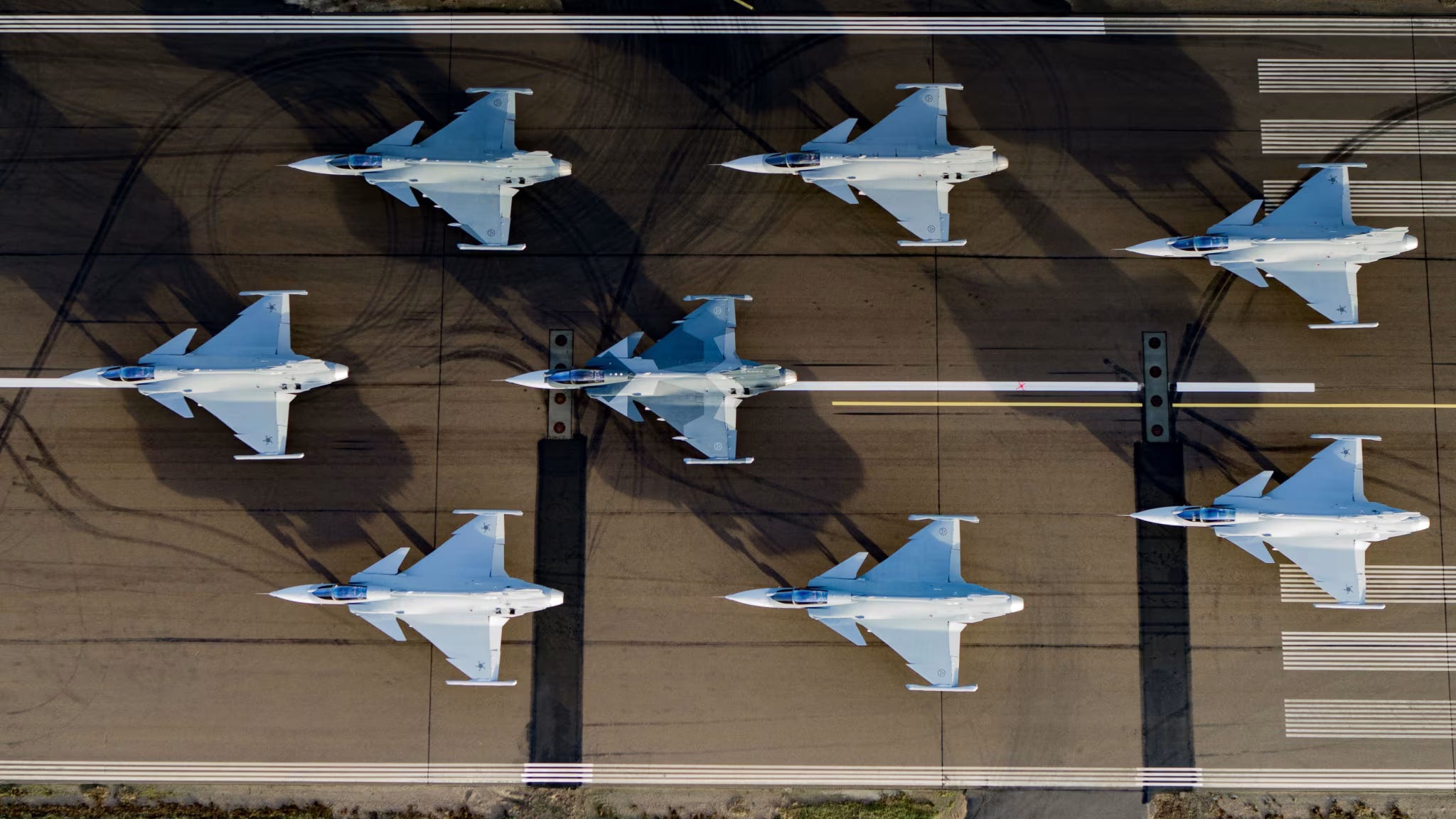
Ukraine is expected to receive its first Gripen fighter jets in about 10 months, while Ukrainian pilots are already undergoing training in Sweden. They see the Gripen as one of the most suitable fighter jets for Ukraine’s operational needs.
Their enthusiasm contrasts with bleak reactions from Russian military commentators, who acknowledge that Gripens armed with Meteor missiles could pose a serious threat to Russian assets.
In this edition:
Sweden Provides a Large Weapons Package to Ukraine, Including Gripen Fighter Jets;
Ukraine as a Testing Ground for Foreign Defence Technologies;
Russia’s Starlink Analogue: Bureau 1440 and the Rassvet satellites;
and 10+ additional developments in Ukraine and Russia.
After several busy weeks — including travel to Seoul for a series of drone-related presentations (read my report here) and to Ottawa for the CANSEC defence trade show, where I saw the Gripen in person — I’m back to my regular reporting.
This week, you’ll receive the full Drone Warfare in Ukraine newsletter with some interesting updates that I can’t wait to share with you. Stay tuned, and in the meantime, check out the latest 2-page Ukraine Drone Brief report.
Thank you for reading and supporting my work!
Sweden Provides a Large Weapons Package to Ukraine, Including Gripen Fighter Jets
Sweden will provide Ukraine with a major military assistance package worth approximately $2.7 billion, Ukrainian President Zelensky said during a joint press conference with Swedish Prime Minister Kristersson on May 28.
Part of the funding will be allocated to strengthening Ukraine’s domestic defence industry, including $400 million specifically designated for drone production. The largest part of the package, valued at around $2 billion, will cover the transfer of 16 Gripen C/D fighter jets to the Ukrainian Air Force. The aircraft are expected to come equipped with advanced weapons systems, including Meteor long-range air-to-air missiles capable of striking targets at distances of 200 kilometers.
In addition to the used Gripen C/D fighter jets, Sweden will support Kyiv’s procurement of up to 20 newer Gripen E/F aircraft, using funds from an EU-backed loan.
Deliveries of the used aircraft are expected to begin in early 2027, after Ukraine finalizes the purchase agreement and Sweden secures the required export approvals. That deliveries of the new Gripen E could begin by 2030. Ukraine’s long-term ambition remains 100-150 Gripen aircraft.
Reportedly, training of Ukrainian pilots and technical personnel on Gripen fighters is already underway and will be expanded this autumn.
Ukrainian expert and co-founder of the Kruk drone training center, Viktor Taran, cited comments from Hero of Ukraine Vadym Voroshylov, known by his callsign Karaya, who is currently training on Gripen fighter jets in Sweden. Voroshylov explained why he believes this aircraft is especially well-suited to Ukraine’s wartime needs:
Designed for dispersed operations: Gripen is well adapted to operating under the constant threat of missile and drone strikes on airfields.
Lower risk of engine damage: After attacks involving cluster munitions, runways and taxiways may be covered with concrete, metal, and stone fragments. Gripen’s air intakes are positioned high on the sides of the fuselage, reducing the risk of foreign object damage to the engine.
Fast turnaround between missions: In modern war, time is measured in minutes. Once an aircraft is detected, the enemy can quickly organize a strike on the airfield. Gripen was designed for rapid servicing between combat missions, reducing the time it spends on the ground.
Refueling with the engine running: The aircraft can be refueled while the engine is still operating, further shortening its time at the airfield and reducing exposure to attack.
Flexible weapons integration: Gripen can integrate both American and European missiles and air-launched weapons. This gives Ukraine more flexibility in using available stockpiles and reduces dependence on a single supplier.
Lower operating costs: after the war, Ukraine will need to maintain its Air Force under limited resources, and Gripen is considered one of the more cost-effective modern fighter jets in its class.
Meteor missile capability: He also highlighted the Meteor missile, regarded as one of the most dangerous air-to-air missiles in the world. Its integration would significantly strengthen Gripen’s long-range air combat capabilities.
A “smart fighter” for high-intensity war: Gripen is not the largest or most expensive fighter jet, but its strength lies in survivability, fast maintenance, operational flexibility, and affordability.
For these reasons, more Ukrainian pilots and military experts increasingly view Gripen as one of the most promising platforms for the future of Ukraine’s combat aviation.
Russian military channels, based on their calculations, conclude that over the next three to four years, Ukraine is likely to receive fewer Gripen fighters than F-16s. However, they see the main concern in the fact that Gripens are being transferred primarily for air-to-air combat against Russian aircraft. Each Gripen can reportedly carry up to seven Meteor air-to-air missiles, whose range — and, more importantly, maneuverability — they assess as comparable to Russia’s own missiles.
Even though Meteor is often described as having an operational range of around 200 km, Ukrainian media Defense Express notes that the engagement range of an air-to-air missile depends on multiple factors: the speed, altitude, and flight paths of both aircraft, as well as how the target maneuvers after launch. These are dynamic rather than fixed parameters. The maximum range is achievable only under optimal conditions: high altitude, head-on courses, and a non-maneuvering target.
Ukraine as a Testing Ground for Foreign Defence Technologies
Over time, more and more foreign defence producers are testing their equipment in Ukraine to obtain the “battlefield-approved” label.
Earlier, I wrote a long article about one such company: Drone Testing in Ukraine: Experience of Lithuanian Granta Autonomy.
The bullet points below highlight other similar cases and experiences involving foreign manufacturers.