

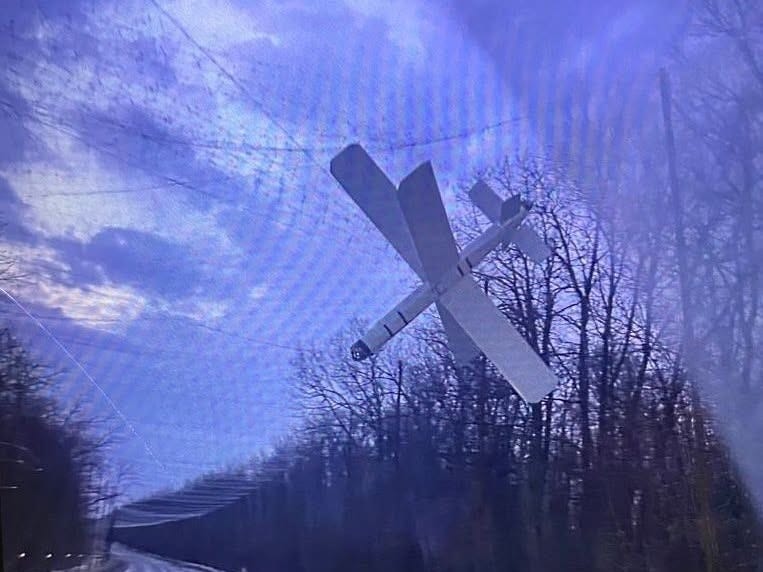
The humanitarian evacuation from Russian-occupied Oleshky has been successfully completed, and we can expect two developments: an intensified Russian disinformation narrative accusing Ukrainian forces of atrocities committed with Western equipment, and an escalation of fighting in Kherson Oblast, as Russia used the pause in hostilities to strengthen its capabilities.
In this edition:
Oleshky Evacuation and Russia’s Build-Up in Kherson Oblast;
Technological Sophistication or Mass Production: What Matters Most in Modern Warfare?
Drone Security Index: How Ready Are Countries for Drone Threats?
And 15+ additional developments in Ukraine and Russia.
This is a reader-supported publication, so your paid subscription makes a real difference. With stable reader support, I can devote more time and resources to my reporting and bring you more paid and free coverage of the war in Ukraine and Russia.
If your organization is interested in partnering with Ukraine’s Arms Monitor, I’d be happy to connect.
Oleshky Evacuation and Russia’s Build-Up in Kherson Region
The ceasefire to evacuate residents of Russian-occupied Oleshky became the longest of the full-scale war to date. At the same time, Russian forces used the pause in hostilities to strengthen their capabilities on the left bank of the Dnipro, concentrating artillery and unmanned systems there.
To allow a humanitarian mission to evacuate residents of Oleshky, a town in Kherson Oblast occupied by Russia, a local ceasefire mediated by the U.S. First Lady Melania Trump began at 03:00 on 27 October 2026 and lasted until the evening of 1 November 2026. During the ceasefire, the roads to Oleshky in the Kherson direction were demined, and humanitarian cargo was delivered to the town.
Residents who chose evacuation were taken out of the town and the surrounding community. The evacuation was personally overseen by the ombudspersons of Ukraine and Russia.
Oleshky residents could choose to be evacuated either to Ukrainian-controlled territory or to Russia. No exact number of evacuees has been announced yet. According to unofficial sources, 17 buses of evacuees left for Ukraine and 4 for Russia.
The Ukrainian delegation involved in organizing the humanitarian corridor accompanied the evacuees to Anapa in Russia; from there, they were flown on four planes to Gomel in Belarus, and then travelled by bus to Ukraine. Along the way, the Ukrainian convoy also picked up residents of other settlements who wished to leave for Ukrainian-controlled territory. Several hundred residents remained in the occupied town, despite severe destruction and the absence of gas, electricity, and water.
Russian media will continue, and likely intensify, a narrative that Oleshky was under blockade because of Ukrainian strikes. American-made Hornet drones feature prominently in this disinformation. The aim is to gain the upper hand in the cognitive domain and put Ukraine on the defensive.
Since the localized ceasefire took effect, both Russian and Ukrainian forces appear to have largely respected its terms, despite a small number of alleged violations. This ceasefire was the first time since 2022 that Russia and Ukraine had managed to hold a truce over such a large section of the front and for so long (more than 100 hours).
At the same time, there are reports that Russian forces are using the ceasefire to strengthen their capabilities on the left bank of the Dnipro River, which could open the way for offensive operations. Kherson was the only regional capital that Russia managed to capture at the start of the full-scale invasion in 2022; Ukrainian forces liberated it in November 2022.
As Kherson City Council member Oksana Pohomii put it: “We, the people of Kherson, know for certain that construction materials and weapons are being brought in there now. Before, our forces controlled the sky and the ground there with drones. Now they are using the ceasefire to bring all this in and fortify themselves, and we don’t know what the consequences will be for Kherson.”
Ukrainian service members also report that Russian forces are preparing an offensive in the Kherson direction; in particular, Russia is moving in artillery systems. This means that after the humanitarian corridor ends, Russia may launch massive strikes using all the types of artillery it is concentrating there: Grad and Smerch multiple rocket launchers, as well as 152 mm systems.
Writing in his personal blog, a senior lieutenant of Ukraine’s Defence Forces with the callsign “Alex” noted that after the ceasefire in Kherson Oblast, Russia is expected to step up offensive and sabotage operations. Russian forces have brought in resources and drone crews and stretched anti-drone nets over areas that were previously dangerous for them, significantly increasing their offensive capabilities.
“This is not about a large-scale offensive, but about likely intensified attempts to cross the Dnipro, a significant expansion of the zone under Russian fire control, and a much denser presence of unmanned systems there compared with the situation before the ceasefire,” he wrote.
Ukraine expects Russian shelling of Kherson to intensify, and November and the winter as a whole may be especially difficult. Dnipro has a complex system of backwaters and islands, and if Russian forces manage to gain a foothold on one of them, they can use it for observation and further offensive operations. They use small boats and small groups to try to land on the islands and move closer to the shore, especially in fog. Despite heavy losses, Russia has not completely abandoned its tactic of small landing operations.
Read my earlier report: Drones for Humanitarian Missions: Delivery to Occupied Oleshky.
Technological Sophistication or Mass Production: What Matters Most in Modern Warfare?
Both Ukraine and Russia are focusing on cheap, scalable solutions, while Western countries still keep betting on sophisticated systems and refining them toward perfection, only to find that once fielded at the front, they do not perform as expected. Countries rearming today need to find the right balance between sophistication and scale.