

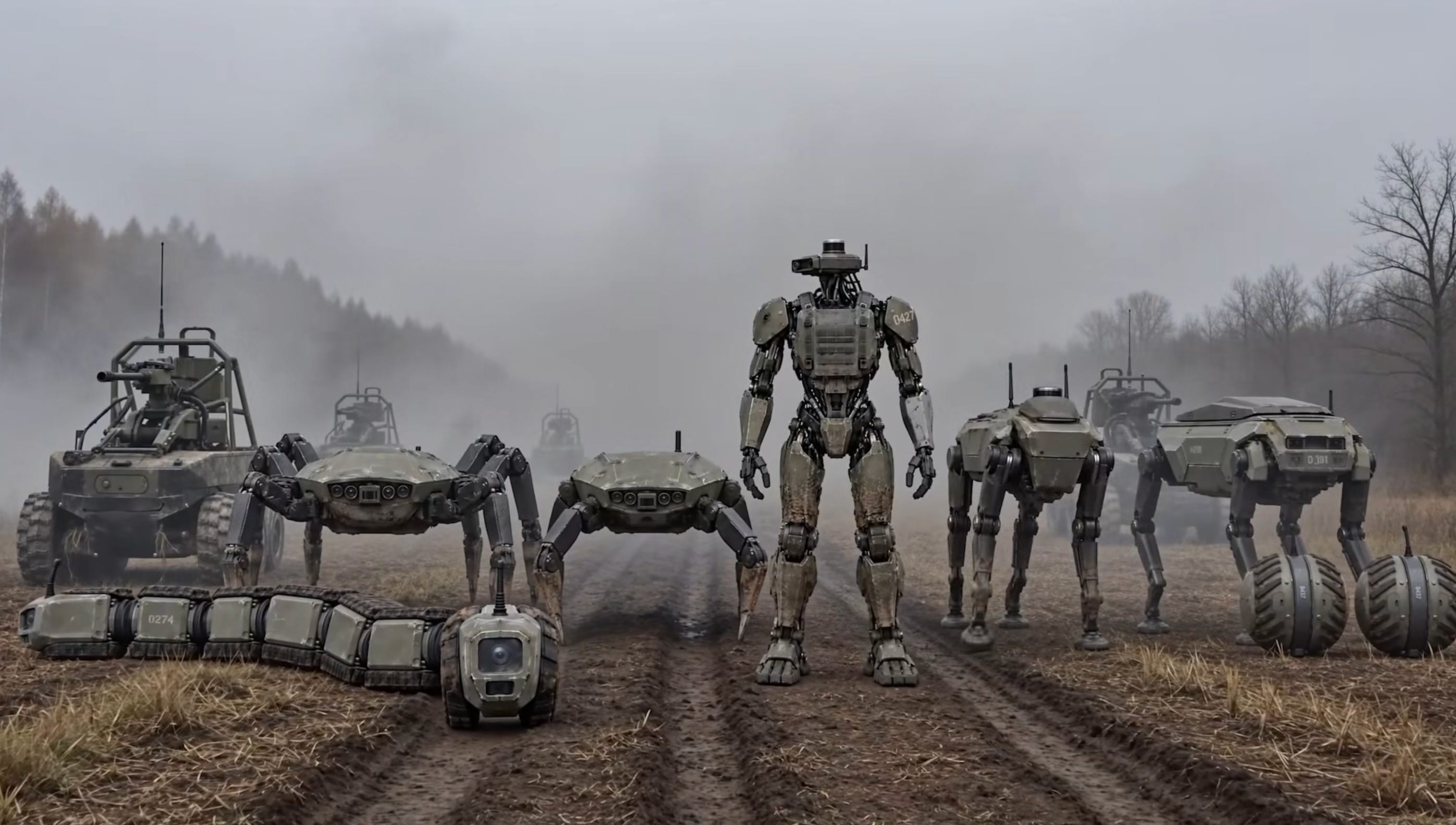
The future seems to be arriving faster than expected, with Ukraine’s former defence minister announcing a new “Army of Robots” initiative. While Ukrainian developers and military personnel have met the idea with scepticism, other countries have been experimenting with humanoid and other robotic systems for military applications for some time.
In this edition:
Trends on the Battlefield and Current Priorities;
Army of Humanoid Robots;
Defence Tech Is the New Agriculture: General Cherry on Drone Production;
and 10+ additional developments in Ukraine and Russia.
Thank you for reading and supporting my work!
Trends on the Battlefield and Current Priorities
With the arrival of autumn and changes in vegetation cover, battlefield activity is changing in intensity and character. According to Ruslan Leviev’s analysis, the pace of Russian advances declined by roughly 20% in September. At the same time, assessing the actual rate of territorial change has become increasingly difficult, as both sides sometimes publish older footage as if it were recent.
Operation Vivaldi illustrates this particularly well. Much of the information being released now concerns achievements from earlier. As Robert “Madyar” Brovdi, Commander of Ukraine’s Unmanned Systems Forces, has noted in his interview with The Telegraph, operations of this kind depend heavily on secrecy. Maintaining operational silence is increasingly difficult in today’s highly transparent information environment and OSINT capabilities; it remains essential — including in communications with allies.
This makes real-time assessments of battlefield momentum especially difficult. Official statements frequently lag behind battlefield developments or present events selectively. In Ukraine’s case, some gains became public only considerably later. Russia, meanwhile, continues to make highly inflated claims about its territorial advances.
Putin claimed that Russian forces had captured 1,301 square kilometres of Ukrainian territory in September 2026. ISW, however, assessed that Russian forces instead suffered a net territorial loss of 80.81 square kilometers in September 2026.
Operation Vivaldi appears to have been more successful than public reporting initially suggested. Ukrainian forces succeeded in cutting off the Shandryholove salient, while some assessments indicate that Ukrainian troops may already be crossing the Zherebets River and pushing deeper into Russian positions.
Another notable development last week was the adaptation of battle tanks to modern warfare. The 475th Assault Regiment, operating with limited infantry resources, used heavily protected tanks together with several types of drones while clearing Russian sabotage groups in Kharkiv Oblast, roughly nine kilometres from the Russian border.
The group combined two heavily protected tanks with FPV drones, a Vampire drone, and a Mavic reconnaissance drone. The Mavic served as the “eyes” of the tanks, providing situational awareness and helping guide their movement.
Russia, meanwhile, continues to expand its armed forces. Following elections to the State Duma, Russian authorities moved toward another round of hidden mobilization. A new decree increased the authorized strength of the Russian Armed Forces by approximately 15,500 personnel. This followed another increase of around 27,000 positions in late July, bringing the total increase over two months to more than 40,000.
According to Brovdi, rapidly mobilized Russian personnel often receive insufficient training before deployment. Nevertheless, the additional manpower continues to pose a serious challenge for Ukrainian forces and should not be interpreted as making Russia’s offensive operations easy to counter.
For Ukraine, one of the principal responses is therefore the continued expansion of unmanned systems. Ukraine cannot compete with Russia primarily through manpower and must preserve its human resources.
Both sides continue to achieve limited tactical successes on different sectors of the front, although recent gains appear more pronounced on the Ukrainian side. The overall tempo of operations is expected to slow further in October for both sides.
Read more about Operation Vivaldi here.
Army of Humanoid Robots
Ukraine’s Former Defence Minister Mykhailo Fedorov announced the launch of the “Army of Robots”, an ecosystem of robotic technologies for the military. The promotional video showed humanoid robots carrying weapons, operating in trenches, and assembled in large formations.