

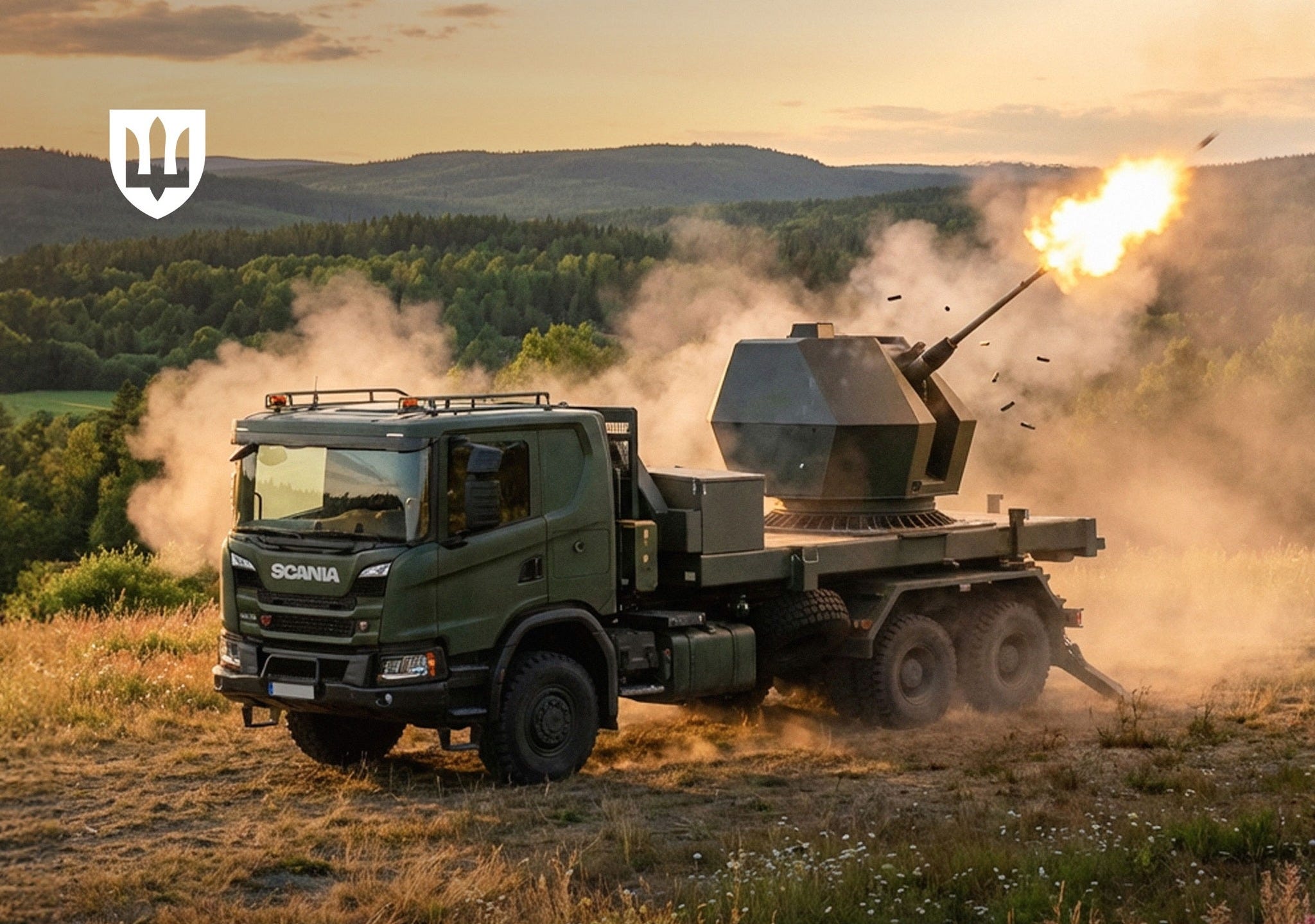
Ukraine is taking a serious approach to developing long-needed domestic air defence capabilities and is even providing approximate timelines for their fielding. However, delivering these innovations in time will require high-quality partnerships and financing.
While some may remain skeptical about the feasibility of producing such advanced technologies, it is worth recalling that at the start of the war, few could have anticipated that Ukraine would become a technological powerhouse. Now its solutions are proving effective not only against Russia, but across different regions and scenarios.
In this edition:
Ukraine Plans to Launch Its Air Defence System by 2027;
What Is Happening with Ukraine’s Arms Exports?
Ukrainian Defence Tech Market: Opportunities for Investors;
10+ additional developments in Russia and Ukraine.
If you’ve missed my latest Drone Warfare in Ukraine newsletter, check it out to learn more about drone munitions in Ukraine and other developments.
At the end of March, Czech volunteers raised a total of €1 million for drones for Ukraine’s Defence Forces. And here I am, trying to raise only $4,000 for a Mavic 3T drone!
If you can, please consider supporting this fundraiser. It is, as always, for the military unit of my university friend Vasyl, who has been serving since the start of the full-scale invasion.
Unarmed Mavic 3T drones used for night reconnaissance truly save lives!
PayPal: https://www.paypal.com/pools/c/9nSSd7NqxK
Thank you for reading and supporting my work!
Ukraine Plans to Launch Its Air Defence System by 2027
The Ukrainian company Fire Point, a manufacturer of Flamingo cruise missiles and long-range FP-1 drones, plans to launch its own air defence system by the end of 2027. According to Fire Point’s Chief Engineer and majority owner, Denys Shtilerman, it could become a more affordable alternative to the U.S.-made Patriot.
As reported by Reuters, to bring down a ballistic missile, the Patriot system often requires two or three air defence missiles, each costing several million dollars. “If we can decrease it to less than $1 million, it will be a game changer in air defence solutions,” Shtilerman said in an interview.
Responding to a question from Serhii Sternenko about the cost of an anti-ballistic interceptor missile, Denys Shtilerman said: “At this stage, the expectation is as follows: if a homing seeker is integrated, the cost per shot will be around $750,000; without it, approximately $500,000. In either case, it will still be capable of intercepting targets. The key priority, however, is integration—with radar systems, command centers, data links, and platforms such as AWACS.”
Fire Point is "deeply interested" in collaboration on radar, missile target-seeking, and communications systems - areas where it lacks expertise. European companies, including Weibel, Hensoldt, SAAB, and Thales, have good radar solutions, the Chief Engineer noted.
While there is a certain degree of skepticism about Ukraine’s ability to develop its own air defence system, Fire Point’s approach reflects a key distinction between the traditional model and Ukraine’s approach. While Western companies often endlessly refine systems before fielding them, Ukraine deploys innovations early and iteratively upgrades them based on real-world use.
Fire Point is currently the largest producer of long-range drones in Ukraine, with a monthly production capacity of up to 2,500 systems. Its Flamingo missiles cost approximately €600,000 per unit. The company plans to scale production further following the launch of a new engine in October and the opening of a rocket fuel plant in Denmark.
Although its FP-5 Flamingo cruise missile is less precise than more advanced ones and remains a work in progress, it is still capable of delivering destructive strikes against critical enemy infrastructure. At the same time, it demonstrates a growing ability to penetrate Russian air defence and electronic warfare systems.
In March 2026, the company reported on the production and testing of the FP-7 ballistic missile. According to Shtilerman, the FP-7 is an analogue of the U.S. ATACMS missile but costs roughly half as much. It is based on the S-400 and has a range of 250–300 km. Ukrainian Dev.UA reported that the FP-7 missile is planned to be named “Pelican.”
According to an interview, the Chief Engineer gave to the Sternenko Community last week, “since we do not yet have a homing head or integration with radar, we are using this highly maneuverable air defence missile as a ballistic missile. It is fully solid-fueled—the propellant is ours, and we cast it ourselves. The flight controller is our own, and the servo drives are also domestically produced”.
By the end of the year, the company also plans to present another ballistic missile, the FP-9, with a range of up to 850 km. The FP-9 was designed from the outset as a ballistic missile; it is not an air defence missile. The missile will have a speed of 2,400 m/s and a very high impact velocity upon hitting the target.
Shtilerman also said that he hopes Ukrainian-made ballistic missiles will begin striking targets in Russia as early as 2026. He also stated that Russia has no real experience in missile defence. ATACMS missiles have been intercepted in part because they have a relatively low terminal velocity when approaching the target.
The most important thing is not to launch one or two missiles, but twenty, thirty, and more.
The company plans to create a pan-European anti-ballistic shield - Project Freya, where a missile derived from Soviet S-400 systems could serve as an interceptor if integrated with European radar and command networks.
“We have missiles similar to those for S-300 and S-400, but our solution is fully composite—unlike the S-400, which uses magnesium. We are telling European companies: we have a product that was designed from the outset specifically to intercept ballistic missiles. This missile is highly maneuverable, relatively low-cost, and—most importantly—we provide access to its software. There are no “switches,” so we would not be able to deactivate it. We invite partners to use our ballistic launches to test and train their radar systems—something that is currently only possible in the United States, where each launch costs more than $5 million. In return, we ask for one thing: allow us to conduct an audit of your software.”
Responding to a question about the viability of laser-based air defence systems, the engineer said he is uncertain how effective they would be in Ukraine’s climate. High humidity presents a significant challenge: instead of a single beam, it may be necessary to split the energy into five, six, or even ten beams, depending on atmospheric conditions—and then maintain all of them on a single point on the target. This is an extremely complex task.
A more promising approach, in his view, is pulsed microwave technology—high-powered radiation capable of disabling electronics and effectively neutralizing drones. Countering such systems would require significantly increasing the cost of drones.
In late March 2026, President Zelensky stated that Ukraine was working with several countries to establish domestic production of all components of air defence systems, “including anti-ballistic ones.” He emphasized that the most important thing now is obtaining licenses and localization in Ukraine.
Also, in March 2026, Fire Point, the State Kyiv Design Bureau Luch, and the research and production enterprise Radionix signed cooperation agreements with the Spanish company Sener, which manufactures, among other things, components for missiles used by IRIS-T air defence systems.
The company Fire Point is often publicly linked to Timur Mindich, who is a suspect in a corruption case related to Ukraine’s energy sector. According to the Chief Engineer, Mindich attempted to buy the company, but his offer was declined. Beyond this, there was no further interaction.
What Is Happening with Ukraine’s Arms Exports?
Over the past seven months, Ukrainian regulators have failed to establish an effective defence export system.