

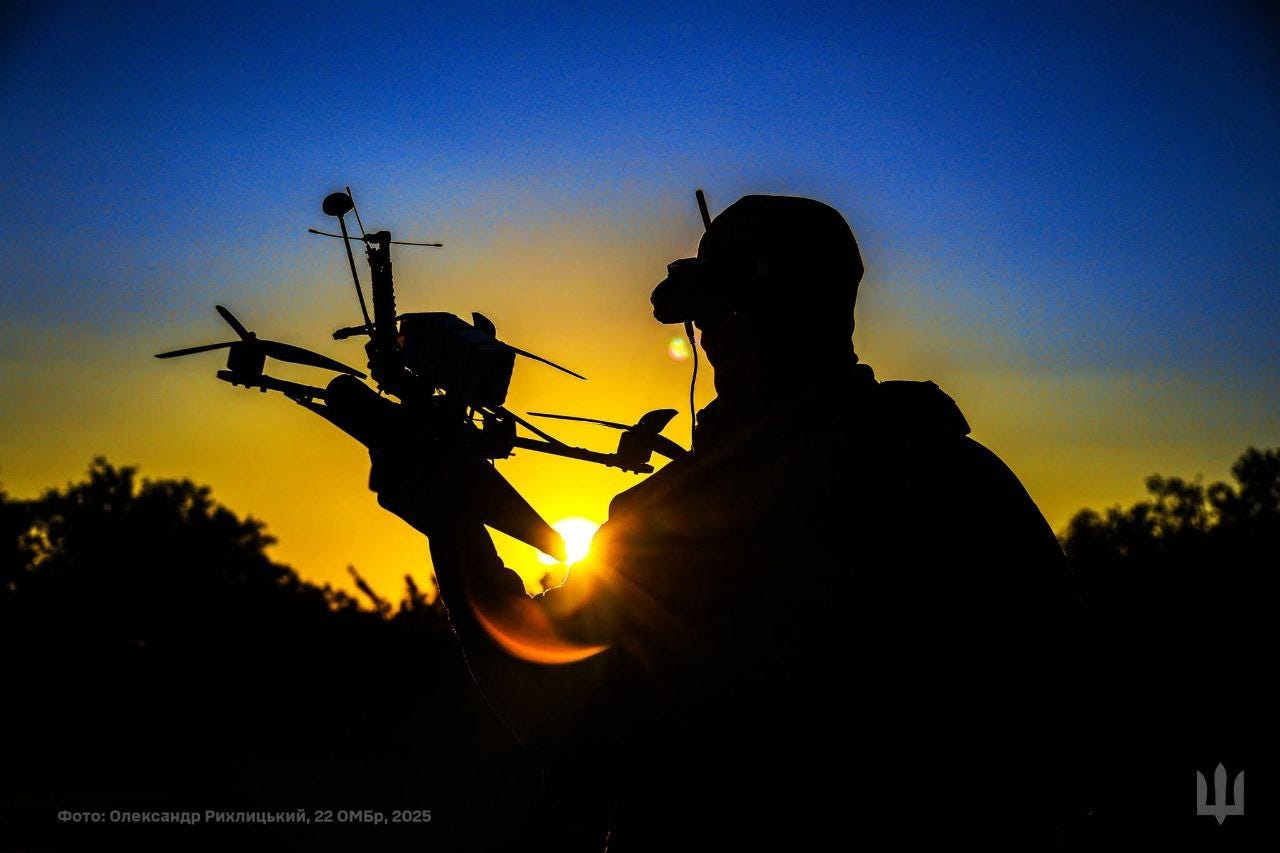
One sector driving Ukraine’s economic growth is defense, which now accounts for about a third of the country’s total output. Within this, defense tech is expected to grow by an impressive 218% in 2025, according to Tech Force in UA. The best way forward is to bring in revenues from abroad and expand what is already a rapidly growing sector.
More and more, we see Western companies localizing their production in Ukraine. Just last week, German titan Rheinmetall announced plans to produce ammunition in the country. Allies are also increasingly investing in Ukrainian technologies such as interceptor drones, which now make sense not only for Ukraine but also for the entire Eastern European NATO flank.
In this edition:
A Year Behind in Repairs: KNDS on Maintenance in Ukraine;
Europe Eyes Investments in Ukraine’s Interceptor Drones;
How NATO’s Security Assistance and Training Mission Supports Ukraine;
Russia’s New Battlefield Tactics in Ukraine;
and 20+ other key developments.
Thank you for reading and supporting my work!
Foreign Military Aid and Direct Purchases
On September 9, the 30th meeting of the Ukraine Defense Contact Group in the “Ramstein” format took place.
Ukraine’s Defence Minister Shmyhal emphasized that it is critically important for Ukraine to advance the following initiatives:
PURL — Ukraine needs a clear schedule for regular financing and delivery of weapons packages.
$6 billion for drone production — including interceptors to protect the economy and civilians, FPVs to hold the frontline, and strike drones to keep pressure on Russia’s military production and military targets.
$60 billion in partner countries’ budgets for 2026 — to ensure the defense of both Europe and Ukraine.
An additional 10 Patriot systems, as well as missiles for Patriot, SAMP/T, NASAMS, IRIS-T, and HAWK. This is urgent, as Russia is preparing new strikes against Ukraine’s energy sector and infrastructure.
Sanctions and confiscation of frozen Russian assets — economic pressure must increase so that Russia has fewer resources to wage war.
Additional developments:
🇩🇪 Germany is in the process of transferring two complete Patriot air defense systems to Ukraine. The first launchers have already been handed over to Kyiv. Norway has agreed to cover half the cost of these two Patriot systems.
Separately, Defence Minister Pistorius said that Berlin, in partnership with Ukrainian manufacturers, is launching a project to procure long-range drones worth €300 million.
🇸🇪 Sweden announced its 20th military aid package to Ukraine, valued at $836 million. The package includes:
18 new Archer self-propelled artillery systems — increasing Ukraine’s total to 44;
155mm ammunition;
mobile coastal radar systems, vessels equipped with grenade launchers, and unmanned maritime systems;
additional weapons, equipment, and radars for the 32 combat boats previously delivered to Ukraine;
500 motorcycles and support equipment for air bases, including trucks and tractors;
radar sensors and control systems for the Tridon Mk 2 air defense systems already supplied to Ukraine;
programmable 40mm anti-aircraft ammunition.
🇨🇦 Canada’s eight Armoured Combat Support Vehicles (ACSVs) have been transferred to Poland and are on their way to Ukraine. All 50 of the ACSVs that Canada committed to Ukraine in 2023 are expected to be delivered by the end of this year.
🇪🇪 Estonia is planning to allocate over 100 million euros ($117 million) in military aid to Ukraine next year.
🇱🇻 Latvia allocates 5 million euros for the PURL initiative to buy US weapons for Ukraine.
🇬🇧 More than £2 billion ($2.54 billion USD) of military support for Ukraine has now been secured through the UK-led international fund for priority military equipment to support the most urgent requirements of Ukraine’s Armed Forces.
The International Fund for Ukraine (IFU) has delivered equipment, including more than 1,000 air defence systems, more than 600 uncrewed aerial systems, electronic warfare systems, and air defence radars – with further deliveries due in the coming weeks.
Over the next 12 months, the UK will fund the delivery of thousands of long-range one-way attack drones, built in the UK, and supporting a 100-year partnership agreement with Ukraine.
The International Fund for Ukraine is administered and led by the UK Ministry of Defence to procure equipment using funds provided by Australia, Canada, Denmark, Germany, Iceland, Lithuania, the Netherlands, Norway, New Zealand, Portugal, Sweden, and the UK.
🇪🇺 EU delivers 80% of promised shells to Ukraine. "We aim for 100% by October," EU foreign policy chief Kaja Kallas said in reference to the 2 million pledged artillery shells.
Also, the EU will allocate €6 billion to Ukraine’s “Drone Alliance” to scale up the production of Ukrainian unmanned aerial vehicles.
🇭🇷 Croatian M-84 tanks have appeared in Ukraine. The M-84 tanks delivered to Ukraine have been equipped with anti-drone protection, electronic warfare systems, and explosive reactive armor. Notably, the variant in service is the modernized M-84A4 Snajper.
🇺🇸 The U.S. House of Representatives passed a defense budget bill for 2026 amounting to $892.6 billion. According to the NYT, $400 million has been earmarked for Ukraine under the Ukraine Security Assistance Initiative (USAI).
A Year Behind in Repairs: KNDS on Maintenance in Ukraine
The Franco-German holding KNDS is one of Europe’s largest manufacturers of armored vehicles. Among the products of its German division are the Leopard 2 tanks, Gepard self-propelled anti-aircraft guns used to protect Ukraine’s critical infrastructure from Shahed drones, and the Panzerhaubitze 2000 (PzH 2000) self-propelled artillery systems, which have been positively assessed by Ukrainian artillerymen.
I’ve prepared a summary of their interview with the DW on the maintenance of equipment in Ukraine.