

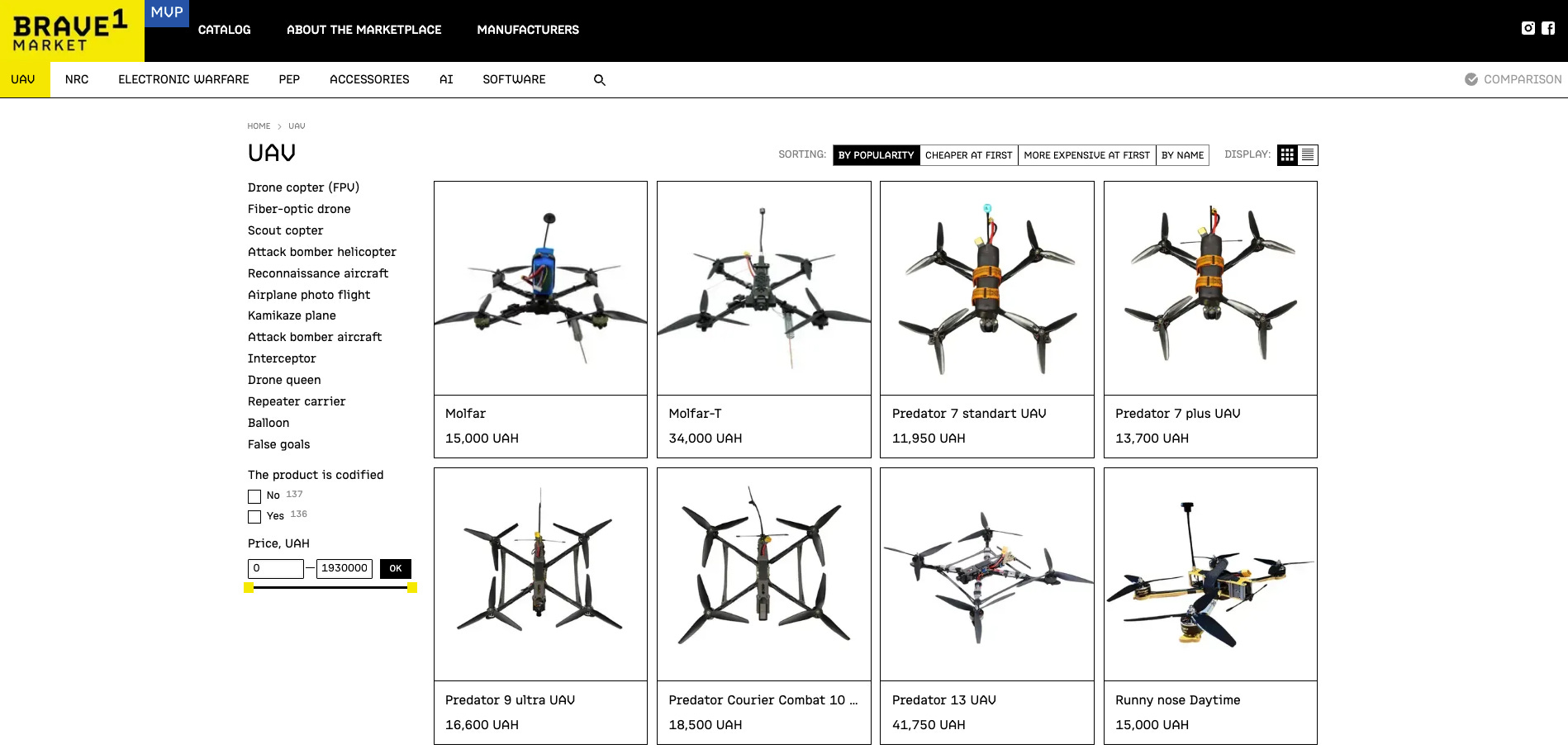
Ukraine is a trendsetter in defence marketplaces. Several countries and private companies, inspired by this innovative procurement approach, have created similar platforms. In July 2026, Canada launched its own drone marketplace, which was modelled on Ukraine’s example. Although the marketplace is still in its early stages, things are moving fast: 12 contracts have already been awarded through it.
I looked at what Canada decided to take from the Brave1 model and what it left behind, and obtained comments from Canada’s Defence Investment Agency on the procurement side of the initiative, and from the Department of National Defence and the Canadian Armed Forces on the military perspective.
If you’re new to my work, I focus on defence innovation in Ukraine and Russia and publish two weekly newsletters: the long-form Arms Trends in Ukraine and the short-form Ukraine Drone Brief. Subscribe to get weekly updates on war technology!
Ukraine’s Defence Marketplaces: Brave1 Market and DOT-Chain Defence
Ukraine has a hybrid model of defence procurement. It combines the traditional route, in which the Defence Procurement Agency conducts all centralized procurement for units, with a decentralized approach in which units can purchase equipment directly. Two marketplaces, Brave1 Market and DOT-Chain Defence, both launched in 2025, have similar functionality and are connected. They allow military units to browse systems and buy them with either electronic points (e-points) in the case of Brave1 or special budgets in the case of DOT-Chain.
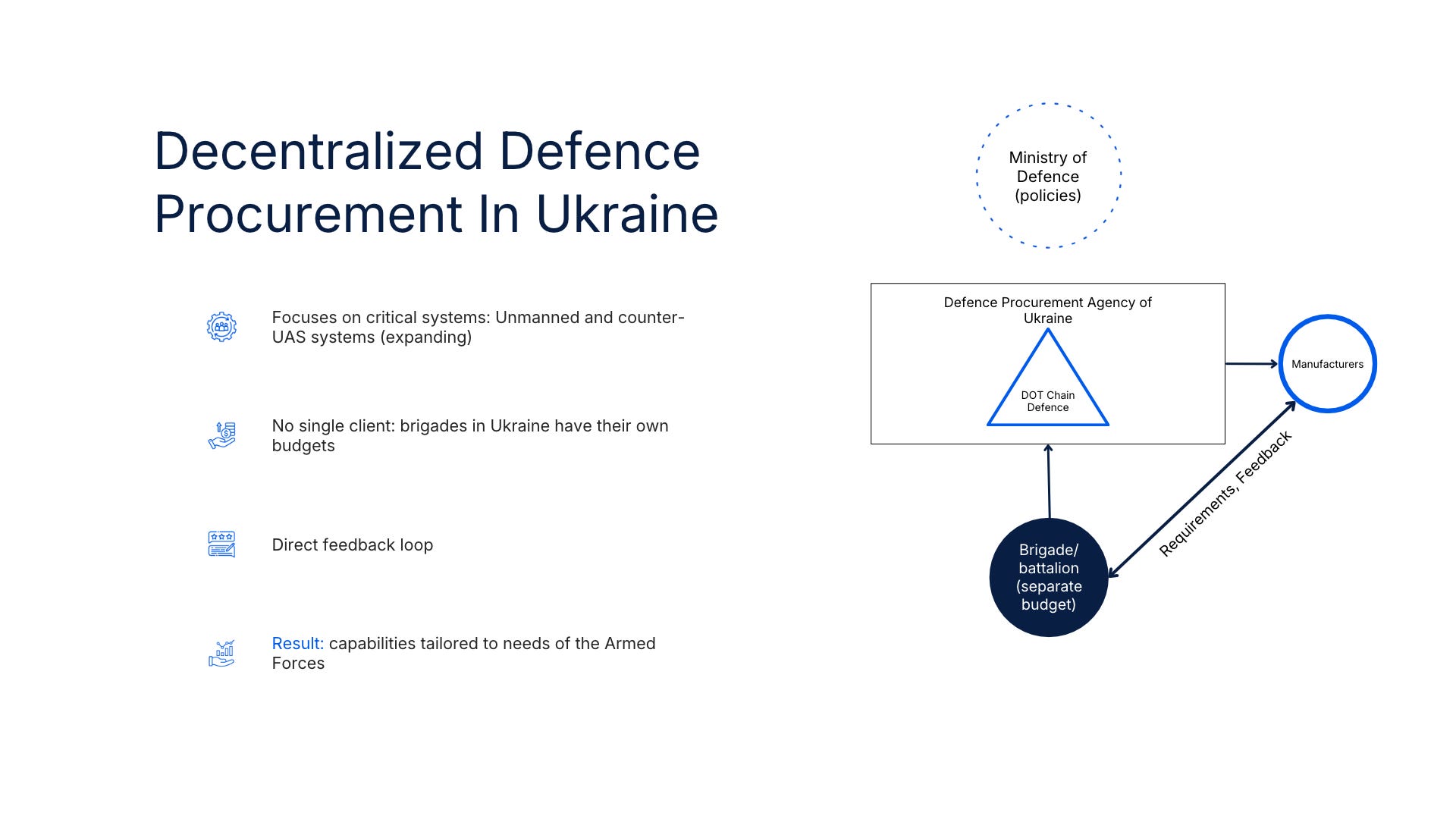
Ukraine’s marketplaces emerged in response to a rapidly growing pool of producers of unmanned and related technologies, whose supplies had to reach the military quickly, without an excessive government intermediary role slowing things down.
The delivery times have been cut from months to weeks. Now, on average, in-stock items are delivered in 8 days, and pre-ordered items in about a month and a half.
Brave1 Market (managed by Brave1, which is a government cluster led by the Ministry of Digital Transformation and the Ministry of Defence) can be described as a catalogue of defence solutions. It lists 7,087 solutions from 955 companies, including not just drones, but also electronic warfare systems, components and software. Foreign producers opening Ukrainian legal entities can also list their products on the marketplace.
It has open and closed sections with different levels of access: responsible personnel in military units, from battalion level up, can see full product information and purchase products with e-points.
Importantly, it is not only military units that can use Brave1 Market. Other buyers of such equipment, including charities, benefactors, local administrations and individuals, can also discover products on the platform and reach out to suppliers.
DOT-Chain Defence (managed by the Defence Procurement Agency under the Ministry of Defence) features only officially codified equipment approved for use, and military personnel can purchase it using special budgets. Today, the marketplace features all key categories of unmanned systems, with nearly 1,200 solutions available from 300 manufacturers.
More than 500 combat units in Ukraine now have access to DOT-Chain Defence. Procurement is carried out by specially appointed procurement personnel within the units.
Between the launch of DOT-Chain Defence in July 2025 and November 2026, combat units received more than 1.5 million drones and other equipment through the digital system. Given Ukraine’s drone production figures for 2026, however, traditional centralized and tender-based procurement still far exceeds decentralized procurement.
Ukraine’s digital defence marketplaces offer multiple opportunities for industry, government and military end users.
For industry, it is a visibility tool that helps companies get discovered. The marketplace lets companies see competitors in the same niche, compare prices and services, and identify top performers. It also helps them find partners and establish partnerships. At the same time, visibility is not the same as contracts: being listed on the marketplace does not guarantee that a product will be purchased.
For military end users, it makes it possible to purchase the systems needed right now on a specific section of the battlefield. Users can connect directly with manufacturers, customize orders to a certain extent, and give feedback.
For the state, defence marketplaces, which are connected to the DELTA battlefield management system, make it possible to aggregate and analyze large amounts of data on market trends, the best-performing products, and the specific needs of different sections of the front line.
Canada’s Defence Drone Initiative Marketplace
In Canada, the new marketplace falls under the Defence Drone Initiative, which is a collaborative project between the Department of National Defence (DND) and the Defence Investment Agency (DIA).
Following Ukraine’s example, Canada decided to take the procurement of unmanned systems out of its traditional, much-criticized procurement system and establish a fast track.
According to comments provided by Canada’s DND, Ukraine’s Brave1 Market was the original inspiration for the Canadian Digital Marketplace. “The Canadian concept adapts several principles from that approach: connecting military users with industry, making systems easier to discover and compare, incorporating operator feedback, and simplifying the path from identifying a requirement to acquiring a capability. The Government of Canada is not adopting Ukraine’s combat rewards system, nor is it implementing any points-based mechanism,” the press service of DND commented.
The marketplace is still under development: some features are already functioning, while most are still planned.
The intended Canadian model comprises four integrated portals:
- a User Portal for capability discovery and feedback;
- a Vendor Portal for industry submissions and product information;
- an Acquisition/Procurement Portal for purchase requests, documentation and approval workflows;
- a Governance/Admin Portal for oversight and reporting.
These portals will be implemented in phases. The first phase will address the procurement portal, which is intended to connect capability selection with the appropriate Government of Canada financial and contracting processes while retaining role-based approvals and accountability.
For now, only National Defence, the Armed Forces and the Coast Guard can buy through the DDI. The goal is to open it later to other federal departments, such as the RCMP and Transport Canada. Unit-level acquisition is part of the intended four-portal design.
The DIA runs the Request for Supply Arrangement (RFSA) on the CanadaBuys portal. In a comment, the Agency stated that prequalification for the marketplace is not based on a specific product; instead, the company is prequalified based on its past experience and support capability or on a description of its current technology readiness.
An interesting feature of the tender notice on the CanadaBuys platform is its list of partnership opportunities that bidders can consider while applying. The list now includes around 330 entities, including manufacturers and academic institutions, that are ready to partner. The list is not easy to navigate, but it is still a useful resource.
As in Ukraine, being listed on the platform does not mean getting contracts. Instead, it increases a supplier’s chances of being discovered, since it has already been pre-vetted by the government.
DIA said the marketplace allows qualified suppliers to compete for future opportunities, which may include research, prototyping, testing, demonstrations and acquisitions. At the same time, Canada may suspend or cancel a supplier’s qualification if it no longer meets the requirements, fails to meet its obligations, or defaults on a contract.
Currently, there are 398 prequalified suppliers in the Defence Drone Initiative Marketplace, and 12 contracts have been awarded.
Objexis AI, a Canadian full-stack unmanned systems developer, was one of the first six companies awarded a contract.
Senan Houlihan, CEO of Objexis AI, who regularly travels to Ukraine and spent a rotation embedded with an infantry unit at the front, described how quickly the process moved for his company. Right after the company qualified for Stream 1 (uncrewed systems and counter-drone), a request for proposals arrived with only five days to respond. About a week after submitting, the company got an email saying it had won. The announcement came during President Zelenskyy’s surprise visit to Canada, where the 100-year partnership declaration was unveiled along with several cooperation deals between Canadian and Ukrainian companies. “I was out flying drones for a client when the announcement was made. Imagine my shock when I found my phone afterward vibrating non-stop, with everyone telling me Zelenskyy was here and the Prime Minister had announced the contract,” Houlihan told Ukraine’s Arms Monitor. In total, it took roughly two weeks from request to contract, a process that usually takes months or even years in Canadian defence procurement.
Houlihan said that a marketplace that buys in smaller, faster increments pushes Canadian industry toward the same rhythm of build, field, learn, improve. It also tells investors there is a real domestic customer, which is what unlocks private capital for Canadian defence startups.
Asked what would make the marketplace work better, Houlihan pointed to six changes:
Show what’s coming. Even a rough, regularly updated forecast of upcoming requests would let companies plan production, hiring and supply chains instead of scrambling each time a new one appears.
Keep it fast. The short time from request to contract should stay, because drone technology changes in months, not years.
Explain the results. Feedback after every competition, whether a company wins or loses, is how firms improve.
Connect companies with soldiers. The best requirements come from the people who use the systems. Companies also need easier access to test ranges and approval to use radio frequencies.
Pay in a way that works for hardware. Payments at set milestones, or part of the money up front, would let smaller firms take on larger orders without covering all the costs themselves until delivery.
Make systems work together. Clear shared rules for data and command-and-control would mean drones and other systems from different Canadian suppliers can operate together from the start.
Houlihan sees most of the remaining challenges as long-standing and bigger than any single program. The most underestimated is volume: as militaries shift toward drones, demand for systems and counter-drone effectors will grow by an order of magnitude, and building sovereign production at that scale is the real long-term test. Startups also need help building production capacity before orders arrive, while most Canadian investors are still new to defence. Other hurdles include reliance on foreign components, limited access to realistic testing and airspace, and a shortage of cleared engineers.
Other Defence Marketplaces
The United States’ Drone Marketplace
The US has moved fastest in putting a platform like this in place. Its Drone Marketplace went live in March 2026 as the Army’s drone (UAS) marketplace and has since expanded. It is now a unified platform for procuring unmanned systems across all military domains, including air, maritime, ground, and counter-drone. It was built in close cooperation with Amazon Web Services (AWS).
Notably, the marketplace is also open to foreign buyers. Thirty-three US allies have joined the marketplace. Among them, Canada, Croatia, Egypt, Japan, Kuwait, Morocco, Albania and Panama signed a statement of intent to take part. In September 2026, Australia became the first US ally to make a purchase through the site.
Unit leaders order directly on the website from approved vendors whose products meet US military requirements. An order is usually accepted within about 24 hours, since the site only needs to confirm who the buyer is. Delivery times depend on the vendor, but for US orders the department says it is “seeing that within 30 days it’s being delivered to the unit or the buyer that is procuring it.”
The Dutch Intelic BASE
Intelic, a Dutch company, took a different approach. Its Intelic BASE platform brings together drone producers from ten countries (France, Germany, the United Kingdom, Ukraine, the Netherlands, Portugal, Latvia, Luxembourg, Lithuania and Czechia), giving governments a clearer view of what is available.
One of its partners is Ukraine’s TAF Industries, which contributes experience in surveillance, strike and counter-drone systems. Other Ukrainian companies also take part but cannot be named.
In an August 2026 comment to Ukraine’s Arms Monitor, Marc Derksen, co-founder and Chief Product Officer of Intelic, said that Intelic BASE is not a procurement or sales platform. Instead, it serves as a portfolio showcasing available systems. When a government or another customer is interested in purchasing a system, the Intelic BASE team can connect them directly with the manufacturer, but it does not participate in the transaction itself.
Although the platform primarily focuses on European companies, it is also open to manufacturers from other NATO countries. For instance, Canadian companies interested in the European market could potentially be included, particularly if their products can be integrated with Intelic’s NEXUS software.
Russia’s Roy.Market
Roy.Market started as a platform for dual-use goods and was relaunched as a full military marketplace in August 2026. It was created by the Center for Unmanned Systems and Technologies, which reportedly unites more than 500 developers.
According to Russian officials, makers of dual-use products can now list items on Roy.Market themselves, setting their own prices, managing stock and handling orders. The developers also say the platform’s logistics were designed with Ukrainian strikes in mind. Instead of large central warehouses, goods can stay with individual suppliers or be kept within existing logistics networks.
The platform’s creators aim to grow the catalogue to more than 10,000 items by 2027, including drone components, personal protective equipment, electronics and field uniforms.
Ukrainian outlet Defense Express points out that this model also brings new weak points. A central digital marketplace can make buying easier, but the physical supply chain still relies on warehouses, transport hubs and other infrastructure that can be hit. The more successful Roy.Market becomes, the more useful information about its suppliers and logistics could be to Ukrainian intelligence.
Final Thoughts
Canada is among the first countries to adopt the marketplace model, one of the most effective and innovative approaches to defence procurement, born in Ukraine out of wartime necessity. The system is still being rolled out in phases, yet the number of companies already qualified and ready for selection is approaching 400.
The special feature of Canada’s marketplace is that it is built around suppliers rather than products.
This brings one important result. For the first time, we can see how large Canada’s defence ecosystem already is. The common assumption that Canada’s defence market is small was not well grounded, and this number puts it to rest.
But how do you choose among 400 suppliers? That is the new challenge. Companies listed on the marketplace will need to keep reaching out, meet military users at industry events, and take part in accelerators, challenges and incubators where they can get noticed.
The marketplace fits well with Canada’s goal of bringing more SMEs and defence innovators into government contracts. Still, implementation is everything. It remains to be seen whether end users will stick with their traditional defence industry partners or open up to new companies and ideas. Militaries are rarely quick to embrace innovation. In peacetime, when the need for new systems is less urgent, it is an open question how far the marketplace will actually be used to discover innovative solutions.
Read my earlier articles on similar topics on Ukraine’s Arms Monitor or external websites:
Fantastic work Olena
The scale of Brave1 Market was the part that stayed with me, because the November 26, 2026 piece says it lists 7,087 solutions from 955 companies and delivery times fell from months to weeks. The Canadian adaptation also stood out, since 398 suppliers are already prequalified and the first contracts took roughly two weeks from request to contract. I also liked the six changes from Objexis AI, especially the call for a regularly updated forecast of upcoming requests so companies can plan production.