

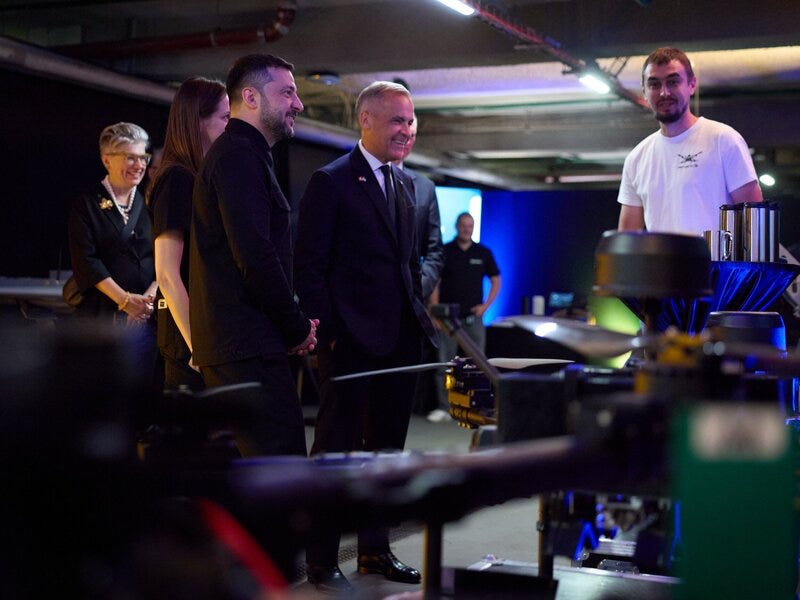
Last week, President Zelensky visited Canada and signed the Ukraine–Canada Declaration for a 100-Year Partnership. It is Ukraine’s second 100-year partnership framework, after the agreement signed with the UK in 2025.
Important note: for now, it exists only at the level of a declaration, and the formal agreement is expected to be signed in December 2026.
In this brief overview, I try to place the Canada–Ukraine cooperation in the context of the revival of Canada’s defence industrial base, as well as its reforms and initiatives in the drone sector.
This partnership doesn't really come as a surprise because Canada has historically been one of Ukraine’s most reliable allies, especially in this war against Russia. Throughout years of Russia’s aggression, Canada’s support for Ukraine has remained consistent. There were no major policy swings like those in the US that directly affected the situation on the battlefield. Nor have there been major disappointments like those Ukraine experienced with some European partners that either refused to provide key weapons systems, or delayed their delivery for so long that those delays had negative consequences for Ukraine.
This can be partly explained by the fact that Canada has not been a major producer of many of the defence capabilities Ukraine urgently needed. Nevertheless, it has provided important equipment, including armoured vehicles and drones. Canada has also led the way in imposing sanctions on Russia. It seized a Russian-registered Antonov aircraft grounded in Toronto and has been one of the first and strongest advocates for using frozen Russian assets to support Ukraine.
The new 100-year partnership framework creates much broader opportunities for both Ukraine and Canada.
Canada now has a rapidly growing defence and security ecosystem comprising more than 585 companies nationwide.
For decades, its defence industry has been deeply integrated with the United States. Canadian companies often found it easier to access the US defence market than to sell to their own government. But during these two years of the Trump administration, Canada has changed.
I have lived in Canada since August 2024, and I have seen how dramatically Trump’s annexation threats and economic pressure have shaped the country’s political debate.
The current revitalization of Canada’s defence can only partly be explained by the threat from Russia. A much more immediate factor has been uncertainty surrounding Canada’s most important ally. Although nobody seriously (at least publicly) talks about the prospect of US military action against Canada, the realization that Canada might not be able to rely on its closest partner has been something of a cold shower.
In 2026 we’ve seen a remarkable number of new defence initiatives, institutions, investments, and reforms announced. The most important policy development was the launch of Canada’s Defence Industrial Strategy. The document places much greater emphasis on building sovereign defence capabilities and supporting domestic producers. It identifies ten “key sovereign defence capabilities” that will receive particular attention under the new approach.
At the same time, Canada is clearly trying to diversify its defence partnerships. The strategy calls for deeper cooperation with European partners, the United Kingdom, and countries in the Indo-Pacific. We also need to be realistic: Canada is highly unlikely to become completely militarily self-sufficient or independent from the United States in the foreseeable future. Nor would that be desirable. The two countries remain closely connected through NATO, NORAD, integrated supply chains, and decades of military cooperation. In the event of a major common threat, they would still have to respond together, making interoperability between their armed forces and military capabilities essential.
Interestingly, the Defence Industrial Strategy does not specifically mention Ukraine as a priority partner. Yet that has not prevented the two countries from deepening their partnership.
All types of drones across the land, air, surface, and underwater domains are now officially recognized as one of Canada’s ten key sovereign defence capabilities. Canada has also launched an unusually large number of initiatives in this area over a relatively short period. Compared with many other countries, even those facing immediate threats, Canada appears to be making a particularly significant push in the drone sector.
The list of these initiatives includes:
MINERVA — a Canadian Army initiative focused on accelerating the integration of larger numbers of uncrewed aerial, ground, and littoral systems into Army operations and strengthening regular engagement with industry.
Uncrewed Systems Defence Innovation Secure Hub (UxS DISH) — a secure innovation hub bringing together government, industry, academia, and the military to develop, test, and commercialize uncrewed technologies.
Defence Drone Initiative (DDI) — a broader effort to accelerate the development, testing, adaptation, procurement, and domestic production of uncrewed and autonomous systems.
Defence Drone Initiative Marketplace (DDIM) — modelled on Ukraine’s Brave1 Marketplace and designed to give the Canadian Armed Forces and Coast Guard faster access to drone and counter-drone technologies.
RED COBALT Uncrewed Systems Accelerator — a Canadian Joint Forces Command initiative bringing together operators, government agencies, and industry to test aerial, ground, and maritime drones, as well as other emerging uncrewed capabilities, in realistic conditions.
The Canadian Armed Forces currently have only around 2,000 drones of various types in their inventory. Ottawa has now awarded contracts worth up to C$50 million, expected to expand this fleet roughly tenfold. The first procurement phase focuses on intelligence, surveillance and reconnaissance drones, as well as uncrewed ground vehicles, and includes six companies.
During President Zelensky’s visit, Canada and Ukraine signed a Joint Declaration on enhanced defence and security cooperation, which the Ukrainian presidency described as the first step toward a bilateral Drone Deal expected to be finalized at the end of September.
Ukraine has already signed Drone Deals with 10 partner countries. These arrangements include mutually beneficial cooperation formats, including joint production, localization, technology transfer, financing, cyber cooperation, and access to new markets, with the precise model tailored to the partner country.
Currently, Canada and Ukraine cooperate within the Build with Ukraine framework for joint drone production. The first is a joint venture partnership between Ukrainian Airlogix and Canadian Sentinel Research & Development, announced in May, focused on producing Ukrainian reconnaissance-drone technologies in Canada. The second, announced during Zelensky’s latest visit, is a partnership between General Dynamics Mission Systems–Canada and the Ukrainian company Green Tech Harvest.
Additional partnerships are currently under negotiation, most likely including two Ukrainian companies, Ratel Robotics and Skyfall.
The Ukrainian delegation organized an event in Calgary to showcase their technologies. The Ukrainian side was represented by JK Land Vehicles LLC, Airlogix, AIDRONESUA, GreenTech Harvest LLC, UFORCE, Skyfall, and Quantropi. More than 30 Canadian companies also took part, including both current and potential partners of Ukraine’s defence industry.
From the Canadian side, according to social media posts, North Vector Dynamics, which describes itself as Canada’s only domestically owned and controlled missile company, met with President Zelensky. UAS producer Volatus Aerospace was also present at the meeting. Sentinel R&D, which has already established a joint venture with Ukrainian Airlogix, participated as well.
Setting drones aside, Canada also announced more than $2 billion in new support for Ukraine, including over $1 billion in defence assistance. Canada will allocate approximately C$350 million (around US$253 million) to procure urgently needed air-defence capabilities for Ukraine through the JUMPSTART program. JUMPSTART is a US mechanism that allows allies and partners to finance the procurement of American-made weapons for Ukraine through the Foreign Military Sales (FMS) system.
Canada is also ready to contribute technology to the pan-European FREYJA anti-ballistic missile programme and to prepare new sanctions against Russia, including measures aimed at making it more difficult for Russia to produce ballistic missiles.
President Zelensky also visited the International Test Pilots School in Canada, where Ukrainian pilots are being trained to operate F-16 and Gripen fighter jets.
Earlier, Operation UNIFIER, under which Canadian instructors have trained more than 49,000 Ukrainian military personnel, has been extended until 2029.
The 100-year partnership with Canada was received largely positively in Ukraine, although some observers were sceptical about the broad and relatively general nature of the declaration. According to the former Ukrainian Ambassador to the United States Valeriy Chalyi, there has been real progress in some areas, particularly defence and security, while cooperation in others, including trade, economic relations, and visa-free travel, has largely remained stagnant. In some areas, such as space cooperation, there is little substance.
At the same time, Chalyi stressed that the partnership still has room to grow. He hoped the future Agreement would be more concrete, include clear and detailed commitments, and go beyond simply restating previously agreed positions.
On the Drone Deal partnership, Ukrainian military officer and founder of the Kruk drone training centre Viktor Taran said the Canadian prime minister had described the proposed model quite openly: combining Ukraine’s battlefield experience with Canadian manufacturing capacity, software, and artificial intelligence.
At the same time, Taran cautioned that the key question is not simply how many drones will be produced, but who will own the design documentation, where localization will take place, and whether Ukraine will remain a supplier of complete solutions rather than becoming merely a source of data and combat protocols for foreign production lines.
Protection of intellectual property is an important issue for Ukrainian defence producers and has become a point of discussion in partnerships with Greece and the United States.
Canadian stakeholders also welcomed partnership with Ukraine and pointed to other areas where Canada could play a more active role in supporting Ukraine in its war of survival.
Human rights and disinformation expert Marcus Kolga wrote that “it’s good news for Canadians: we stand to benefit enormously from Ukraine’s hard-won expertise in drone technology.” At the same time, he stressed the importance of helping Ukraine fight the war now: “Ukraine needs weapons now to defend its people from Putin’s escalating nightly bombardment and campaign of terror.”
Kolga argued that Canada should press allies such as South Korea to adjust their policies and allow the immediate sale of surface-to-air missiles to Ukraine, noting that thousands of Ukrainian lives are at stake.
He also called on Canada to designate Russia a state sponsor of terrorism and begin expelling Russian intelligence operatives working under diplomatic cover. Europe has already faced suspected Russian sabotage and terror operations, while Canada has not been immune either. Incendiary devices placed on DHL aircraft in Germany were reportedly intended for flights to Canada.
In his view, supporting Ukraine means helping it defend its skies now, while also strengthening Canada’s own defences against Russia’s expanding campaign of hybrid warfare.
According to national security expert Wesley Wark, “there is one unique capacity that Canada has been mysteriously reluctant to supply. The capacity is imagery from the latest set of radar satellites that the Government of Canada operates—called the Radarsat constellation mission (RCM)”.
Canada had authorized MDA to provide Ukraine with synthetic aperture radar satellite imagery capable of operating through cloud cover and in all weather conditions. The imagery was combined with other commercial satellite data to produce near-real-time intelligence for Ukrainian authorities.
Wark notes, however, that the Canadian RADARSAT support reportedly lasted only about a year before being quietly discontinued, with no public explanation. The capability had been highly valuable for tracking Russian military movements, targeting weapons systems, and supporting Ukraine’s battlefield defence.
Speaking from my personal experience, what I admire about Canadians is their modesty and willingness to learn. Unlike some others, they are not convinced that their innovations are automatically the best or that there is nothing to improve. They understand their shortcomings, are openly critical of them, and are ready to change.
That said, it remains to be seen how many of the initiatives described above will survive and develop in the coming years, because defence is a long game. We also have to understand that for Ukrainian or European companies coming to Canada, the sense of urgency probably won’t be the same as on NATO’s Eastern Flank.
The coming months will likely bring further updates on Ukraine–Canada defence cooperation, as well as new partnerships between Canadian and European companies, which are developing quickly. Stay tuned!
During my Postdoctoral Fellowship in Defence Innovation at the Canadian Global Affairs Institute, which ends next month, I have written several pieces on Canada:
Lessons and Warnings for Canada's Defence Investment Agency;
MINERVA Initiative and Drone Integration in Canadian Army Land Operations;
The Potential for Canada-EU Cooperation on Counter-UAS Capabilities;
The Defence Industrial Strategy, Sovereign Capabilities, and Defence.
For the NATO Association of Canada, I also wrote two short analyses examining the nature of Canada’s military assistance to Ukraine in 2024 and 2025:
Canada’s Military Assistance to Ukraine in 2024: Key Trends;
Canada’s Military Assistance to Ukraine in 2025: Key Trends.
Also, here are my other articles about Canada, Ukraine, and drones:
And, finally, my conversation with the Canadian journalist and top Substacker Paul Wells: The Q&A: “The human may not be able to make decisions at the speed modern war requires.”
Thank you for reading and supporting my work! Here I publish weekly newsletters Arms Trends in Ukraine and Ukraine Drone Brief.
Also, there is an occasional newsletter Drone warfare in Ukraine.
While the defense cooperation agreements are publicly disclosed and rather anodyne, has anyone seen the text of a drone cooperation agreement between Ukraine and another country? While they are announced, I cannot find any public disclosure, and they certainly have not trickled down to what we are doing.
" Cold shower for Canada" regarding U.S. - Canada relations..heh, that was a good one.
Having Canada form the relationship with Ukraine we in the U S. would like makes sense for the U.S, as Canadian presence closer to Russia sets off fewer alarm bells in the Kremlin. Over the Atlantic, across Europe and þver the Alps and Carpathian Mts, they would see us coming 1000 miles away. I agrue with others that Trump may indeed be a secret Canadian asset. I get some laughs on that one. If so, i still criticize the leadership style : playing mind games with the American public ( All North America) and our Allies - " the genius".
It seems the U S. is trying the same Canada Ukraine Cooperation On Steroids with Isreal, so my attention is admittedly divided with That whole.. conflict . . Isreali scientists and engineers are laudable, but too much ballyhooed in my opinion. Canada's investment is wiser.
Space will still be there, and i hope Europe and America realize Ukrainians were instrumental in helping " the Russians" beat us there. African americans are often admonished by white supremacists for the latter's " building the space program", irrespective of the black ladies who did the math for it.
A comprehensive relationship with Canada is immensely beneficial, more currently for Ukraine as infrastructure and economic maintenance during this war. " Today for you tomorrow for me" is a Spanish axiom, mistaken as transactional, but really more a faith in good karma and a way of being.
Rambo: " That was Good Timing"
Col Trautman: " What are friends For?"
- Rambo 3