

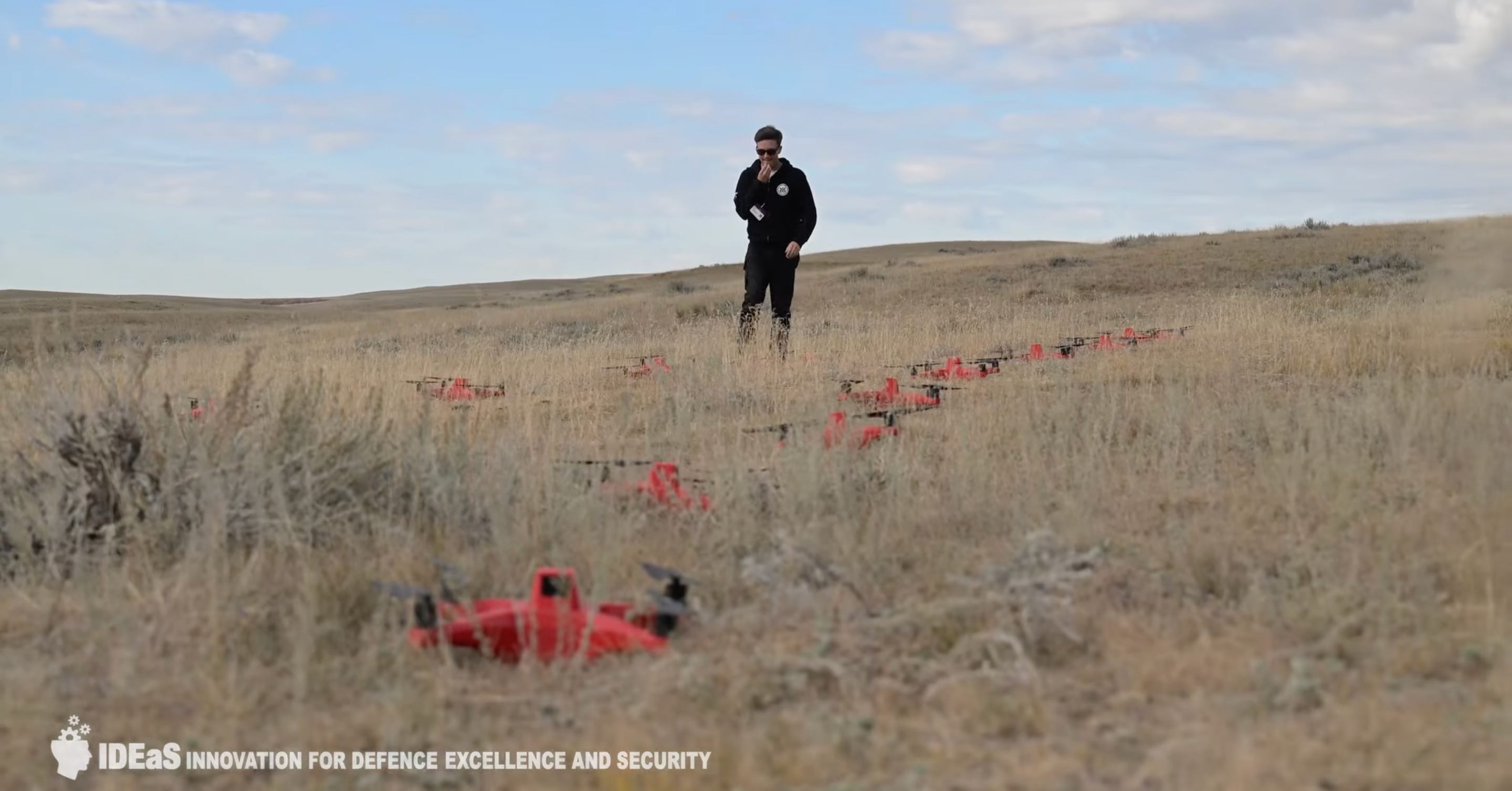
It has been over a month since my visit to Canadian Forces Base Suffield, where I attended the demo day for selected C-UAS solutions and the symposium where I presented on defence innovation in Ukraine and NATO. Although the trip was logistically challenging, as the venue was near Medicine Hat, Alberta – deep in the Canadian prairies – I’m happy it worked out and I was able to attend. I had the opportunity to see live demonstrations of some of the solutions, as well as to discuss them with the Ukrainian military officers who were also invited to this CUAS Sandbox to offer their insights.
CUAS Sandbox
The whole event was organized by the Canadian program IDEaS (Innovation for Defence Excellence and Security), under Defence Research and Development Canada (DRDC). What’s fun about IDEaS is that they really do have a lot of ideas, but not always the budget to put them into practice or to contract companies. The first thing I heard about them was exactly that – the industry viewed them with skepticism as they had no contracting powers.
Things started changing last year. IDEaS is now piloting a new mechanism designed to close the gap between funding innovation and actually buying it. Once the R&D phase is complete, the technology is tested, and if it meets the acquisition criteria, DND/CAF has the option to buy it at scale for operational use.
An IDEaS Sandbox is an opportunity for selected companies to test and demonstrate their solutions to DND/CAF in a simulated environment and to gain feedback from the Department of National Defence and the Canadian Armed Forces on what they think of their solutions. The C-UAS Sandbox is organized annually and includes not only domestic innovators, but also companies from global partner countries. This time, for instance, there were innovators from the UK, Switzerland, the US, Finland and Australia. This means the IDEaS Sandbox challenge offers great potential for other innovators who want to test and showcase their solutions, particularly those from Europe, which is now Canada’s priority partner.
For almost a month, selected innovators were invited to Canadian Forces Base Suffield, which hosts the largest military training area in Canada and the largest live-fire training exercises in the country. The Manoeuvre Training Area covers 1,588 square kilometres of the 2,700-square-kilometre base. It offers virtually ideal conditions for testing – vast, flat terrain and lots of sunlight. The previous Sandbox in 2025 took place in downtown Ottawa, and the next one, in 2027, will be held there as well, with a focus on threats in an urban environment.
Testing is a very important opportunity for defence innovators, as they usually have to pay for it. Here, the selected companies did not have to carry any testing expenses: IDEaS funds the entire sandbox, and innovators are not charged a fee to attend.
The 22 solutions selected for this cohort fell into the categories of detecting or defeating aerial threats. Some of them offered a mix of detection and defeat capabilities. DRDC evaluators wrote reports on how the testing progressed, and the companies received final reports to help them further develop their products.
I visited the testing range on a VIP Day when special guests from government, media and international delegations could come and observe some of the proposed solutions. Among them, we saw the low-cost interceptor missiles by the Canadian company North Vector Dynamics. These could be particularly interesting against jet-powered Shahed-type threats, which Ukraine is facing right now. We saw the return of Australia’s AIM Defence, which previously won Canadian contracts, with its laser technology that also has good potential in armed conflict conditions. It was also interesting to see the aerostat balloon by Finnish innovators Kelluu, potentially for reconnaissance purposes.
What’s most interesting is that the Canadian organizers invited a small delegation of Ukrainian military officers, who stayed with the innovators for two weeks, observed their work, and offered insights on how their solutions could be improved and applied. This is the best practice possible, and it’s great that the Canadian authorities recognized its value and invited their Ukrainian colleagues.
Impressions of Ukrainians
If I were to summarize some of the feedback I received from the Ukrainian officers, as well as privately from my contacts in Ukraine’s Defence Forces, it would come down to these six main points:
Canadian Forces Base Suffield offers practically ideal testing opportunities – opportunities that are hard to find in Ukraine and in Europe. There is a feeling that large resources are available; what is lacking, of course, is an understanding of how best to spend them and a sense of urgency – of the inevitability of conflict, which many in Canada still think is geographically very far away.
The majority of the solutions we saw are still mostly oriented toward peacetime. Yes, they are dual-use in nature, but it’s important to understand how the dynamics will shift during active warfare. For instance, a technology such as a laser needs a higher target-processing rate, the ability to distinguish friend from foe, and less time to focus on each drone. Some of the solutions seemed very fragile in conditions of armed conflict. However, with the right input, they all have the potential to find the right application.
There were innovators who tried to create “sterile” conditions even for testing and trials of their technology. If they want to achieve real results, they should be ready for real challenges, not modelled perfect situations.
We also know that some innovators exaggerated the performance of their systems to get into the program, while in reality their solutions struggled to perform even the simplest tasks. This means that IDEaS will make its selection criteria stricter for future cohorts.
The Ukrainian officers suggested how valuable it would be to bring real Ukrainian drone pilots and see whether innovators are able to detect, engage, and defeat threats when their opponents are highly skilled and trained in combat conditions.
It would also be great to create a Canada-Ukraine defence innovation platform that would institutionalize this type of innovation cooperation despite the large geographic distance.
Key Messages from the Ukrainian Presentations
The C-UAS symposium, which concluded the month of testing and trials, brought together government and military officials from NATO allies, as well as defence researchers, to discuss policy and technical issues related to counter-drone defence.
I delivered a presentation focusing on defence innovation cycles in Ukraine and across NATO. The central message of my presentation was that the defence industry, end users and governments must work together, communicate closely and be willing to adapt to achieve a common goal: delivering the capabilities that armed forces need right now to address existing challenges.
I briefly addressed how rapidly Canada is rolling out its drone and counter-drone initiatives. In early November 2026, it was announced that Canada will spend at least CAD 2.3 billion (approximately $1.8 billion) over five years on deploying advanced combat drones and counter-drone systems.
A whole series of related initiatives appeared in 2026, with some focusing on procurement, such as the Defence Drone Initiative Marketplace, which is modelled on Ukraine’s approach. Others originate within the military, such as the Canadian Army’s MINERVA initiative and the Joint Forces Command’s Red Cobalt Accelerator. I describe these initiatives in more detail in my article: Canada–Ukraine 100-Year Partnership: What Does It Mean for Both Countries?
For me, it was particularly interesting to hear the Ukrainian delegation describe how Ukraine’s C-UAS architecture has been changing and evolving in response to evolving threats.
Core messages
Drones and EW have reshaped the doctrine of operations in the electromagnetic spectrum.
The contest between drones and EW follows the classic thesis–antithesis–synthesis formula: every new solution creates the need for a new countermeasure.
Technological evolution is not chaotic but a spiral. In Ukraine, EW development has been a direct response to drone development.
“In modern warfare, victory belongs to whoever controls their own electromagnetic spectrum.”
Early phase of the full-scale war
The battlefield was shaped by classic fixed-wing reconnaissance UAVs such as the Russian Orlan and by civilian quadcopters such as the DJI Mavic, used mainly to adjust artillery fire.
Electronic support relied on TCI-type monitoring stations and portable spectrum-monitoring and direction-finding equipment.
Electronic attack relied on military systems such as Bukovel and on anti-drone rifles, which used barrage jamming across standard GNSS, communication and video bands.
As drone use intensified, Ukraine moved from ad hoc EW groups to regular units, with EW platoons at brigade level and within tactical groupings.
High-tech electronic support assets were used at the tactical level, while frontline units relied mainly on anti-drone rifles.
2024–2025: a turning point
Classic kinetic air defence proved ineffective against cheap, highly manoeuvrable targets, so EW became the baseline defence.
The frequency ranges used by UAVs expanded rapidly, which drove the creation of new detection systems.
The growing intensity of warfare required centralized command and control:
Iceberg, a Defence Forces software platform, controls EW assets and issues commands to them.
Graphite is a system for detecting enemy UAVs.
2026: Russia adapts
Russia expanded its strike UAV lineup with the Shahed and Gerbera families, including jet-powered and longer-range platforms.
Speed, altitude and operational range have increased, and elements of autonomy have emerged.
Russian drones are more EW-resistant. Adaptive CRPA antenna arrays have grown from 4 elements to 8 and 12, and 16- and 32-element arrays have started to appear.
Russian drones now use mesh modems to relay data in protected frequency bands. These modems are very broadband, so jamming them takes many assets.
Ukraine’s response to evolving threats
Ukraine has shifted from local jamming to zonal, layered jamming and spoofing.
Defence lines across the whole country are now suppressing CRPA antennas.
Specialized complexes such as Bukovel, Monolit and Damba disrupt mesh links, destabilize networking protocols and disable swarms.
The key problem is a shortage of systems to protect critical assets.
Russia is expected to produce 36,000 jet-powered Shaheds in 2026.
Attacks have increased during the day. Ukraine has already worked out tactics against night attacks.
AI is essential against these targets, because manually hitting a point target at such speeds is extremely hard.
EW brings down up to 50% of the missiles and drones flying over Ukraine.
FPV drones are far more dangerous for soldiers on the front line. There are eight projects aimed at countering fiber-optic FPV drones, including special UGVs designed to cut fibre-optic cables and clear roads, such as Prymara Killer.
Armed Forces of Ukraine EW Research Centre: offer to partners
The centre has five specialized departments covering the full development cycle, from analytics and reverse engineering to field testing and building EW systems.
Its main areas are cyber-EW, signal databases, laser technologies and directed energy.
It offers partners joint projects, field testing, and integration of Ukraine’s battlefield experience into their research programmes.
Final Comments
After my presentation, I was asked a question about hybrid threats – what are they? According to a definition given by NATO, hybrid threats combine military and non-military as well as covert and overt means, including disinformation, cyber attacks, economic pressure, deployment of irregular armed groups and use of regular forces. The EU includes in this category drone-related activities such as hostile overflights, airspace violations, disruptions to airports, and risks to critical infrastructure, external borders, and public spaces.
At the time, when I was asked this question, Europe was the epicenter of hybrid attacks, with Germany experiencing dozens of such incidents every month. It takes only one drone to disrupt the operation of an entire airport, inflict huge economic losses, and spread panic in society.
Almost a month after my presentation and that question, we learned from media reports about unidentified drones flying over military bases in Canada in 2024 and 2025. While there is no further information about these potential threats and no proven links to Russia or other hostile actors, such incidents raise questions about how well-prepared Canadian authorities are to counter them. Everything seems to be going well on the testing ground, but it’s different when a real adversary wants to inflict damage – to gather intelligence, transport illicit cargo, or conduct an attack with an explosive-laden drone.
Hostile actors, whether state-affiliated or non-state, are numerous and continue to learn from modern conflicts in various ways. I hope I’m wrong, but it seems that Canada’s counter-drone defences may soon be put to a real-world test.
Recently, I authored and co-authored several publications on opportunities for Canada-EU and Canada-Ukraine defence cooperation. Some of them were published here, in Ukraine’s Arms Monitor, while others were published in external sources.
Opportunities for Enhancing EU–Canada Cooperation in Unmanned Technologies. Published by the Canadian Global Affairs Institute (CGAI)
Canada–Ukraine 100-Year Partnership: What Does It Mean for Both Countries? Ukraine’s Arms Monitor
Why Canada and Ukraine Must Team Up on Defense Innovation. Kyiv Post
Thanks for the definition of hybrid threats.
Olena, what struck me most was the gap between testing in ideal conditions and what Ukrainian soldiers actually face on the battlefield. Some systems apparently struggled with basic tasks, yet the companies developing them may still be years away from understanding real combat conditions.
There's a wider geopolitical shift here. For decades, Ukraine looked to NATO countries for military technology and expertise. Now NATO countries are learning from Ukraine about what actually works against an adapting enemy.
Canada's effort to connect testing with procurement is important, but I think the bigger challenge is institutional. Russia and Ukraine are adapting their drone and electronic warfare capabilities constantly, while Western procurement systems often move much more slowly.
Having advanced technology and being able to deploy it when needed are two very different things. That gap could become a serious weakness for NATO.