

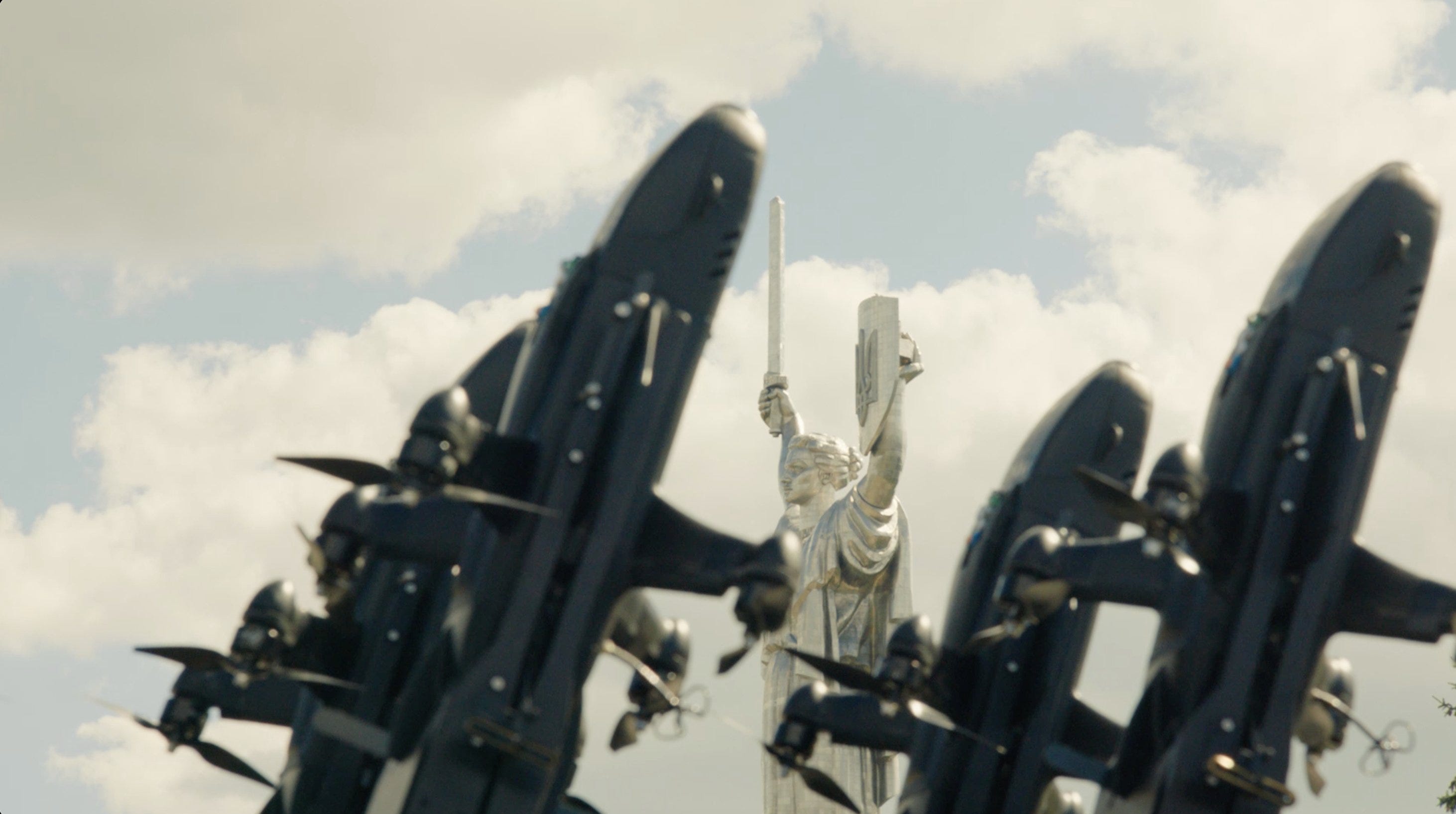
Ukraine held its first robot parade, showcasing unmanned ground vehicles moving in formation, maritime drones, FPV drone swarms, and interceptor drones. Over the past year, Ukraine has significantly strengthened its unmanned capabilities. At the same time, new threats continue to emerge. One of the most pressing challenges is Russia’s growing use of jet-powered Shahed/Geran drones. While effective countermeasures are only beginning to emerge, some Ukrainian developers are partnering with international companies to design and test potential solutions.
In this edition:
Korean Company Develops Battery Packs for Ukrainian Interceptor Drones;
The Challenge of Jet-Powered Shaheds;
What Is Russia’s Banderol Missile/Drone?
Heavy Bombers: A Pilot of “Vampire” Tells About His Daily Operations.
For more concise weekly updates on developments in drone warfare in Ukraine and Russia, consider subscribing to my Saturday edition of the Ukraine Drone Brief, available to VIP subscribers.
As you know, none of my publications are sponsored, so I rely on your support to continue this work. Thank you for reading and supporting me and Ukraine!
Korean Company Develops Battery Packs for Ukrainian Interceptor Drones
According to Ukraine’s military intelligence (HUR), North Korea is now deploying around 400 drone operators to Russia. HUR says their drones will likely be used for reconnaissance and attacks against targets inside Ukraine.
South Korea, meanwhile, remains reluctant to provide military support to Ukraine, which also limits its opportunities to learn directly from Ukraine’s combat experience. At the same time, South Korean businesses seem to recognize the importance of working with Ukraine much faster.
Two weeks ago, I wrote about the first Korean company testing its defence solution with Ukrainian military units. Several other Korean innovators have also been partnering with Ukraine.
Mobius is the South Korea-based company now developing, with Ukrainian partners, a high-performance battery solution for a new generation of interceptor drones capable of reaching speeds of more than 400 km/h — and potentially exceeding 600 km/h. I spoke with Eugene Choi, CEO of Mobius, to learn how this cooperation is progressing.
When the company first explored cooperation with Ukraine, its initial idea was relatively broad: developing batteries for use across different types of drones. During early discussions, the company was advised that competing with Ukrainian manufacturers in batteries and components for inexpensive drones would make little sense. “Ukraine is probably the best in the world when it comes to low-cost drones,” Eugene told me. “Cost-wise, they are way better than us.”
Instead, the Korean company began exploring technologies in which its own advantages could complement Ukrainian expertise. Ukrainian developers were seeking battery systems capable of supporting interceptor drones flying faster than 400 km/h.
As Russia increases the share of jet-powered Geran drones in its mass attacks against Ukraine, conventional interceptor drones are too slow to engage these faster-moving targets. Jet-powered Gerans can fly at speeds exceeding 300 km/h, while an interceptor generally needs to be at least 20% faster than its target. Recently, Ukraine’s Defence Forces have received their first domestically produced jet-powered interceptor, Alexa Spatium.
High-speed interceptor drones place very different demands on their power systems than conventional FPV drones.
The Korean company Mobius is developing its battery packs using commercially available cells. The innovation lies primarily in how those cells are integrated into the battery system. One of the greatest challenges is heat. Very high discharge rates can cause battery cells to heat rapidly, creating both performance and safety problems. The Korean design combines a specialized thermal-management material with a customized circuit architecture intended to prevent overheating during high-power operation.
Ukraine’s winters create another challenge for battery-powered drones. Batteries stored or deployed in very low temperatures may require time to reach an optimal operating temperature before providing maximum performance. For conventional systems, several minutes of preparation may be acceptable. Air-defence interceptors do not have that luxury. When a Russian Shahed or another aerial target is detected, an interceptor may need to launch almost immediately.
“For interceptor drones, it should be a very quick response,” Eugene Choi from Mobius explained. “Warm-up time is going to be critical.”
The project has now reached the final design stage. The formal testing of the latest design is expected to begin in September. The company representative also plans to travel to Ukraine for that purpose.
Mobius deliberately designed the pack around a standardized architecture so that it could potentially be integrated into several platforms. This could include other high-performance drones, unmanned maritime systems, and additional battery-powered defence applications that require high power output. Standardization is particularly important for Ukraine’s rapidly expanding drone ecosystem, which includes thousands of drone models.
The company is interested in working not only with its existing Ukrainian partners but with other interceptor-drone developers in Ukraine and NATO countries.
If interceptor production reaches hundreds of thousands of systems annually, battery manufacturing will also have to move far beyond prototype quantities. For the initial phase, the company plans to begin small-volume production in South Korea before the end of this year. Its current target for October through December is approximately 2,000 battery packs per month.
If Ukrainian demand grows as expected, that capacity would be insufficient. The company therefore plans to expand production during the first quarter of next year and is considering establishing an assembly facility in Eastern Europe. Poland is one of the leading options because of its role as a logistics hub supporting Ukraine. The location could also offer an advantage: reducing investors’ concerns about concentrating the production of strategically important defence technology in a facility that could become a target of a Russian operation.
The longer-term model could consequently involve two production locations: one in South Korea and another in Eastern Europe closer to Ukrainian customers.
The company is also raising investment to accelerate this expansion. Several Korean investors and at least one European investor have expressed interest, according to the company representative.
According to Eugene, there is another obstacle to Korea–Ukraine defence cooperation – a bureaucratic one. For South Korean citizens, travelling to Ukraine remains difficult because government authorization is required; obtaining permission can take approximately 45 days.
Eugene also added that attempts to contact the relevant embassy channels had been difficult. A dedicated fast-track mechanism for companies participating in approved Ukraine–South Korea defence and technology projects could therefore make defence cooperation between the businesses considerably easier.
Although the future of a formal Ukraine–South Korea defence partnership remains uncertain, growing business involvement in Ukraine is creating a precedent for deeper cooperation and offering some hope that the broader relationship may eventually change.
Considering the U.S. administration’s decision to scale back military exercises with South Korea, Seoul may find itself in a situation similar to that of other U.S. allies, including Canada and European countries, which have been diversifying their defence partnerships over the past year. In this context, deeper defence cooperation with Ukraine could make particular sense for South Korea.
Read other relevant reports:
Newtype Industries: The First Korean Defence Startup Testing in Ukraine;
Ukraine and South Korea: Underexplored Opportunities for Defence Cooperation;
Drone warfare in Ukraine: war in the Middle East and Ukraine’s expertise.
The Challenge of Jet-Powered Shaheds
According to Ukrainian electronic warfare expert and adviser to the President, Serhiy “Flash” Beskrestnov, Russia is increasingly using jet-powered Shahed drones and other strike systems for attacks against targets in Ukraine’s rear areas.