

Just as Ukraine was getting closer to managing waves of conventional Shaheds, the threat changed again. Russia began employing larger numbers of jet-powered systems, creating a new challenge for Ukraine’s air-defence architecture.
The existing system has not adapted easily to these faster and higher-flying threats, forcing Ukraine to adjust once again. Several countermeasures are now being explored, ranging widely in cost and effectiveness, and work on new solutions is ongoing.
In this edition:
Middle-Strike Drones Remain a Key Battlefield Capability;
Approaches to Countering Jet-Powered Drones;
Why Drone Carriers Have Faded Away in Ukraine.
For the list of weekly drone-related updates, check my Ukraine Drone Brief.
Middle-Strike Drones Remain a Key Battlefield Capability
While our attention has shifted in recent months away from medium-range strike drones, also known as “middle-strikes,” they remain an effective combat capability on some of the most intense sections of the battlefield.
The Sloviansk direction currently is one of the hottest sectors of the front. Unable to overcome Ukrainian engineering fortifications, Russian forces intensified their offensive operations and focused on creating a kill zone extending roughly 40 km from the line of contact.
The systematic use of middle-strike drones over recent months has helped Ukrainian forces expand their own kill zone along the Sloviansk-Kramatorsk direction. In practice, this means protecting the first line of defence by establishing fire control over the enemy’s operational rear.
Using this approach, the Apache Unmanned Systems Battalion of the 81st Brigade acts proactively by destroying Russian offensive potential before it reaches the frontline.
Operators can launch and fly medium-range drones from protected bunkers or concealed positions using computer terminals. The operator can remain at a distance from the launch site. Even if EW completely disrupts the satellite signal as the drone approaches the target, some middle-strike systems can switch to an automatic target-acquisition mode, allowing them to identify and engage the designated object independently.
“The more logistics we cut, the more problems they have on the frontline: shortages of ammunition, drones, fuel, lubricants, and food. Morale also matters. Now they will think several times before deciding to move anywhere,” told the servicemen from the Apache Battalion in an interview with Censor.Net.
Medium-range strike capability is one of the focus areas for the British-Ukrainian company Trypillian. Trypillian told me that the medium-range segment today serves as a critical connective layer in the overall architecture of warfare, bridging the tactical battlefield at the line of contact with the strategic depth targeted by long-range strike systems.
Middle-strike operations cover an operational zone extending from approximately 30 to 200 km and beyond, where the enemy concentrates key logistical assets, including ammunition and POL depots, command posts, supply routes, heavy equipment, and repair facilities.
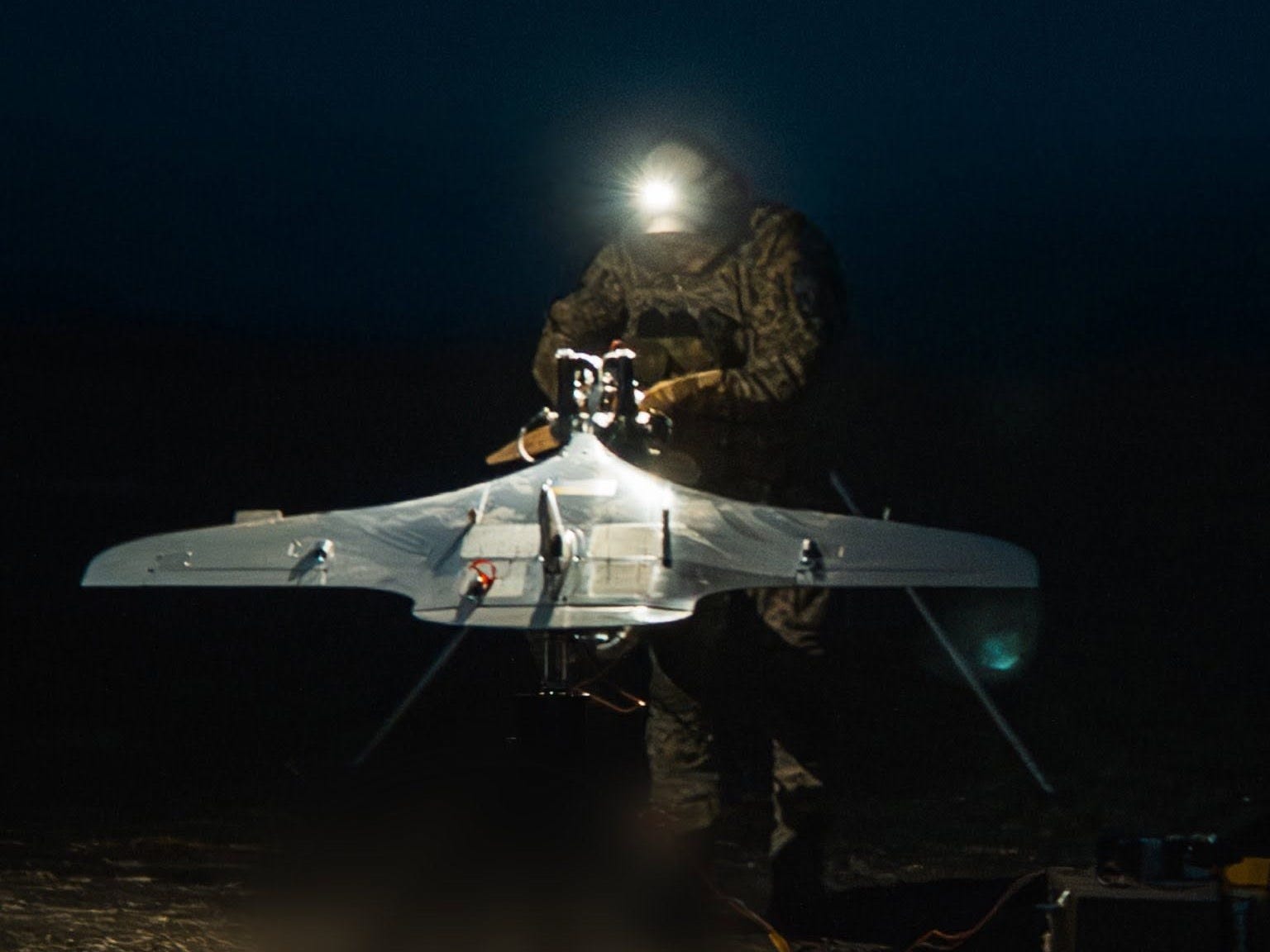
Trypillian’s flagship platform in the middle-strike segment, ATOM can perform both reconnaissance and strike missions. The drone carries a 2.5 kg warhead and has a stated range of around 70 km, while newer versions of the platform are being developed for greater operational depth.
Medium-range systems apply systematic, continuous pressure on enemy logistics, so the enemy loses the ability to plan predictable resupply, while supply routes become slower, more expensive, and less reliable.
In an interview with Radio Khartia, Trypillian's Commercial Director, Viktoriia Kulchytska, said that Ukraine’s UAV industry is developing ahead of current requirements, with pilot and military-engineer demands changing about every two to three months.
Trypillian’s first middle-strike platforms had a range of around 50 km, which at the time was beyond the reach of conventional FPV drones. That range gradually increased to around 70 km and is now expanding toward 100-200 km, and in some configurations even 300 km.
“When we received the first feedback from the military about our ATOM, which was flying 50-70 km, we understood that we needed to develop a second version. And that is not as simple as it may seem. It might look as though building an aircraft for 50 km and one for 150 km is essentially the same thing — just make the aircraft larger, and it will fly farther. That is a misconception. From an engineering perspective, the aircraft has to be redesigned in a fundamentally different way. When we change payload and range, we do not simply change the size of the aircraft; we change the aerodynamics and the way it flies. This takes months of work,” Kulchytska explained.
Speaking to me about trends in the middle-strike segment, Kulchytska highlighted three factors that she believes will define its evolution: expanded mass production, greater autonomy, and continuous improvements in electronic-warfare resilience.
According to Trypillian, market scaling is already underway. In the first months of this year, the Ukrainian government contracted approximately five times more middle-strike systems than during all of last year, which the company sees as evidence that the industry is moving toward more predictable mass production.
At the same time, one of the most important challenges for the company’s technology roadmap remains the “de-Chinafication” of its supply chain. Trypillian says it has reached an approximately 80% localization rate and argues that replacing Chinese components with Ukrainian and Western alternatives is essential to build long-term defence partnerships with allies and combine Ukraine’s development speed with Western financial and industrial scale.
In June 2026, Ukraine’s Ministry of Defence launched its first large-scale competitive tender for middle-strike UAVs. The acquisition was expected to cover “tens of thousands” of standard attack and reconnaissance-strike drones from multiple suppliers.
One of the best-known drones in this sector is the American Hornet. Recently, Janes reported that over the past three months, the Armed Forces of Ukraine deployed more than 10,000 Hornets with a 200 km operational range.
Read my report about the Hornet here.
Approaches to Countering Jet-Powered Threats
Jet-powered drones, rather than conventional drones, could become the next major threat for countries worldwide. This is one of the most widely discussed topics in Ukraine, and a significant share of the latest weekly developments focuses specifically on this threat.
Ukrainian experts identify four main approaches to countering jet-powered drones: