

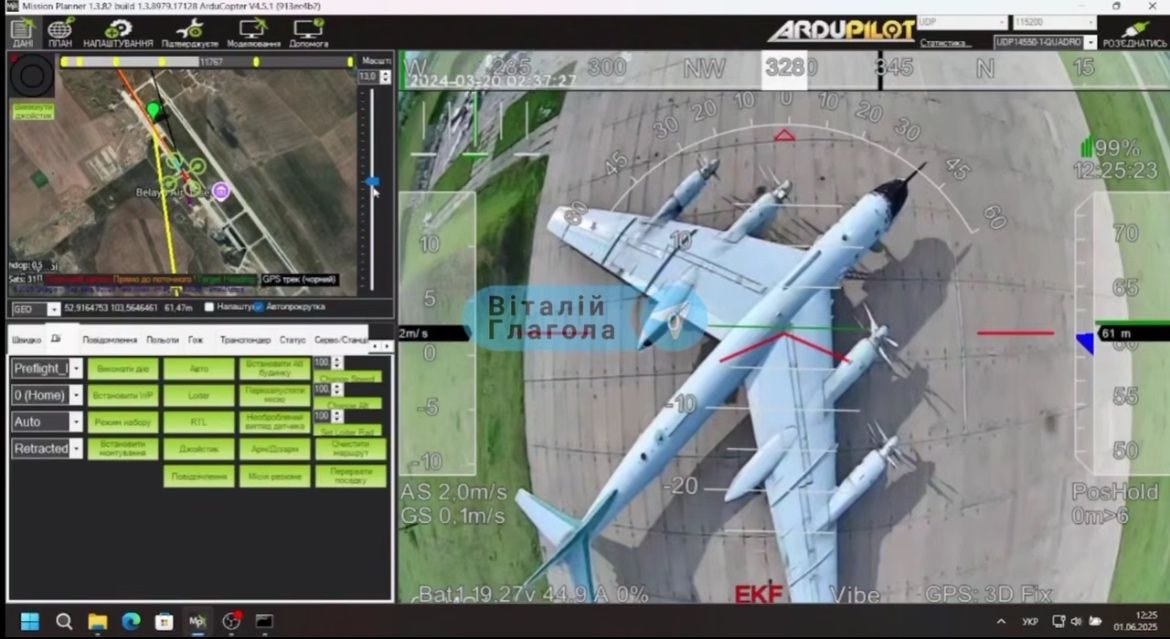
On June 1, the Security Service of Ukraine (SBU) executed a drone operation, Pavutyna (Spiderweb), targeting four Russian airbases housing strategic bombers. It took 18 months to prepare.
According to SBU reports, 41 enemy aircraft sustained varying degrees of damage (this figure has not yet been confirmed by independent sources or satellite imagery services).
SBU estimated that the drone strike disabled 34% of Russia’s cruise missile bombers, causing approximately $7 billion in damage.
“The brilliance of this operation lies not in its technical uniqueness, as similar solutions are used by both sides of the conflict, but in its organizational and logistical execution, amplified by [Russians’] utter negligence in implementing even the most basic security measures,” - Russian military analyst commented.
The technical aspects remain an interesting point of analysis. While official information about how the operation was executed and what systems were used has not been provided, I’ve compiled some key points and conclusions based on open-source reporting.
Operation Spiderweb showcased Ukraine’s innovative approach to drone warfare, combining remote human oversight with semi-autonomous capabilities and likely AI-enhanced support.
The mission utilized a mix of software tools that enabled remote operation, communication over 4G/LTE networks, and targeting functions, drawing on both open-source platforms and domestically developed Ukrainian technologies.
Though not fully autonomous, the operation likely incorporated artificial intelligence to assist with flight control and targeting accuracy, especially for precision strikes against critical components of high-value aircraft, Kateryna Bondar wrote for CSIS.
According to a Ukrainian intelligence official, who spoke on the condition of anonymity to The Washington Post, FPVs were smuggled into Russia and concealed inside trucks and beneath the roofs of houses.
The drones were delivered directly to the airfields, including the "Belaya" airbase in Irkutsk Oblast, located more than 5,000 kilometers (3,106.8 miles) from Ukraine.
Wooden containers were later brought in the same way, into which the drones were placed before the attack. When it was time to strike, the containers were loaded onto trucks and moved closer to the airfields.
The specially modified civilian trucks were disguised as mobile homes or commercial cargo. These vehicles were equipped with retractable launch platforms and onboard communication systems, allowing remote activation.
There were no ground control stations or, even more so, any sabotage operators nearby.
According to the Russian military analyst, FPV control was carried out via mobile networks (4G, LTE, and similar). The bandwidth of modern mobile networks is more than sufficient for such tasks.
The FPV drone was controlled via a software-hardware system based on ArduPilot.
ArduPilot provides advanced flight stabilization, waypoint navigation, failsafe routines, and programmable mission profiles. In this case, each drone was integrated with a compact onboard computer (such as a Raspberry Pi), connected to a webcam and an LTE modem via Ethernet. The camera feed was used for visual navigation, while control signals were routed through ArduPilot’s UART interface, allowing operators to pilot the drone remotely with stabilized, responsive input—even when faced with significant signal latency.
In addition to manual control, the drones were likely equipped with AI-assisted targeting features to enhance their strike precision.
According to open-source reports, SBU teams studied the structural design and visual profiles of specific aircraft models, such as the Tu-95MS, Tu-22M3, and A-50. To identify weak points, they are believed to have examined preserved examples in Ukrainian aviation museums, including the Poltava Museum of Long-Range and Strategic Aviation.
Last year, large-scale scanning of aircraft was conducted, after which AI was trained to recognize their features and automatically carry out pickering algorithms - targeted attacks on the vulnerable parts of aviation equipment.
As seen in footage from attacks, the drones didn’t merely crash into the aircraft; they deliberately struck areas likely to cause the greatest damage, such as missile-carrying pylons and over-wing fuel tanks.
Based on photos of the drones used in this operation, Defense Express concluded that the Spiderweb operation most likely employed "Osa" FPV drones produced by the Ukrainian company First Contact (“Pershyi Kontakt”).
The "Osa" is one of the few FPV drones featuring a distinctive, thick, and enclosed frame that houses all the electronics and internal wiring. Unlike most other designs, where power cables are exposed and antennas are typically placed at the rear, the "Osa" integrates a fixed power port directly into the frame, with one of its antennas positioned in the nose section near the camera.
In contrast, the majority of FPV drone manufacturers use an open-frame or “skeletal” design with top-mounted wiring, which simplifies construction but leaves components more exposed.
According to the manufacturer’s specifications, the "Osa" FPV drone can carry up to 3.3 kg of payload and stay airborne for up to 15 minutes. It can reach speeds of up to 42 meters per second (around 150 km/h), enabling it to perform strikes even in stormy wind conditions. This was probably one of the key factors likely influencing its selection for the operation.
As of January 2024, it was known that First Contact had already been conducting research and testing of AI-powered drones.
According to the recent report by the ISW, Russia and Ukraine have demonstrated some integration of limited AI capabilities into drones as of May 2025, but mostly they have not deployed the technologies at scale on the battlefield.
For instance, Russian forces used a swarm of six drones with different-colored wings for drone-to-drone recognition. In late May, Ukrainian forces reportedly used a new AI-powered GOGOL-M “mother drone” for the first time on the frontlines.
According to estimates, Russia’s centralized approach to drone innovation and production may inhibit its efforts to pioneer the development of AI/ML drones. It can erode some of the Russian drone developers’ independence to pursue technological breakthroughs due to limitations imposed by Russian bureaucracy.
On the other hand, a lack of investment and immediate combat needs are impacting Ukraine’s development of AI/ML drones.
Goliath is teetering. Can’t wait to see the shape of the next stone David fits in his sling.