

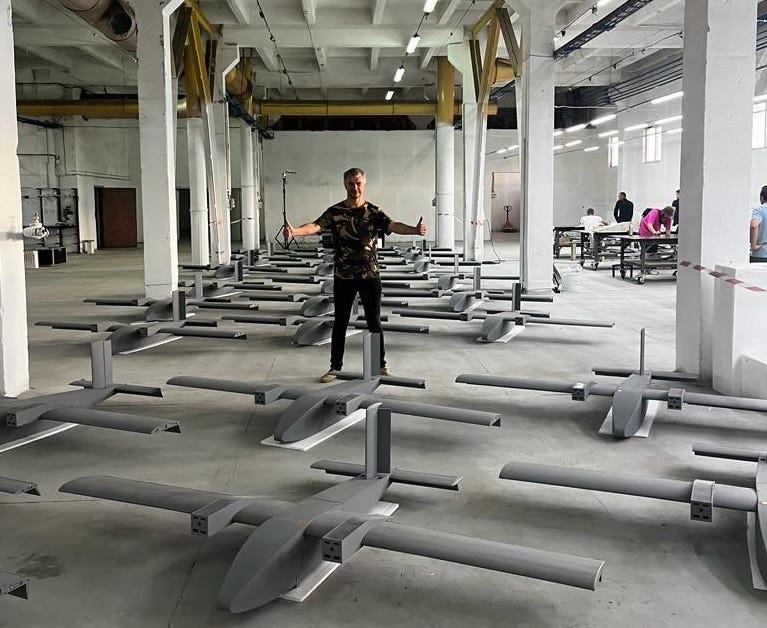
“You can’t build a defense company without being in Ukraine,” says Estonian entrepreneur and investor Ragnar Sass. With more than 800 producers, Ukraine holds a leading position in unmanned technologies—and this has not gone unnoticed. Just last week, the U.S. and Ukraine announced a $50 billion drone cooperation initiative, a large and strategic commitment.
Help Ukraine win, and it will help you confront the massive security challenges looming across different regions!
In this edition:
Ukraine and the Future of Drones: U.S. Interest in Ukrainian Systems;
Osa FPV Drones and Operation Spiderweb;
“You Can’t Build a Real Defense Company Without Living in Ukraine”: Summary of Interview with Ragnar Sass for Militarnyi.
Thank you for reading and supporting my work!
Ukraine and the Future of Drones: U.S. Interest in Ukrainian Systems
I’ve been receiving many inquiries from people in different countries interested in engaging in Ukraine’s drone production — whether by purchasing Ukrainian drones, setting up joint ventures, or learning from Ukraine’s battlefield experience in other ways.
At present, Ukraine’s defense exports remain closed due to wartime conditions: everything produced is directed to the frontline. The domestic industry has been pushing the government to reopen exports, but this has not yet happened. According to officials, Ukraine is considering a limited opening only to its most trusted allies — primarily NATO members — who can guarantee that sensitive technologies will be protected.
At the same time, many foreign defense companies are establishing a presence in Ukraine. They are opening offices, hiring Ukrainian engineers, and building direct communication channels with military units to benefit from battlefield insights. One example is the German company Quantum Systems, which has localized part of its drone production in Ukraine. Norwegian Radionor Communications also decided to open a representative office and potentially a full-service center in Ukraine, expanding its direct support for the country’s drone warfare efforts. French carmaker Renault is also preparing to begin production of drones for Ukraine.
Recently, Ukraine’s Brave1 technology cluster started the Test in Ukraine initiative. This program allows foreign companies to send their products to Ukraine, provide online training, and then receive feedback from Ukrainian forces after battlefield trials. The program has already received 45 applications that so far include drones, laser weapons, missiles, and AI-based systems. I reported on the “Test in Ukraine” here.
Meanwhile, due to security risks and export restrictions, many Ukrainian drone producers are relocating part of their operations abroad. Several have already opened factories in European countries. According to a survey by the Technological Forces of Ukraine (TFU) association — which unites multiple UAV and defense tech manufacturers — around 85% of companies have either moved part of their business abroad or are actively considering it. This creates the potential for establishing joint production facilities with Ukrainian manufacturers outside of Ukraine. “Some things we don’t produce in Ukraine at all for security reasons, and we can safely develop them in protected zones,” Ukraine’s First Contact told Ukraine’s Arms Monitor.
Even under limited cooperation opportunities, there are still multiple ways to engage with Ukraine — and those who act first will be the ones to benefit most in the future.
Last week, Ukraine reached an agreement with the United States on the $50 billion drone partnership. President Zelensky announced this during a briefing in Washington. According to him, such cooperation will provide funding for Ukrainian companies engaged in drone production. The details of this commitment remain unclear.
This proposal represents Ukraine's strategic pivot toward appealing to Trump's "America First" agenda by positioning the deal as beneficial to U.S. industry rather than traditional aid. Sam Scanlon, in his op-ed for The Hill, calls this deal “a strategic bridge between America’s current industrial limitations and the wartime production capacity… It is also a warning shot to China that the U.S. is getting serious about scaling military drone innovation at speed and cost”. Rebuilding America’s defense industrial base will take years, if not decades. Ukraine will be able to deliver operationally relevant drones at scale today, while the US rebuilds factories, trains workers, and realigns acquisition models to fit a 21st-century fight.
“There are three areas where the U.S. stands to benefit the most. First — long-range attritable drones or one-way attack (OWA) systems. Second — unmanned ground vehicles for logistics, medevac, guard duties, or even setting sectors on fire. And third, and most importantly, — naval systems, UUVs or USVs like Magura,” Sam told Ukraine’s Arms Monitor. “The U.S. government is really focused on deterrence in the Indo-Pacific, thinking about what lessons from Ukraine are transferable there. The last two areas are especially interesting because of their modularity and applicability for different mission sets. These systems, especially the unmanned ground vehicles, can carry different attachments — for logistics, for mounting drone radars, or even putting weapon systems for kinetic UAV takedowns on top of their unmanned systems. A U.S. company, Stidar, is doing this in Ukraine now, working with frontline units, and one of the effective and promising Ukrainian companies, Tencore, already has a full modular loadout on their UGV for many different use cases. That kind of modularity really makes sense for the future of warfare instead of having vendor or system lock, but creating systems adaptable to many different scenarios”, he added. I wrote a large article about Tencore and their TerMIT drone - you can read it here.
According to Sam, while Ukrainian drones could make a lot of sense for the ‘Unleashing American Drone Dominance’ program, they probably won’t be at the forefront of the U.S. government’s priorities. Many U.S. companies, backed by venture capital or private equity, will likely have the leading edge because of the ‘America First’ policy and relationship with different organizations with acquisition authority. These types of companies are already producing FPVs and will probably get the first opportunities. For Ukrainian companies, breaking into the U.S. DOD will be harder due to a lack of familiarity with the complex acquisition process and contract pathways, as well as a perceived risk from U.S. contracting authorities. At the same time, probably no U.S. company can currently manufacture at the scale of Ukraine’s TAF Drones, which produces 300,000 FPV drones per year, outside of maybe 1-2 companies that could get into the low 100 thousand manufacturing capability next year.
“There are two areas in which I know we can cooperate — and where we are already in negotiations ourselves — electronic warfare (EW) and drones,” Valeriy Borovyk, the founder of Ukraine’s drone company First Contact, told Ukraine’s Arms Monitor. “As for the $50 billion project — some say it will be a joint production, others say it will be U.S. procurement of drones in Ukraine. All of this depends on U.S. decisions. This development will be historic, and it would be interesting to take part in this story. But it is important from our side not to approach it with bias, but with openness, and to clearly present what we can offer,” Valeriy added.
This is not the first time we have seen an announcement of the upcoming US-Ukraine partnership on drones. In July, Ukraine signed agreements with several U.S. companies on the joint production of drones, including interceptor drones. Among the partners is the American company Swift Beat.
I strongly believe that if a defense company wants to stay afloat in the coming decades, it must find a way to partner with Ukraine in one form or another.
On that note, Ukraine’s Defense Tech Valley, a dual-use tech investment summit, will be held on September 16–17 in Lviv, Ukraine, bringing together over 5,000 tech users, developers, and decision-makers from more than 40 countries. Don’t miss it!
Osa FPV Drones and Operation Spiderweb
Last week, Ukraine’s Security Service Chief Vasyl Maliuk disclosed new details about Operation Spiderweb (read my report here), conducted on June 1, which destroyed or damaged more than 20 Russian bombers. I’ve summarized the newly available information and included exclusive insights from the founder of First Contact — the manufacturer of the Osa FPV drones designed specifically for this operation.