

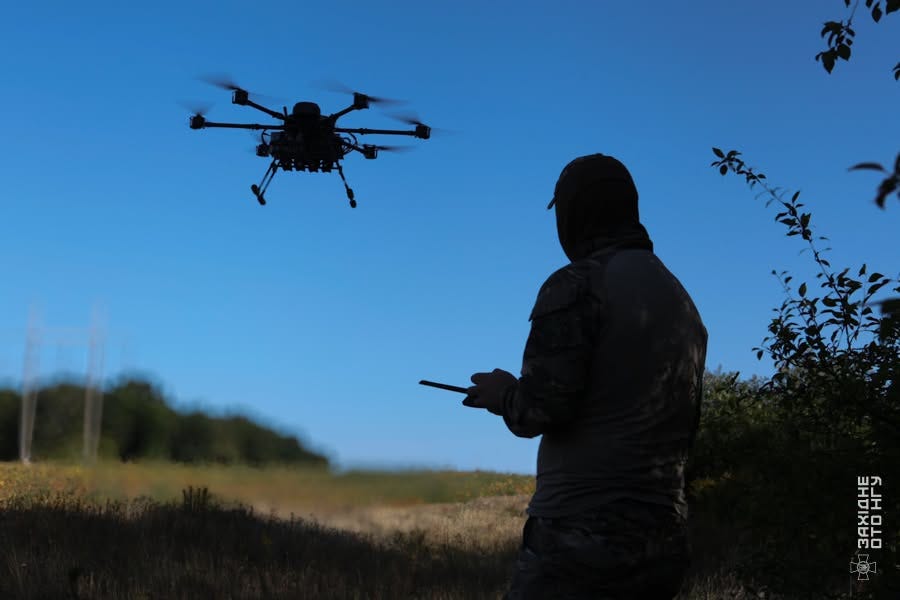
We often discuss how civilian technologies are adapted for combat use, but last week we saw the reverse. The delivery of four tons of provisions to the occupied Ukrainian city of Oleshky demonstrated how drones used for strikes can also be repurposed for humanitarian missions—delivering aid while operating under active countermeasures by enemy forces seeking to prevent such operations.
The challenges Ukraine’s Defence Forces had to overcome, including direct Russian fire and electronic warfare countermeasures, show that under conditions of active interference, missions like this would be nearly impossible for humanitarian organizations to conduct on their own.
Oleshky is a Ukrainian city just nine kilometres from Kherson. Russian forces occupied it in the first days of the full-scale invasion. According to the Kherson Regional Military Administration, after all these years, about 2,000 people remain in the city, including nearly 50 children. They live without electricity or gas supplies, with little or no access to medical care and medicines, and face acute shortages of food and drinking water. The city is under near-total military and information isolation, with movement severely restricted and reliable information about conditions inside Oleshky extremely difficult to obtain.
All roads and approaches to the city are mined. Oleshky lies only a few kilometres from Ukrainian-controlled territory within the range of drones operated by both sides. As a result, the skies over the city have become a constant battlespace, with drones hunting other drones and targeting virtually anything moving on the ground.
Commercial drivers who attempted to bring food into the city by road during the summer came under heavy fire and were forced to turn back.
Ukraine has appealed to both the International Committee of the Red Cross (ICRC) and international partners to help organize civilian evacuations. However, these efforts have produced no result: Russia has not agreed to establish a humanitarian corridor.
Earlier, Kremlin spokesperson Dmitry Peskov claimed that Ukraine was allegedly obstructing the delivery of humanitarian aid to Oleshky.
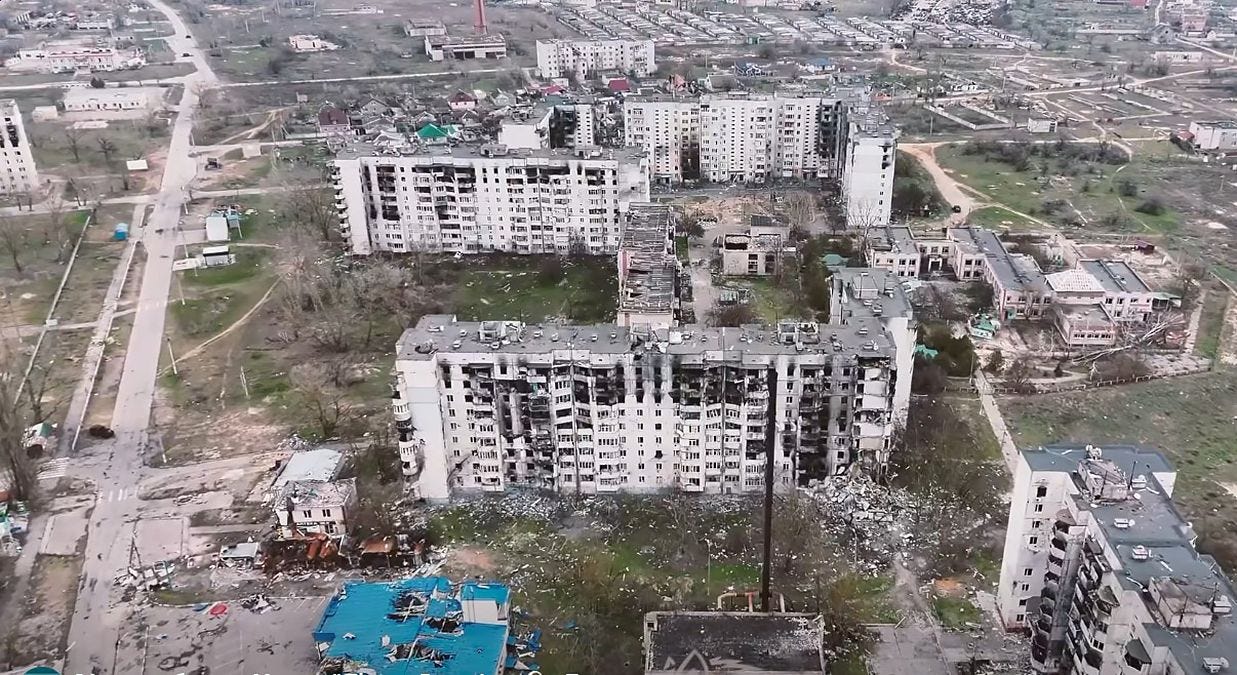
Last week, several units of Ukraine’s Defence Forces carried out a unique operation that successfully delivered around 4 tons of food, drinking water, medicines, hygiene products, and other essential supplies to 100 designated locations in Russian-occupied Oleshky across the Dnipro River. According to the Ukrainian OSINT channel DroneBomber, each package weighed 38 kg. Several Vampire drones were reportedly used in the operation along with other UAV types.
The operation involved several Defence Forces units, including the Bolharychi unit of the 11th Brigade of the National Guard of Ukraine and the 34th National Guard Regiment.
Ruslan Muzychuk, press secretary of the National Guard of Ukraine (NGU), wrote on his LinkedIn that this case illustrates an important evolution in how we think about unmanned systems: “The same technology used to protect troops and positions on the frontline can also help reach civilians in areas where traditional humanitarian access is impossible. And this is not a risk-free mission. Russian forces have attempted to disrupt the deliveries by shooting down drones carrying supplies”.
The National Guard of Ukraine’s Commander, Maj. Gen. Oleksandr Pivnenko told Ukraine’s Arms Monitor that ground transport cannot reach the city because it is located on the other side of the Dnipro River, and access to it is controlled by the occupying forces. A drone, however, can cross the river, reach a designated point, and drop a payload without putting a driver, volunteer, or service member at risk on a mined road under constant fire.
The drone deliveries cannot replace a full-fledged humanitarian corridor, which Russia has refused to open. But until that happens, unmanned systems remain the only practical means of delivering assistance.
Drones have long been used in rescue operations and to deliver supplies to remote or hard-to-reach areas. What makes this case particularly unusual is that these humanitarian drones are operating in an active battlespace. The National Guard told me that “Russian forces actively attempt to shoot down all of our drones, using electronic intelligence and electronic warfare systems, as well as interceptor drones. But what matters most is that the mission achieved its objective: approximately four tonnes of food supplies were delivered to the city”.
Most of the platforms used in this operation were multirotor drones; however, the NGU did not disclose specific models, payload capacities, or flight profiles, as the Russian side closely monitors how Ukraine conducts such operations and uses every detail to improve its ability to shoot down the drones.
Organizing such a mission required accounting for several challenges. The enemy can destroy drones in flight, hit the packages being dropped, or target the people who come to collect them. That is why the operation required extensive preparation, taking into account everything that could be anticipated — from routes to the choice of timing and drop-off points. Distributing the cargo across multiple locations reduces the risk that a single strike could destroy the entire delivery or disrupt the operation.
According to an interview with a drone operator from the 34th Separate Marine Brigade “Borysfen,” recorded in spring 2026, delivery routes have to be planned very carefully because Russian forces actively hunt the drones and may also target civilians receiving the supplies. “Every flight carried out for a delivery mission can become a one-way mission,” he said. Even when a drone returns to its launch point, the mission can remain dangerous because Russian forces may track its flight path and use that information to identify the launch area.
Some of the drones were reportedly lost in this operation. “As for drone losses, it would be unrealistic to claim that a mission like this can be carried out without them,” the National Guard told me.
The second challenge was coordination. This joint effort involved numerous units of Ukraine’s Defense Forces, so all participants had to synchronize their actions within a very limited timeframe.
The National Guard of Ukraine is highly experienced in these types of tasks. It has carried out logistical missions along the frontline for a long time, and each mission provides data on the enemy’s response. Modern electronic warfare and the rapid pace of change on the battlefield mean that methods that work today have to be updated every few months.
Russia uses occupied Ukrainian territories to deploy its forces and to establish drone launch sites closer to Ukrainian areas. In May, the Ukrainian Air Force identified a site in Oleshky used by Russian drone operators who had regularly targeted the Ukrainian-controlled right bank of the Dnipro River, including attacks on civilians described by Ukrainian authorities as a “human safari.” Russian forces had established the position in a former sanitary and epidemiological station and set up a battalion-level command post there.
There are fresh reports on social media that Russian personnel have been searching the homes of Oleshky residents for packages delivered by drones and confiscating them. “They immediately start asking questions if the food is not Russian-made: ‘Where did you get it?’ And they say, ‘If the Ukrainian Armed Forces are dropping food supplies to you, then you are cooperating with them,’ Tetiana Hasanenko, head of the Oleshky City Military Administration, told Ukrinform. Following this mission, Russian governmental and non-governmental sources intensified their campaign blaming Ukraine for the blockade of the city.
While this successfully coordinated and executed mission deserves recognition, it is unfortunately not enough to resolve the humanitarian crisis in Oleshky. Stronger international pressure is needed to compel Russia to open a humanitarian corridor.
In response to the humanitarian catastrophe in Oleshky, Ukraine initiated an urgent discussion of the situation at the OSCE.
Read other relevant reports:
Big respect to the pilots and crews. A good job, well done 👍
Excellent and important example of how unmanned systems are reshaping far more than combat operations.
The Oleshky mission shows that the real value of drones is not simply the platform, but the ability to sustain a mission under fire, electronic warfare and denied ground access. In that sense, resilient unmanned networks are becoming not only instruments of military power, but also critical tools for humanitarian access in contested environments.