

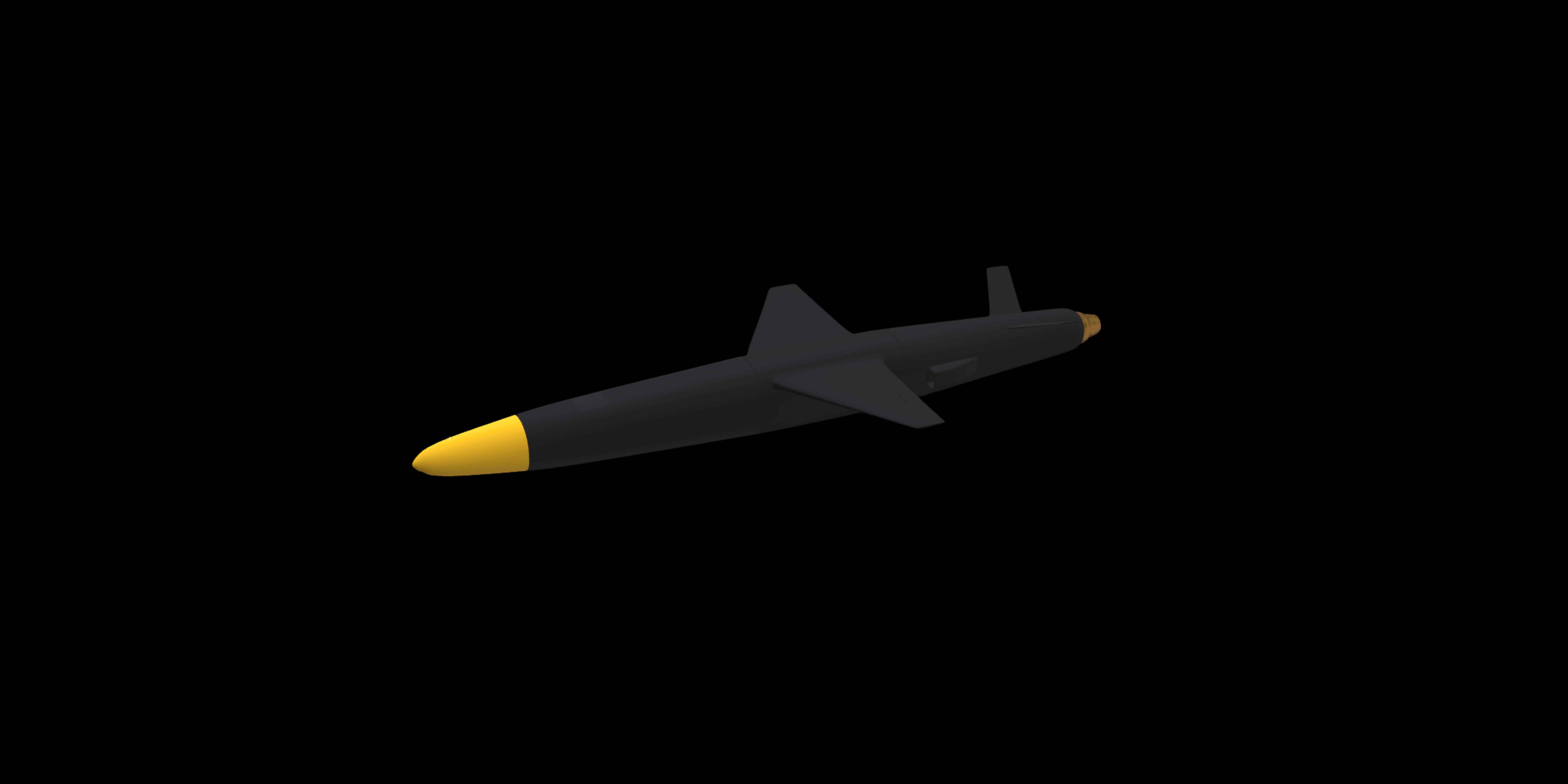
Russia’s new modification of the Geran relies on Susanin, an optical navigation system similar to DSMAC. It lets this small cruise missile stay on course and remain accurate even when satellite signals are jammed, including in the final stage of its approach. Ukraine already has some countermeasures, but mass production of this system would mark a worrying trend for Ukrainian air defence.
The Geran-5 K5-K
Russia’s new jet-powered kamikaze drone, the Geran-5, has gone through another round of modernization, producing a new variant: the Geran-5 K5-K. Its aerodynamic configuration and its technical and tactical characteristics mean it can be classified as a small cruise missile.
Ukraine’s Defence Intelligence (HUR) examined this long-range weapon and released its technical specifications:
Dimensions: 4 m long (compared with 6.5 m for the original Geran-5), with a 3 m wingspan (down from 3.2 m).
Speed: Cruising speed exceeds 450 km/h. Maximum speed during certain maneuvers can reportedly reach 1,000 km/h.
Altitude: Maximum operational ceiling increased from 5 km to 6 km.
Range and payload: Unchanged at 1,000 km and 90 kg, respectively. The examined model carried a TBBCh-90 thermobaric warhead.
Propulsion: TRD-200 turbojet engine, assembled in Alabuga using Chinese components.
Navigation: Susanin electro-optical terrain-matching system. The examined variant uses a dual-band camera and a Chinese-made Coke Pi microcomputer, an alternative to the Raspberry Pi.
Avionics: Similar to those of the Geran-4 Seeker, including the SADRA Seeker inertial navigation system, an anti-jamming CRPA antenna, a tracker and a mesh modem.
Foreign components: Of 93 identified foreign-made electronic components, 52 came from US manufacturers, 10 from Chinese manufacturers and 10 from Swiss manufacturers.
Susanin optical navigation system for autonomous guidance
According to the Russian Telegram channel Russkoe Oruzhie (“Russian Weapons”), the Geran-5 K5-K shows significant progress in autonomous guidance. Its Susanin optical navigation system is similar in principle to the Otblesk-U system used on the Kh-101 cruise missile. It guides the drone by comparing camera images of the ground with reference images of the terrain stored on board. This lets the drone stay on its route and complete its mission even when communication is lost and satellite signals are unavailable.
Susanin is a compact, cylindrical unit fitted with a camera lens. It holds a database of preloaded terrain imagery and mapping data. During flight, a downward-facing camera captures images of the ground and compares them with the stored references. This lets the drone determine its own position and navigate toward its target, even where satellite navigation is unavailable or jammed.
At the final guidance stage, just before it reaches the target, the drone corrects its trajectory to compensate for errors built up by its inertial navigation system. Russian sources claim this gives accuracy within a few metres. Unlike satellite navigation, such systems cannot be jammed by electronic warfare, which makes them well suited to striking heavily protected targets. They can, however, be degraded by other means, such as poor visibility, camouflage or changes to the landscape.
The Russian Telegram channel Boevye Tekhnologii (“Combat Technologies”) wrote that Susanin is not a standalone system but part of a layered navigation suite.
The inertial navigation system (INS) takes over when optical navigation becomes ineffective, such as in fog, at night, or over bodies of water. Satellite navigation provides global positioning data, helping narrow the search area for optical terrain matching. If the optical system cannot establish a reliable match at a designated checkpoint, the drone continues along its route using INS until it reaches the next checkpoint. This combination is particularly important for Geran-series drones, given their long operational ranges, over which INS positioning errors can accumulate significantly.
These drones also operate in environments with intense electronic warfare (EW) interference and are designed to strike specific targets, such as bridges, warehouses, and communications facilities.
Susanin is prepared for specific terrain before each flight. Over cities, it relies on high-resolution reference images to pick up straight lines and sharp contrasts. Over plains, it focuses on linear features and water: roads, power lines and riverbeds. In hilly terrain, shadows and relief make landmarks harder to read, so Susanin serves mainly as a backup, with the main burden on inertial and other navigation. Over water, steppe and desert, there are few details and a lot of glare. These areas are considered “dead zones” for optical navigation, so corrections are either not planned there at all or placed only at their edges, where the first distinct landmarks appear.
While some call Susanin Russia’s TERCOM, in principle, it is closer to DSMAC, used on Tomahawk missiles, though simplified to save weight and power. Compared with TERCOM, which navigates by terrain elevation, it works better over flat terrain and cities, but TERCOM is more resistant to weather and darkness.
Some limitations of Susanin:
Fog, heavy rain, haze and darkness sharply reduce its effectiveness; it is designed mainly for daytime use.
Visible changes to the landscape, such as new construction, flooding or cleared forests, can make reference images outdated.
Over large uniform areas such as water, snowfields, steppe or desert, optical navigation is nearly useless, and the drone relies on INS.
Implications for Ukrainian air defence
According to the Ukrainian defence outlet Defense Express, the Geran-5 K5-K can reportedly reach up to 1,000 km/h in a terminal dive toward its target. In the cruise phase, however, its speed is expected to stay around 450 km/h. At that speed, it could potentially be intercepted by systems originally developed to counter jet-powered Shahed drones.
Ivan Kyrychevsky of Defense Express also stresses the need to limit Russia’s ability to launch these weapons, rather than relying solely on interception. Publicly available information is still limited, though. It remains unclear whether the K5-K can be air-launched, which Russian military units operate it, and whether ground launches rely only on large stationary catapults or also use mobile launchers.
According to Oleh Katkov, editor-in-chief of AIN.UA, the Geran-5 K5-K is no longer merely a missile-drone hybrid but a fully fledged, relatively inexpensive cruise missile. However, its 90 kg warhead is roughly four to five times lighter than those of conventional cruise missiles such as the Kh-101 or Kalibr. But while those missiles can cost millions of dollars, the K5-K is estimated to cost hundreds of thousands. As a result, Ukraine is forced to use expensive conventional air defence against a relatively cheap weapon.
Open-source estimates have previously placed the cost of even the baseline Geran-5 at roughly $200,000 per unit. The new version is expected not to be significantly more expensive.
Katkov also said that Russia buys turbojet engines for its drones from China in large quantities, mainly through private commercial transactions. According to him, these engines are commercially available for around $20,000 each.
Ukraine, by contrast, relies on European- and US-made turbojet engines, which are more expensive and available in smaller quantities. This limits its production of efficient interceptor drones.
Serhii “Flash” Beskrestnov, adviser to President Zelenskyy, said Ukraine may have to introduce blackout measures, particularly for road lighting and certain stretches of highway. He also noted that Russian drones can navigate by images of the Earth’s surface and fly at very low altitudes. “If this drone flies 20, 30 or 40 metres above the ground, it will be very difficult for our radars to see and track it,” he said.
According to Ukrainian assessments, Russian strike drones will keep developing toward higher speeds and autonomous guidance. This includes machine-vision algorithms that let a drone recognize objects in images from its onboard camera. In the future, such drones could detect vehicles, trains, and other targets on their own, without constant operator control.
Ukraine considers it possible that Russia could launch up to a thousand drones at once. In that scenario, the autonomously guided drones or cheap missiles could search for targets on their own within a designated area, creating new challenges for Ukrainian air defence.
How Geran use evolved in 2026
Some of the key changes we saw in 2026 in the design and tactics of Geran drones:
The increasing use of high-speed, jet-powered Geran drones, which are harder for Ukrainian interceptor drones to counter.
The emergence of the Geran-5, which has a conventional aircraft configuration and a cylindrical fuselage that make it resemble a small cruise missile.
The growing use of jet-powered Gerans in Ukraine’s rear regions, including areas near the Polish border. Meanwhile, gasoline-powered Gerans are focused on frontline areas or used in foggy, low-visibility conditions.
A shift in tactics from mainly nighttime attacks to 24/7 attacks aimed at paralyzing civilian life.
Increasing attacks on railway infrastructure, particularly moving trains.
Increasing use of the “Geran Seeker,” a Shahed/Geran variant designed to search for and strike high-value targets.
Don’t forget to subscribe to receive my weekly newsletters:
Read my earlier posts on this topic: