


If the radio fails, the person may never come back — which is why military communications is among the top three areas receiving the largest investment in Ukraine. HIMERA is the country’s only mass producer of tactical radios, which are extremely hard to intercept. HIMERA’s handheld radios are used in Ukraine and are now available in the United States and Canada.
The start-up ranks among the top ten by investment attracted in Ukraine and recently received a Google grant to scale its business. I spoke with HIMERA co-founder Misha Rudominsky and Michael Redding from Canadian Quantropi Inc., about what Ukraine can teach the world about military communications.
Remember: my publications are not sponsored. This digest is supported only by private individuals — readers and subscribers like you.
Thank you for reading and supporting my work!
HIMERA positions itself as Ukraine’s only mass-producer of tactical radios, offering an innovative adaptive communication system for both civilian and specialized users in complex environments. The idea for HIMERA was born in 2022, amid Russia’s advance on Kyiv, when its founders saw firsthand that existing communication systems were failing on the battlefield.
There were several radios used on the frontline in Ukraine, including Motorola and Harris. Civilian walkie-talkies, such as the widely used Motorola models, were never designed for battlefield conditions. Professional military radios like L3Harris remained rare and expensive, reaching Ukraine mostly as partner aid.
With backgrounds in hardware startups and consumer electronics, Rudominsky and his team decided to build communication devices that would be affordable, scalable, and resilient. Their main priority was clear: the radios had to withstand EW.
The HIMERA ecosystem currently includes four core products designed to create a resilient, secure communications network:
G1 PRO – a portable radio offering over 48 hours of autonomous operation;
B1 – an autonomous repeater ready for immediate deployment. In May 2025, in partnership with Aerobavovna, a Ukrainian military balloon producer, the B1 repeater was tested at altitudes of 500–800 meters, dramatically expanding its coverage;
E1 – an internet extender optimized for high throughput in challenging terrain;
R1 – a repeater with internet-relaying capabilities, enabling a fully wireless network configuration.
Each product incorporates advanced protection features to minimize the risk of detection, interception, and jamming. This includes AES-256 encryption, mesh/MANET network architecture, and pseudo-random frequency hopping, ensuring secure and uninterrupted communication across the battlefield.
The company’s communication systems are used by over 7,000 personnel within Ukraine’s Defence Forces.
HIMERA’s strategy rests on four pillars: relevant functionality, scalability, affordability, and user experience.
Relevant functionality: “We are working in some of the harshest environments: we are hard to detect, hard ot jam, hard ot intercept,” commented the co-founder of HIMERA, Misha Rudominsky, to Militarnyi.
Scalability: HIMERA uses only commercial components, so it can manufacture faster, build supply chains quickly, and deliver larger numbers to meet urgent battlefield needs.
Affordability: HIMERA’s goal is to make advanced communications affordable. Many competitor systems are priced for special forces or marines with big budgets, while regular ground troops can’t afford them. We’re bringing this level of functionality to those who need it most.
User experience: “In military communications, many products are overly complex — it can take months to learn how to use them. We focus on simplicity and speed; if a user already knows the basics of radio communication, they can learn everything about our product in a single day.”
Flagship Product: G1 PRO
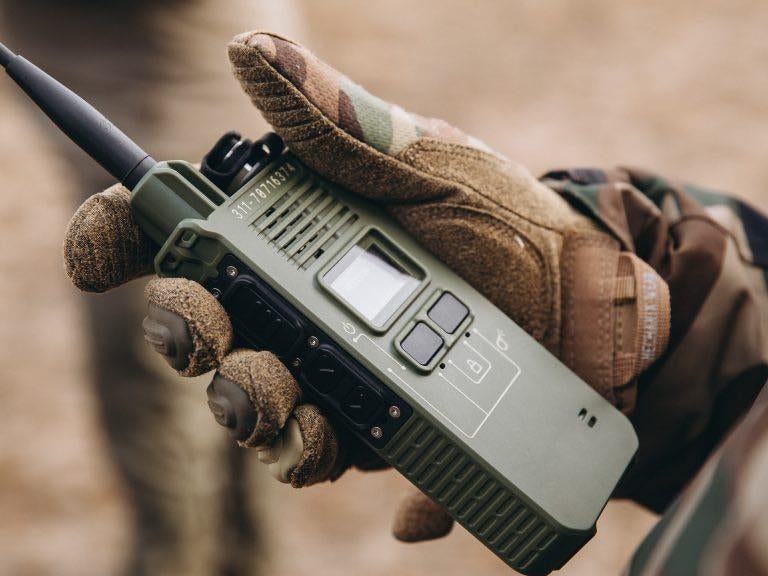
HIMERA’s flagship product is G1 PRO — a handheld radio that lets soldiers talk to each other and has an operating temperature range from minus 20c to 50c and a range of 3 km.
Back in 2023, the well-known Ukrainian radio and drone expert Serhiy “FLASH” Beskrestnov, whom I regularly quote in my digest, commented on HIMERA radios: “The device is a niche, low-power radio built for reconnaissance teams, SOF units, UAV crews, and intra-platoon communications — but it has all the attributes of a true military radio. Priority goes to units on the front lines where active combat is taking place. The reason this radio deserves attention is simple: very few Ukrainian teams have managed to design, build, and scale a military electronic device into small-series production. These successes should not go unnoticed”.
We can only imagine how much the product has improved since 2023. As of July 2025, Himera’s products have had more than 80 updates.
Already in April 2025, FLASH reported: “I had a chance to test Himera’s new radios for range. In the open field, everything works smoothly at nearly 3 kilometers. Inside a vehicle, about 1.5 kilometers. But the MESH system helps a lot”.
Misha Rudominsky told Ukraine’s Arms Monitor that the Ukrainian defense sector still relies on a mix of imported systems alongside locally developed solutions like HIMERA. These domestic innovations are becoming increasingly widespread due to their adaptability to current battlefield realities.
The main advantages of G1 PRO include:
Battery life: Best-in-class — ~48 hours continuous use (typical competitors: 8–12 hours).
Weight & durability: Ultra-light (~300 g) vs typical 1–1.5 kg radios; water- and gas-resistant; survived extreme mechanical and blast tests (including drops and severe shock).
RF protection: Frequency-hopping waveform that spreads across ranges — difficult to detect, jam, or intercept; fully encrypted.
Post-quantum security: Integrated post-quantum encryption in partnership with a Canadian partner, Quantropi.
Networking & data: Mesh networking and efficient voice/data transmission for situational-awareness systems.
Functions as a small field computer enabling fast, reliable voice and data exchange on the battlefield.
Designed for rapid production and supply-chain scale-up using commercial components.
In 2025, the G1 PRO was integrated with Ukraine’s Kropyva situational awareness system, using a built-in Teneta TNT modem developed by Teneta Labs.
HIMERA is ready to produce 100,000 radios per year. For now, production runs at roughly 1,000 devices per month — but both in Ukraine and abroad, demand continues to grow.
International Partnerships
As mentioned, HIMERA’s products have already reached international markets in the US and Canada.
In spring 2024, Himera signed an exclusive agreement with the American company Reticulate Micro, which specializes in secure communications. The companies signed an exclusive distribution agreement, according to which Reticulate will supply HIMERA’s battle-tested tactical communications systems in the United States and to key government customers worldwide.
As Joshua Cryer, President and CEO of Reticulate Micro, noted, HIMERA radios “fill the gap between cheap, low-quality comms and radios with premium features — and premium prices.”
“We do not seek to compete with large MESH tactical radio programmes; in fact, we see HIMERA technology as a complement to many of the radios currently fielded by US and coalition forces,” he added.
In December 2024, HIMERA announced the delivery of its communication systems to the U.S. Air Force. The company revealed that in the fall of 2024, it successfully sold its tactical radios outside Ukraine for the first time, specifically to the Air Force Research Laboratory (AFRL).
Since February 2025, the team has had an official partner in Canada — Quantropi Inc. Quantropi is a firm that specializes in quantum-secure data encryption technologies.
According to Misha Rudominsky, this partnership enables HIMERA to integrate advanced post-quantum encryption into its products. Quantropi became the exclusive distributor of HIMERA products in the United States and Canada, and also gained the right to promote these technologies across NATO and allied countries.
James Nguyen, Co-Founder and CEO of Quantropi, explained that this partnership with HIMERA allows Quantropi to combine its cutting-edge cryptographic technologies with one of the most battle-proven tactical radios on the market.
Michael Redding, CTO at Quantropi, told Ukraine’s Arms Monitor that while many theoretical solutions to military challenges exist, Ukrainians hold an advantage because they have already tested theirs on the battlefield. “I know of a start-up somewhere in the West that says they’ll have a tactical radio ready in two years. But I’m holding a HIMERA radio right now. It’s minimalist — no unnecessary parts, no features no one needs — and incredibly user-friendly. For instance, you can tell it was designed for people who wear gloves, because the conditions it’s made for are cold, wet, and demanding. Our police officers, security personnel, and border guards can already use these radios. Everything about it feels thoughtful and well-iterated, shaped by real feedback from those who rely on it.”
Michael said these radios are already available in Canada through Quantropi and could be useful for ambulance, police, and fire services.
Trends in Military Communications
Since 2022, military communications in Ukraine have undergone a significant transformation — both in terms of the number of users and the ways communication systems are applied in the field.
“We see much higher expectations for functionality today: users need not only reliability but also flexibility, integration with digital tools, and simplified configuration,” says Misha.
At the same time, operating conditions have become more complex - communication often needs to be maintained across challenging terrains, with command posts located farther from the front line and under constant threat from electronic warfare (EW). The impact of EW systems has increased dramatically, pushing Ukrainian developers to design solutions that are more adaptive, autonomous, and resistant to interference.
Trends in military communication that are already visible now include the following:
Spectrum congestion. The radio environment is increasingly crowded with dual-use and military emitters, making spectrum management and robust anti-interference techniques essential.
Shift to secure communications. Operational security is paramount. Systems must minimize detectability and resist interception and jamming.
From voice to data-centric systems. Communications must carry not only voice but also situational data, telemetry, maps, and command&control messages — effectively becoming the backbone of battlefield coordination.
In short: the future is uncertain, but the direction is clear —communications will become more secure, data-centric, distributed, and resilient. Building practical, field-proven solutions now is the best way to prepare for whatever comes next.
Misha said that Ukraine’s allies, especially European countries, should start preparing their tactical communication systems right now.
It’s important to choose solutions already adapted to the conditions of modern warfare — resistant to EW and capable of dynamic frequency changes.
Communication systems should not exist in isolation but be integrated into situational awareness and battle management tools from the outset. They should be scalable and affordable enough to equip the entire army, not just individual units.
And finally, soldiers at every level should be trained in coordination and communication — everyone must understand how to stay connected and work as one system.
With Michael Redding from Quantropi, we talked about Ukraine’s sense of urgency — and the difficulty of replicating it in other countries during peacetime. We agreed that no one can be certain that peaceful nations, their societies, or their armed forces won’t face security threats in the coming years. One clear lesson from the current conflict is that adversaries are practising and iterating far faster than expected. Critics once blamed Russia’s rigid, hierarchical command for slow decision-making, but that has changed.
“Russia has been taking notes. Are we taking notes? How quickly can we retrofit an EW package onto our drones? Do we even have enough drones — tens, hundreds — to meet a sustained threat? If an adversary fields a cloud of drones over Canadian territory, what capabilities do we have to detect, disrupt, and defeat it?” Michael added.
I’ll leave it there, hoping that those questions will spark reflection and motivate responsible decisions as soon as possible.
Read my previous reports:
Canada’s Drone Blind Spot, and What It Can Learn from Ukraine, and the expanded version of this article in the Canadian Defence Review;
Daily Dynamics of Drone Warfare: Summary of an Interview with Serhiy FLASH.
Do you know what frequency band the radios support? Can they be tuned to different bands?