

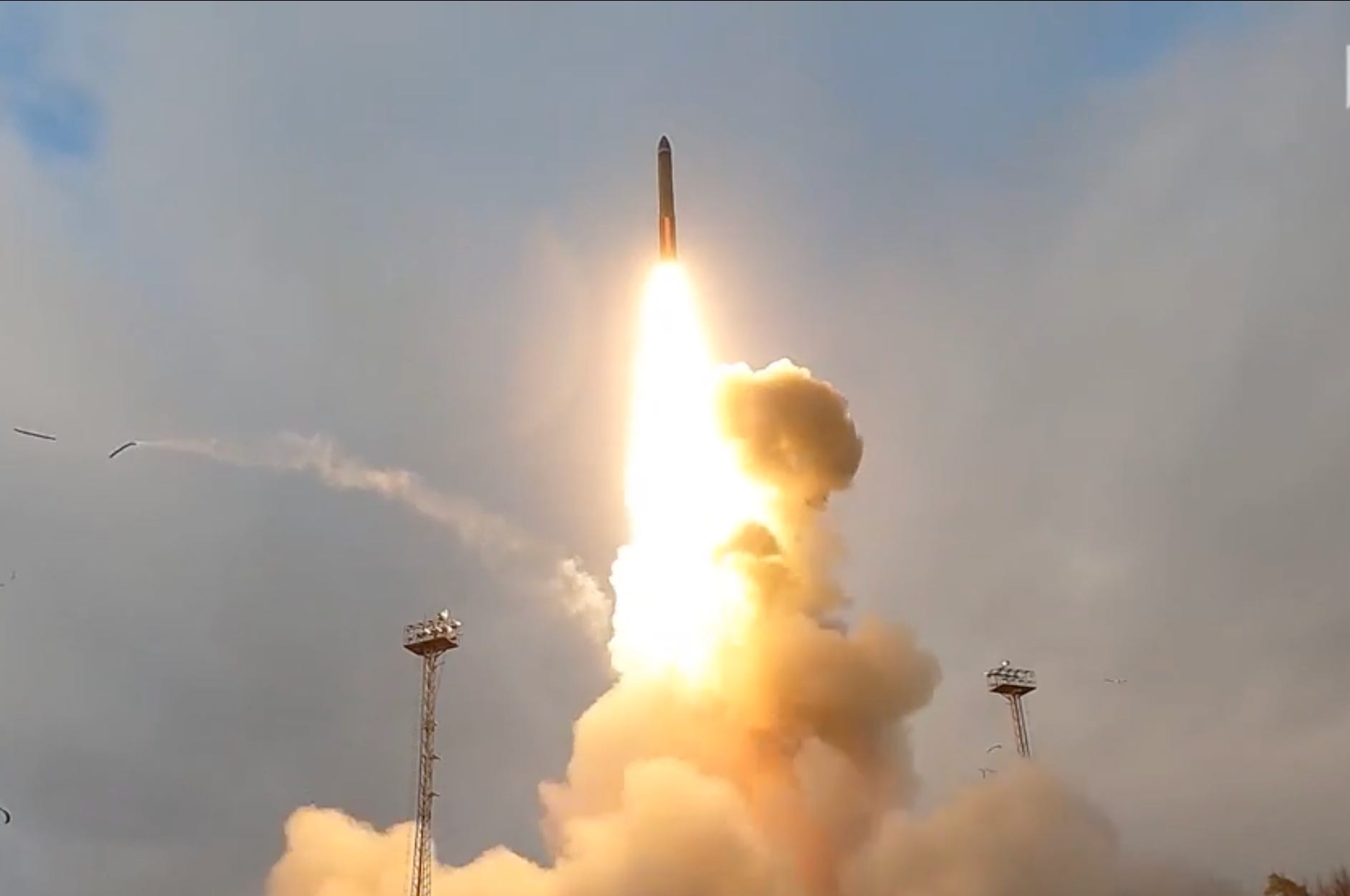
While Russia builds a triple ring of air defenses around Moscow, Ukraine continues striking targets across the rest of Russian territory. Reportedly, around 60 regions of Russia are already experiencing a gasoline crisis.
Despite sliding into an economic abyss and facing a shortage of skilled workers, Russia follows the logic of “war excuses everything” as it tries to stretch its military production capacity.
In this edition:
Russia Tests the Burevestnik Nuclear-Powered Missile;
How is Russia’s Arms Industry Organised and Operated?
The Impact of Russia’s People’s Military-Industrial Complex on the War;
How Ukraine’s Deep Strike Campaign Affects Russia;
and 10+ other developments from October.
My digest on Russia is always free — please read and share!
Military Cooperation and Alliances
According to a NATO official, about 80% of the critical electronic components used in Russian drones and other modern weapons are manufactured in China.
The WP analysis indicates that Chinese commercial drone producers have played a key role in enabling Russian drone makers to expand production capacity.
Customs statistics show that China exported record amounts of fiber-optic cable to Russia in May (119,000 miles) and June (130,000 miles), followed by a dramatic increase to 328,000 miles in August. By contrast, Ukraine received only 72 miles of cable in August, the most recent month for which data are available.
Similarly, China’s exports of lithium-ion batteries to Russia peaked at $54 million in June, declining slightly to $47 million in August. Over the same period, exports of such batteries to Ukraine remained modest — between $11 million and $12 million per month.
According to the WSJ report, Russia imported more than 3.3 million motors from the Chinese company Shenzhen Kiosk Electronic Co, which likely sources them from other Chinese manufacturers. These engines can have nonmilitary uses such as washing machines, pumps, or electric scooters. But the report says the “final recipient” is Rustakt LLC—a Moscow-based company identified by Ukrainian intelligence as a drone maker. In December 2024, the European Union sanctioned Rustakt for its support of Russia’s military.
Additional developments:
Mercenaries from North Korea are helping Russian forces in Ukraine’s Sumy region by operating drones and adjusting strikes on Ukrainian positions. North Koreans are working in the territory of Russia’s Kursk region. They conduct reconnaissance using drones, identify positions of the Armed Forces of Ukraine, and help adjust strikes.
Independent investigators from the Conflict Armament Research identified a modified North Korean submunition used as a warhead in a Russian FPV drone used against Ukraine. While North Korea has previously supplied Russia with personnel, artillery shells, and ballistic missiles, this marks the first known instance of North Korean bomblets being repurposed for use in small Russian drones.
Venezuelan President Maduro turned to Russia, China, and Iran for help in strengthening his country’s aging armed forces. According to internal U.S. government documents obtained by The WP, Caracas has sought defensive radars, aircraft maintenance, and possibly missile systems.
The deputy head of Russia’s parliamentary defense committee said that Moscow could supply Venezuela with its Oreshnik missiles.
Defense Production and Innovations
Putin claimed that Russia recently completed the successful test of a new nuclear-powered and nuclear-armed missile, Burevestnik, calling it “a unique weapon that no other country possesses.” Because of its onboard nuclear power, the weapon has, in principle, a nearly unlimited range. Putin alleged that the test lasted around 15 hours, with the missile traveling more than 14,000 kilometers. The Norwegian government confirmed that the test flight launched out of Novaya Zemlya, an archipelago off the northern coast of Russia. The Burevestnik has not yet been fielded.
CEPA Fellow Pavlo Luzin, whose interview I’ve added below, said that Burevestnik is pure mystification. Building a compact nuclear reactor for a cruise missile is practically impossible. It is more an attempt to bluff and to scare, disorient and demoralise the enemy.
Additional developments:
Report by Frontelligence Insight proves that Moscow has no plans to seriously downsize its current, already expanded army. Russia is estimated to have produced roughly 240 T-90M tanks in 2024 and is believed to be on track for a similar figure in 2025. Even accounting for battlefield losses, the net effect appears to leave Moscow with more operational T-90M tanks than before. Combined with more restrained use of armor on the battlefield this year, the buildup suggests the Russian army may require far less time to replenish its tank park than many analysts assumed. It also underscores that Russia retains the capacity to sustain a war of aggression.
How Much Do Russian Missiles Really Cost? (report by Militarnyi).
Cruise missiles
9M728 Iskander-K — ~$1.5 million per unit.
Kalibr — ≈ $2.0 million per unit.
3M-14S (special nuclear warhead) — ≈ $2.0–$2.3M) per unit;
Kh-101 (“Izdeliye 504AP”) — ~$2.0–$2.4M per unit.
Ballistic & hypersonic
9M723 Iskander-M — ~$2.4–$3.0M per unit.
9-S-7760 Kinzhal (air-launched ballistic/hypersonic) — ~$4.5M per unit.
Zircon anti-ship hypersonic cruise missile — ~$5.2–$5.6M per unit. (Still one of the least documented Russian missiles in this war; no high-quality public imagery to date.)
Russia has begun serial production of its glide bombs, which now have a range of up to 200 km thanks to the integration of turbojet engines. This upgrade enables Russian aircraft to strike targets without entering Ukrainian air-defense zones.
Earlier glide bombs fitted with UMPK guidance kits had a maximum range of around 75 km, marking a major increase in standoff capability.
Pictures of a KAB that impacted in the Poltava region last month, published by Ukrainian electronic warfare specialist Serhiy FLASH Beskrestnov, showed a Chinese-made turbojet engine that can be purchased for $US18,000 ($27,650) on Alibaba.
How is Russia’s Arms Industry Organised and Operated? (summary of the article)
Because the sector is so closed, it is very difficult to investigate what is happening in Russia’s defense-industrial complex. Illiia Bolharyn interviewed Pavlo Luzin, a senior fellow at CEPA and the Saratoga Foundation, who has studied the Russian defense industry for many years.
Here is my summary of his article for Oboronka:
Since the 1990s, Russia has been constantly rearming. The Topol-M missiles were adopted in the 1990s. The Iskander systems began development in the late 1990s. At the same time, they started building a dozen nuclear submarines. It is noteworthy that the Americans allocated funds to decommission Soviet submarines while Russia was building new ones.
Later came larger rearmament programmes: 2011–2020 and 2018–2027.
By 2022, Russia had 1,356 enterprises connected to the defence industry. Most of them are organised within state corporations: Rostec, KTRV, the United Shipbuilding Corporation (USC), Almaz-Antey, Roscosmos and Rosatom. These are real “matryoshkas” made up of hundreds of factories, legal entities, and research institutes — and these corporations keep absorbing new enterprises.
For at least the past decade, Russia’s entire defence sector has been operating at a loss. Aware of this, the Kremlin in the 2010s set a target that by 2027, half of defence industry output should be civilian. However, civilian products from defence plants hardly withstand competition from imports.
Export data: for many years, there were two principal figures — Russian official data and SIPRI’s estimates. They used to coincide, but starting from the 2010s, that changed. Russia claimed exports of $15 billion, while SIPRI put them at around $7 billion per year.
The reason is that Russia subsidised exports, effectively supplying weapons for free. Vnesheconombank (VEB), which finances exports, provided loans at about 2% per annum in rubles. Creditors were allowed to repay the loans after receiving the equipment.
Real buyers of Russian weapons in the 1990s were China, later India (until the S-400 deal), Algeria, and Vietnam. Now, Russian exports are roughly $1 billion a year because production capacity is mainly working to fulfil domestic defence orders.
Currently, Russia is almost entirely dependent on equipment and components from China. China is not doing this out of charity — Russia still has to pay. But China is not interested in Moscow’s defeat; as long as Russia is fighting, China gains time.
As long as the border with China remains open, components will be available. There are constraints, like skilled labour and software, because talented programmers rarely choose to work for the defence industry (unlike in Ukraine, where the best minds are working for the common cause).
Before 2022, Russian authorities mentioned 2 million defence-industry employees, but by Pavlo’s calculations, the figure was about 1.5–1.6 million. Questions remain about workforce quality: the majority are ordinary labourers, while engineers and scientists are catastrophically scarce. The average age is 43, and 35–40% of employees are of pre-retirement or retirement age.
How do they incentivise people to work in factories? They offer roughly 100,000 rubles (1200 USD) per month instead of the old 60,000, but the working week has risen from 40 to 70 hours. Hourly pay has therefore barely changed.
“I remember an interview with a young engineer who was the chief designer at the Ivanovo Machine-Tool Plant. In the interview, he called his main achievement the successful copying of a Czech machine tool. That says something about their design capabilities. And although some design bureaus do create new things, more often they develop based on existing technologies.”
Among Russia’s strengths are centralisation, access to money, and motivation. You cannot say this is solely Putin’s war when a significant part of society supports it.
Tanks — everything comes down to people and equipment. Even if UralVagonZavod somehow began producing 200–300 new tanks a year, that would take decades and a huge number of radial-forging machines.
Shells — looking at the propellant industry’s performance, there is no sign that they can suddenly surge output. And two years’ worth of shell supplies from the DPRK also indicate that Russia has difficulties scaling up production.
Navy — Russia does not build cruisers, and there are major problems producing large landing ships. Frigate production is constrained by engine problems that were only partially solved after 2014. But Russia does produce small missile ships (cruise-missile carriers), and will likely continue to do so — especially given they can be moved between the Baltic, Caspian, and Azov-Black Sea regions via rivers and canals.
Aviation — tactical aircraft continue to be produced at roughly 12 airframes of various types per year. Modernisation programmes for the Su-30/34/35 helped: some avionics are now localised, while other components are still imported. Helicopters are produced in small series — around 10–15 per year.
FPV drones — the production sites are numerous and dispersed across regions. These are assembly operations affiliated with regional elites that build drones from Chinese components. Output is therefore measured in many tens of thousands or even hundreds of thousands, depending on the model.
We will most likely see equipment simplification: instead of IFVs, there will be armoured cars, possibly wheeled “tanks.” They will try to keep producing aviation, missiles, and drones. But reducing the range of product types also means closing plants, which creates political risks — no one wants to take responsibility.
At the same time, one should not assume that loss of money or production potential at defence plants will end the war. If there is political will, the Kremlin will find ways to keep fighting.
Read my recent summary of the Russian article: Digital warfare — a New Reality.
Sanctions Evasion and Arms Control
Russian snipers are using Canadian rifles despite sanctions. Although Canada has banned all military exports to Russia, Canadian-made firearms continue to appear in Russia. Images of these rifles are increasingly surfacing on Russian social media — shown both in the hands of snipers and listed for sale.
A seemingly brand-new Cadex rifle was displayed at the OrelExpo 2025 gun show, held in Moscow from Oct. 2 to 5, according to photos of the event. Cadex said it does not export to Russia. How the rifles got there is a mystery.
Canada’s Global Affairs (MFA) spokesperson said that Canadian exporters were responsible for validating that the end-users of their products were not under sanction.
Additional developments:
South African officials launched an investigation into how locally manufactured electronic components ended up inside Russian drones Garpiya A-1, targeting Ukraine.
The device in question is a laser range finder produced by Lightware Optoelectronics Ltd., a company located near Pretoria. According to Ukraine’s special envoy for sanctions, Vladyslav Vlasiuk, the equipment can be used to measure distances and potentially trigger explosions.
The Italian newspaper Corriere della Sera published an investigation where it stated that in 2024, at least 232 tonnes of liquid epoxy resins were shipped from Italy to Russia — about 20% of all imports of this type of raw material.
Epoxy resins are a key ingredient in the production of carbon-fibre (carbon composite) airframes and fairings. Such composites are used to manufacture lightweight but strong casings for ballistic missiles and loitering munitions, including elements of the Iskander-M design.
Despite strict Western sanctions, the Russian shadow fleet continues to transport billions of dollars’ worth of oil across the Baltic Sea every day. Companies based in Lithuania, Latvia, and Estonia are helping to keep Russia’s “shadow fleet” running, in particular, by refueling the tankers.
The Impact of Russia’s People’s Military-Industrial Complex on the War
All of us already know about the role of Ukraine’s civil society in this war, but the involvement of Russia’s volunteer efforts remains an underreported issue — which is why I found this piece by Samuel Bendett extremely insightful.
Here is my summary:
From the start of Russia’s February 2022 invasion of Ukraine, Russian civil society has mobilized to an unprecedented degree to assist the military.
Numerous Russian voluntary and civil society organizations, small technical start-ups, and individuals took to social media platforms such as Telegram to call for assistance, advertise their efforts, or actively fundraise to purchase all manner of supplies and equipment.
This assistance comprised drones, counter-drone technology, EW and SIGINT systems and equipment, drone detectors, frequency analysers and antennae, as well as vehicles and commercial vans, UGVs, uniforms, medical equipment, masking nets, spare parts and food items – essentially, anything and everything needed by the soldiers on the frontline.
For the most part, the Russian military bureaucracy still allows the flow of such civilian-acquired and built supplies and technologies directly to the front, often to specific units and soldiers. Many volunteers can travel to the frontline unimpeded to deliver such technology and equipment.
The extent of Russian government support for what has been dubbed the “People’s VPK” is not always clear. (VPK is a Russian acronym for the military-industrial complex.)
Some efforts receive MOD assistance and facilitation, while others receive assistance from local and regional governments. Others claim that their efforts are supported entirely by donations from regular citizens and wealthy individuals.
In late 2024, President Putin even ordered the domestic defence sector to work more closely with the People’s VPK.
In December 2024, Defence Minister Belousov noted that the MOD’s traditional development and acquisition procedures, which provide for a long, strictly regulated process of weapon and systems development, testing and production, make it “extremely difficult” to rapidly provide the troops with much-needed technical solutions.
Between April 2024 and December 2024, more than 65 People’s VPK projects were delivered to the military, comprising 31 types of UAV, eight ground robotic systems, two types of electronic reconnaissance equipment, 20 electronic warfare systems and four types of unmanned surface vessels.
By December 2024, more than 100,000 products from small domestic design bureaus and civilian manufacturers had been purchased for military needs.
In mid-2025, the Russian military was still depending on volunteer and start-up efforts for key technologies, systems and supplies, a trend that is likely to continue as long as the fighting in Ukraine.
The MOD has launched accelerator platforms as a bridge between developers and end-users. However, it is still unclear how many Russian developers trust or even engage with such official outlets, or instead work directly with specific commanders and units.
Overall, the Russian defence industry maintains a monopoly over technology development and fielding, but the impact of so many voluntary organizations and their success has not gone unnoticed by many in the Russian government.
Given the lack of historical and socio-cultural perspective on private sector military development in the country, some in the Russian government have defaulted to simply calling for the state to take control of this wider civil society initiative to “prevent the spread of UAS technology that could fall into the hands of terrorists”.
Events such as the annual “Dronnitsa”, hosted by the Centre for Assistance to Novorissya, and a few smaller meet-ups, aim to ensure that volunteers can continue to do their work alongside and often in cooperation with the official Russian defence industry and military bureaucracy.
According to a Russian volunteer, Chadaev, who is one of the co-organizers of the annual Dronnitsa event and is behind the effort to set up Ushkuynik enterprise, Russian culture prefers a vertical arrangement for managing efforts and directing resources, since it is easier for many Russians to listen to authority “from above” rather than attempt to build cooperative efforts themselves.
Other Russian commentators said that current military acquisition mechanisms are not set up to procure products and technologies from the volunteers. The MOD is still geared towards dealing with established enterprises with products that pass official certification.
The Russian defence industry is currently being encouraged by the Russian government to cooperate with the People’s VPK, and is taking major steps to regain its major development and manufacturing role.
Russian Drones
Russia unveiled its interceptor drone. The drone follows a typical interceptor layout: four motors and vertical take-off. Conceptually, the drone resembles the Ukrainian interceptor Sting. There is a high probability that, when developing similar interceptors, the Russians borrowed some design solutions from Ukrainian models, which have repeatedly demonstrated effectiveness in intercepting various types of UAVs. (Read my report on STING here).
Russia uses three types of Shahed kamikaze drones that differ by their share of imported components. The newest variant — the Shahed “Alabuga” (Geran), contains 294 imported components from: China & Taiwan — 120/294 (40.82%), USA — 100/294 (34.01%), other countries — 74/294 (25.17%).
The Shahed “Izhevsk” modification, also known as the Garpiya, has fewer imported parts — 112 items; their distribution is: China & Taiwan — 40/112 (35.71%), USA — 40/112 (35.71%), other countries — 32/112 (28.57%).
The classic Iranian Shahed variant contains 105 imported components, of which 40/105 (38.10%) originate from the United States and 65/105 (61.90%) from other countries.
Ukrainian drone expert Serhiy FASH has recorded the appearance of the Russian EW systems of the “Shtora” type in the FPV frequency band 6.2–7.2 GHz on video. These are not yet serial-produced systems, but they already exist.
"The enemy adapts to innovations quite quickly. We can hide any solutions and developments, but as soon as they fall into the enemy’s hands as trophies, they immediately share the information about them in groups and start the process of developing the same solution or a countermeasure,” Serhiy added.
How Ukraine’s Deep Strike Campaign Affects Russia
According to the Russian independent outlet The Insider, in 2025, drone attacks on Russian oil refineries are occurring at much greater distances from Ukraine and with increased intensity.
There have been 45 confirmed successful strikes on 22 facilities (18 between January 1 and March 31, and 27 between June 1 and September 30). If the current trend continues, the total could reach 60–70 strikes by year’s end.
This time, most of the attacks targeted refineries located 500 kilometers or more from the Ukrainian border.
Altogether, these strikes have triggered a severe gasoline crisis. Supply disruptions are now observed in nearly 60 Russian regions, with the situation particularly dire in occupied Crimea.
A JPMorgan Chase & Co. estimate, cited by Bloomberg, appears realistic: Russia’s refinery throughput has fallen below 5 million barrels per day — a drop of about 500,000 barrels per day, or roughly 10%. Reuters puts the decline even higher, at 17%, or 1.1 million barrels per day.
The key issue is the trend: refinery strikes continue, disabling capacity faster than it can be repaired — meaning the percentage will keep rising.
By the end of 2024, Russian oil refining had decreased by only 3%, to 267 million tonnes, but in 2025 the decline is expected to be far more significant. In August–September 2025, at least ten major refineries were forced to partially or completely halt operations.
In the medium term (6–12 months), according to an international affairs expert, George Voloshyn’s assessment, refinery shutdowns could reach 25% of total installed capacity.
After that, the forecast for Russia is even more grim, as difficulties replacing AVT units (atmospheric-vacuum distillation systems) will likely stabilize refining output at levels well below prewar volumes and could lead to a surge in low-quality fuel and rationing of higher-grade products through administrative allocation.
Experts at the International Energy Agency share a more optimistic view, predicting a recovery in refining volumes after June 2026 — though their forecast appears not to account for further Ukrainian attacks.
Zelenskyy is predicting that the Kremlin will face an unprecedented budget deficit of around $100 billion in 2026.
Other Developments
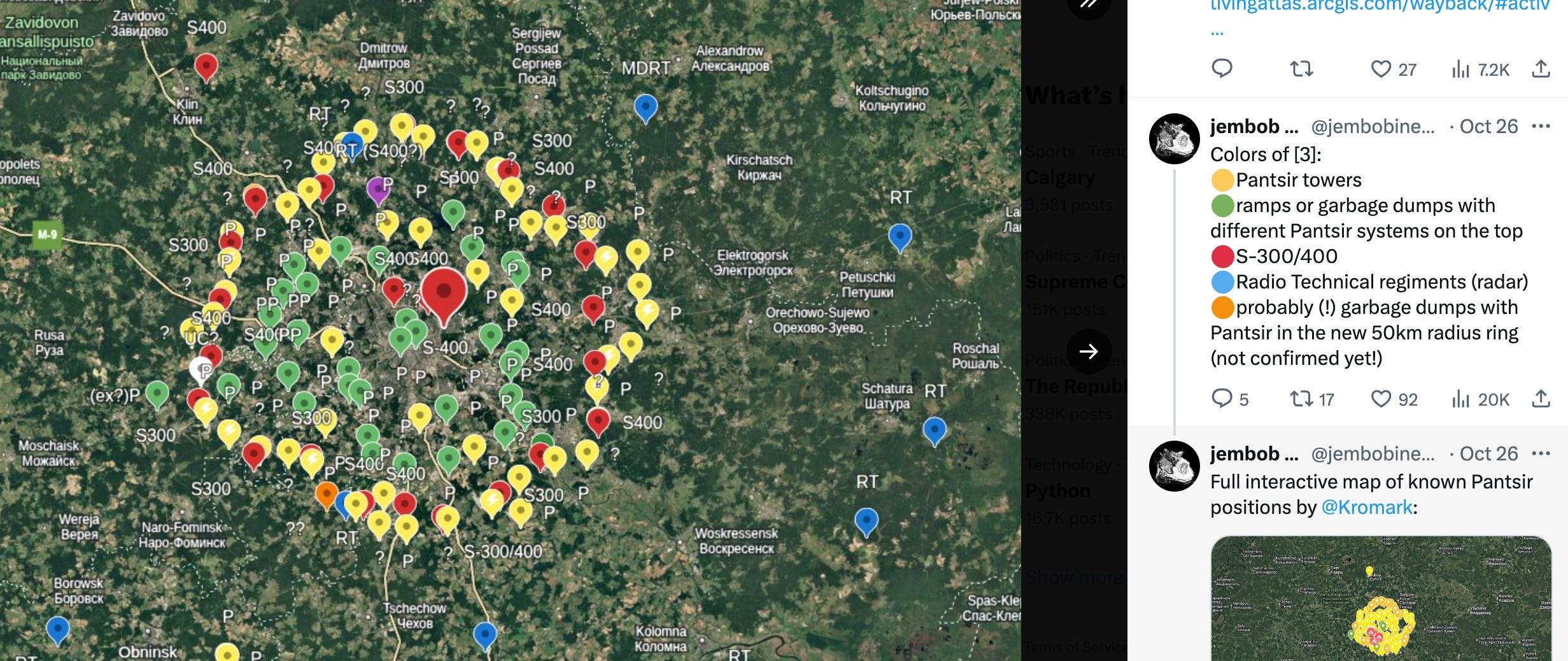
Russia has reinforced its air defense network around Moscow, according to the jembob project. Over the past two months, at least 21 new air defense positions have been established within a roughly 50 km radius of the city. About 80% of these are located south of Moscow, in the direction of Ukraine.
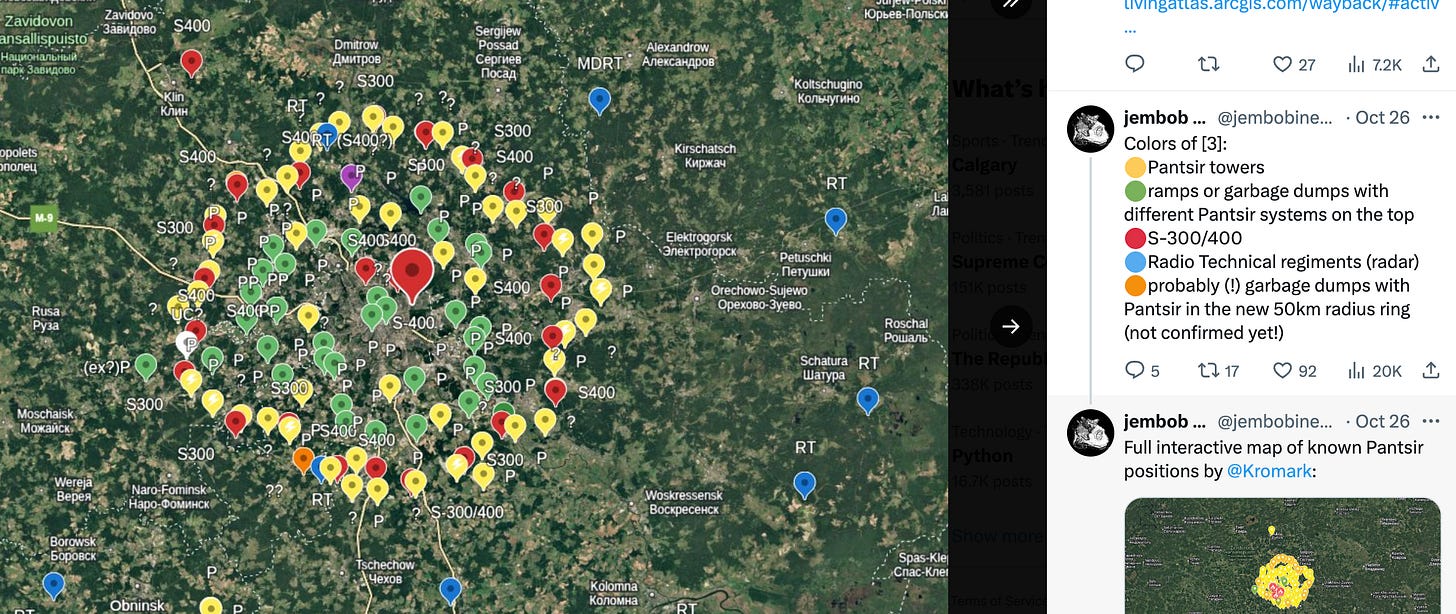
Image: jembob / X At the same time, according to the estimates, only about 60% of objects in the Russian Federation are protected.
Russian authorities have introduced a new restriction on mobile internet and SMS services for citizens returning from abroad, citing security concerns linked to drone attacks. The measure, described as a 24-hour “cooling-off period,” will disable mobile internet and text messaging for Russian SIM cards after subscribers return from international roaming or if their card has been inactive for more than 72 hours. The same mechanism already applies to foreign SIM cards.
Russia is targeting UK space infrastructure, and in particular “shadowing” military satellites, on a weekly basis, according to the head of UK Space Command. Shadowing involves orbiting and aligning a satellite close to the target satellite, in order to be near enough to jam communications or intercept signals to steal critical information.
Ukraine’s intelligence indicates that at least 1,436 African nationals are fighting for Russia in Ukraine, though the true figure is likely higher.
The Kremlin uses “money, lies, and coercion” to recruit foreigners.
Russia trained militants at a resort in Serbia to prepare them for street clashes in Moldova during the parliamentary elections.
This was reported by the editorial team of Radio Free Europe/Radio Liberty (RFE/RL). The training took place at the “Sun River” resort complex on the banks of the Drina River. Just six days before the elections, on September 28, Moldovan police arrested about 70 people, stating that most of them had received training at the Serbian facility.
Plenty of developments!
Thanks for the detail. I am not seeing how you can not be sure that more (subcontracting components) is not being outsourced to China or NK based on availability /pricing of components and helping to improve delivery rates.