

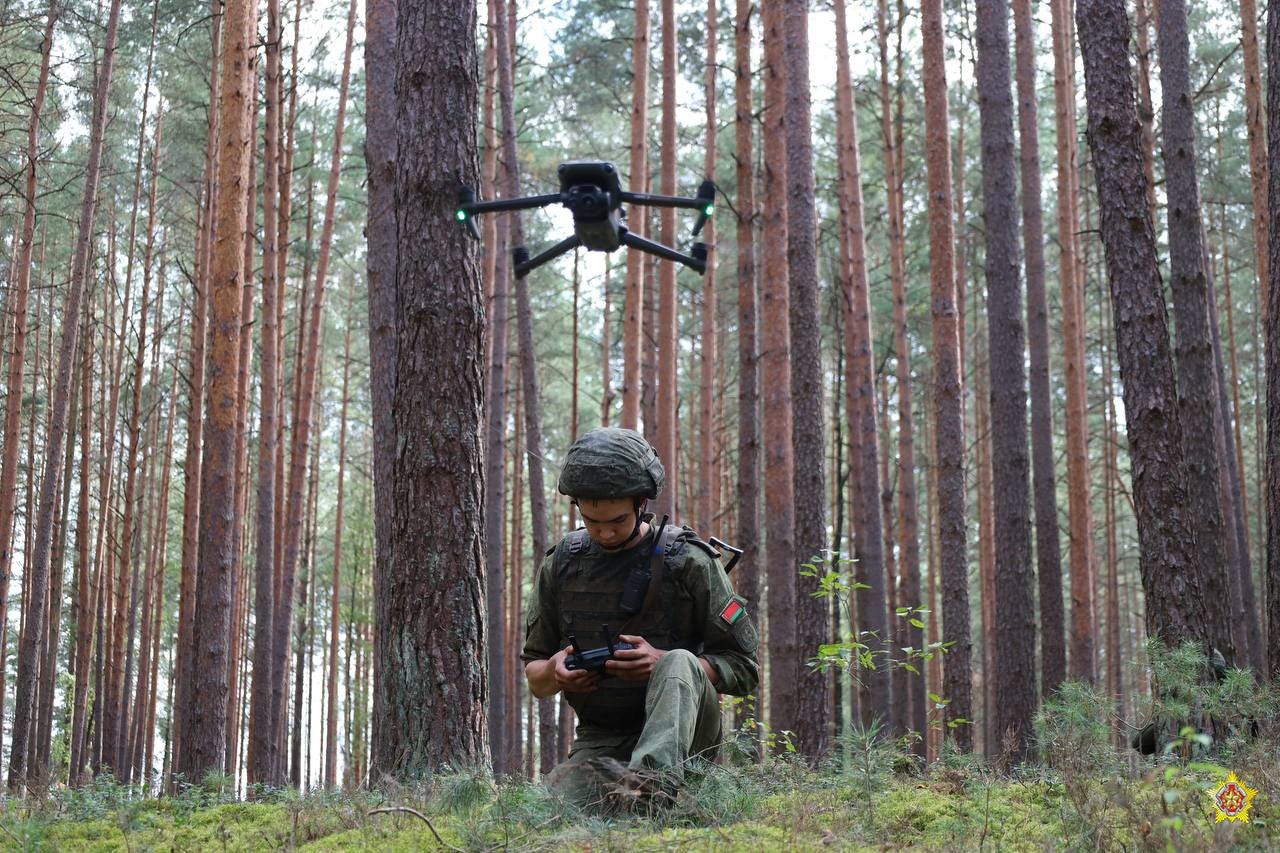
“While Poland panics and NATO trembles, ‘Zapad-2025’ showed what we can do!” — Russian media never fails to hype up its military. At the strategic Zapad-2025 exercises in Belarus, Russia kept personnel numbers low — likely to avoid OSCE’s mandatory observation threshold of 13,000 troops. The smaller scale was then used to present the drills as routine and peaceful, while shifting the blame onto NATO countries for raising the risk of military incidents and destabilizing regional security.
But can the security situation be destabilized even further? Apparently, it can, as unidentified drones are now appearing regularly in the skies of European NATO member states and disrupting civilian infrastructure.
In this edition:
Russian Drone Incursions in Europe;
Zapad-2025 Military Exercise;
Moscow Adapts Its Ballistic Missiles to Evade Ukraine’s Air Defences;
and 20+ additional developments in Russia.
Thank you for reading and supporting my work!
Russian Drone Incursions in Europe
On September 9, 19 Russian drones entered from Ukrainian territory into Poland, prompting jets from several NATO countries to scramble and shoot 4 of them down. Russia denied intentionally flying drones into Poland, claiming instead that Ukrainian electronic jamming may have forced them off course.
Days later, on September 13, Russian drones violated Romanian airspace, prompting Bucharest to scramble fighter jets.
Several Danish airports, in particular, the one in Copenhagen, faced drone-related disruptions in late September. Overnight sightings were reported near the airports in Esbjerg and Sønderborg, over Skrydstrup airbase—which hosts Denmark’s F-16s and F-35s—and above a military installation in Holstebro.
The drones were left to fly their course. Danish defense chief put it simply: “When you shoot something down in the air, something also comes down again,” underscoring the dangers of using kinetic counter-drone measures over populated areas.
Later, reports emerged of unidentified drones being spotted over Finland, Sweden, and Lithuania. The flights of unknown drones halted operations at the airport in the German city of Munich on October 2nd. Due to security restrictions, 17 flights were unable to depart from the airport, affecting nearly 3,000 passengers.
On the night of Friday, October 3rd, 15 unidentified drones were circling the Elsenborn military training ground in Belgium.
In general, 10 NATO countries (Lithuania, Latvia, Denmark, Norway, Romania, Poland, Estonia, Germany, France, and Belgium) have seen drones or disruptions over their territory in the past three months.
According to Ukraine’s UAV and radio expert Serhiy FLASH Beskrestnov, sightings of mysterious drones have been concentrated in countries near Russia. The drones are unlikely to appear spontaneously—they must either be flown long distances, which NATO’s air defence would track, or launched locally by small sabotage groups. FLASH suggests they may have been deployed from Russian ships in the Baltic Sea.
In the context of the developments in Denmark, three Russia-linked ships have emerged as possible players in the mysterious drone flights. Investigation by Danwatch revealed that a Norwegian ship with a Russian crew was located a few kilometers from Copenhagen Airport during the drone attack. Danwatch revealed that the ship’s owners have previously collaborated with a large Russian paramilitary organization (RSB Group) for years.
So far, the tangible impact has been limited to disrupting airports and civilian flights, but the informational effect has been significant, fuelling fear and speculation.
From a strategic perspective, such operations fit into Russia’s hybrid warfare playbook, Serhiy FLASH adds. They project the image of Moscow as a powerful, unpredictable adversary, aiming to deter Europeans from confrontation. They also divert attention from Ukraine by pushing NATO countries to focus resources on bolstering their own air defence instead of supporting Kyiv. Finally, they allow Russia to test NATO’s “red lines,” probing how far it can go without provoking a strong reaction. In this sense, the drones are as much a psychological and political weapon as they are a physical one.
It is unlikely the drones are being used for reconnaissance, given Russia’s advanced satellite intelligence capabilities, FLASH noted on his Telegram.
Military Cooperation and Alliances
British researchers Oleksandr V. Danylyuk and Dr. Jack Watling from RUSI concluded that Russia is helping China prepare to seize Taiwan in 2027. Russia has agreed to supply and train China’s People’s Liberation Army (PLA) in airborne operations, an area where China lacks experience but Russia has combat know-how.
Under the deal, Russia will sell China:
37 BMD-4M light amphibious assault vehicles (100 mm gun, 30 mm automatic cannon)
11 Sprut-SDM1 light amphibious anti-tank guns (125 mm cannon)
11 BTR-MDM ‘Rakushka’ airborne APCs
Several Rubin command/observation vehicles and KSHM-E command vehicles
All vehicles will be fitted with Chinese communication and command systems, tested for compatibility with Russian electronics.
Russia will also train a battalion of Chinese paratroopers on how to use this equipment. The biggest benefit for the PLA is not the hardware itself, but the training in airborne tactics and command-and-control procedures that only Russia can provide, thanks to its combat experience. Read more about Russia-China cooperation in my previous report.
Additional developments:
Russia reportedly approached Türkiye with a proposal to repurchase the S-400 air defense missile systems that Ankara received in 2019. Türkiye had originally bought two of these systems in 2017 for $2.5 billion, a deal that sparked a major diplomatic dispute with the United States. Russia, which does not have S-400s in reserve, would benefit from boosting stocks lost in Ukraine. The deal would also help Russia’s struggle to meet its commitments to other S-400 buyers, such as India.
According to internal Vietnamese documents obtained by the Associated Press, Russia and Vietnam developed a back-door system to conceal arms deal payments and evade Western sanctions. Vietnam has purchased Russian military equipment—including fighter jets, tanks, and ships—on credit, and then repaid that debt through its share of profits from a joint Vietnam–Russia oil venture in Siberia. These transactions bypass conventional banking channels and are structured to keep funds flowing discreetly, even under tightened sanctions aimed at curbing Russia’s war in Ukraine.
South Korea launched an investigation into reports that Russia may have supplied nuclear reactor modules for submarines to North Korea.
Moscow allegedly transferred two or three such modules to Pyongyang during the first half of this year.
The report states that the delivery involved reactor cores, turbines, and cooling systems removed from decommissioned Russian submarines. “Such a move could represent a breakthrough in North Korea’s long-standing ambition to build its own nuclear fleet,” the article noted.
Zapad-2025 Military Exercises
The joint military exercises of Russia and Belarus, called “Zapad-2025,” began on September 12 and lasted for four days.
Russia conducts annual strategic exercises in different regions, practicing operations in potential “theaters of war.” One year it’s Zapad, then Vostok, followed by Tsentr and Kavkaz. Over four years, the situation in possible theaters of war changes, and then they repeat all these exercises in a cycle. Several times, such exercises have served as precursors to Russian invasions of neighboring countries.
For example, during Kavkaz-2008, Russia concentrated troops and equipment near the Roki Tunnel — a highway under the Greater Caucasus mountain range. It was precisely this tunnel that Russia used to invade Georgia six days after the official end of the exercise.
And during Zapad-2021, which involved more than 200,000 Russian and Belarusian troops, the so-called “Central Federation” (the name given in the exercise scenario to the joint forces of Russia and Belarus) practiced airborne landings, deep raids, and other maneuver operations against a notional adversary called the “Polar Republic.” Five months later, Russia attempted to carry out precisely such a “blitzkrieg” in reality — trying to seize Kyiv, Hostomel, Kharkiv, Mykolaiv, and other Ukrainian cities as part of the full-scale invasion.
Poland decided to completely close its border with Belarus from the evening of September 11 due to the “Zapad-2025” military exercises. Ukraine was monitoring developments in Belarus and strengthened its defence capabilities along the border.
Here is a summary of an excellent report by Fabrizio Minniti and Dr Giangiuseppe Pili for RUSI, Wartime Zapad 2025 Exercise: Russia’s Strategic Adaptation and NATO:
For both Moscow and Minsk, Zapad 2025 functioned as much as a political instrument as a military rehearsal. Their goal was to project carefully tailored messages to domestic and international audiences, while managing the significant resource constraints imposed by the ongoing war.
The official participant numbers were kept below the OSCE Vienna Document thresholds for mandatory observation, which require outside monitoring for exercises with 13,000 or more personnel.
This long-standing practice, used by Russia since at least Zapad 2013, allows it to under-report total numbers and modularise parallel events to avoid mandatory verification.
Unlike previous iterations, which emphasised demonstrations of military mass and tempo, Zapad 2025 appeared as a meticulously calibrated, scaled-down, and geographically constrained exercise.
Militarily, it served as a field laboratory where Russia stress-tested and refined its Initial Period of War (IPW) playbook, incorporating direct lessons from the Ukrainian battlefield.
The focus this time was on high-leverage capabilities such as long-range precision fires, integrated air and missile defence (IAMD), and electronic warfare (EW), while conserving mass and materiel critically needed in Ukraine.
Russia’s Initial Period of War (IPW) seeks to disorganise an adversary through rapid deep strikes against operational command and control (C2), airbases, IAMD nodes, logistics hubs, and rail chokepoints.
The exercise stressed ISR–fires integration, long-range precision strikes (including from standoff bombers), and counter-ISR/EW operations. Russia also rehearsed tactics designed to compensate for weaknesses exposed in Ukraine, such as the use of glide bombs to mitigate limited air superiority.
It further practiced deploying dense Ground-Based Air Defence (GBAD) and electronic warfare to counter adversary ISR capabilities—a persistent challenge on the front lines.
For NATO, Zapad 2025 underscores the need for a nuanced threat assessment.
NATO must be prepared to exploit predictable Russian vulnerabilities while addressing key areas of weakness.
Since the IPW strategy relies on early deep strikes against critical infrastructure, C2 nodes, airbases, and logistics hubs, NATO and Ukraine must prioritise hardening these targets to increase their resilience.
Furthermore, accelerating the integration of air and missile defence with counter-ISR capabilities is the centre of gravity for any contemporary defensive strategy against Russia’s IPW playbook.
The exercise’s emphasis on GBAD and EW suggests that Russia sees these as its most effective tools for securing a favourable outcome.
Russia’s IPW doctrine is not static. The emphasis on long-range fires, an IAMD duel, and electronic/cognitive shaping highlights a deliberate effort to build a military capable of overwhelming a defender’s strike complex and exploiting the resulting opportunities on the ground.
Defense Production and Innovations
According to Ukraine’s HUR, by the end of 2025, Russia intends to produce 57 modern fighter jets of various models – Su-57, Su-35, Su-34; around 250 T-90M tanks, over 1100 BTR-3 and BTR-82A armored personnel carriers, as well as 365 artillery systems. These are new combat units, not modernizations.
During more than three years of full-scale invasion, Russia has lost over 4,000 tanks, including an astonishing 1,200 T-80s.
According to estimates of the Conflict Intelligence Team, the largest Russian tank producer, Uralvagonzavod, produced between 60 and 70 T-90M tanks in 2022. In 2023, amid efforts to mobilize the defence industry, output may have risen to 140–180 tanks. By 2024, production could have exceeded 200 units per year, possibly approaching a rate of 250–300 tanks annually.
However, according to analyst and former British Army intelligence officer Sergio Miller, CIT’s estimates are overstated. He argues that Russia struggles to produce even 100 new T-90Ms per year, with most being upgraded T-90As rather than entirely new tanks. Miller noted that Uralvagonzavod itself reported only 100 deliveries in 2024 and, in reality, may have completed as few as 10 T-90s this year. With such low output, he concluded, the Kremlin will find it difficult to rebuild its depleted armored regiments.
Last month, I reported that Uralvagonzavod has been using hundreds of pieces of foreign equipment in its tank production — read more here.
Additional developments:
By the end of the year, Russia also plans to manufacture about 2500 missiles of various types. Among them are cruise and ballistic missiles for the Iskander system, air-launched ballistic missiles like the Kinzhal, and others. New long-range missiles and modern hypersonic anti-ship systems are also under development.
Ukrainian and Western officials report that Moscow has managed to adapt its ballistic missiles to better evade Ukraine’s air defences, the FT reported. Russia is believed to have upgraded both the Iskander-M mobile system, with a range of roughly 500 km, and the Kinzhal air-launched ballistic missile, which can reach around 480 km. These missiles reportedly begin on a standard trajectory before abruptly shifting course—either by diving steeply in the terminal phase or performing evasive manoeuvres designed to disrupt and outmanoeuvre Patriot interceptors.
Ukraine’s interception rate of ballistic missiles had improved during the summer, peaking at 37% in August. However, by September, it had dropped sharply to just 6%, even though the number of missile launches was lower.
Kyiv Post reports that Russia’s long-range strike capability has dropped significantly, with its strategic bombers now launching only about half as many cruise missiles as a year ago. A review of Ukrainian Air Force data shows the bomber fleet has fewer operational aircraft, missile deliveries to airbases are down, and Ukrainian drone attacks have hit missile factories. According to Ukraine’s SBU, Russia’s heavy bombers averaged 33 cruise missiles in nighttime massed strikes during April–May, but that figure fell to just 19 in June–July.
According to open sources, Ukraine has attacked Russian cruise missile plants at least twice: on May 28-29, 2025, and Aug. 11, 2025.
After a brief pause in early August, Shahed drone attacks surged again in September, averaging about 188 per day—similar to June (181) and July (203)—with roughly 5,400 drones launched monthly across the June–September period, suggesting production may have plateaued, according to Igor Anorkhin. Since September 8, Ukrainian officials have begun publishing estimates of Shaheds in total salvos, showing they account for about 58 percent—around 3,250 drones in September—consistent with earlier assessments of Alabuga’s output.
The latest innovation in Shahed is installing video cameras and modems so that strike drones, which are preprogrammed, have possibilities to be guided online, and drones that previously only served as decoys are now also used as reconnaissance drones deep inside Ukrainian territory. Serhiy “FLASH” Beskrestnov warns that the emergence of Shaheds fitted with cameras and remote-control modems is no surprise — but their effectiveness against moving targets is limited. Unlike the Lancet, a Shahed’s launch and in-flight control are less dynamic, so realistic targets are railways, mass transport and large equipment rather than small pickups; a 50 kg warhead is ill-suited to hunting light vehicles. FLASH notes these drones use Chinese cameras and radio modems, with a practical employment range of about 200 km (the technology could extend to ~400 km), making rail transport within that envelope the primary vulnerability.
Sanctions Evasion and Arms Control
Between 2023 and 2024, Chinese companies supplied more than $63 million worth of materials to Russian drone manufacturers under sanctions. Around $14.3 million of these supplies went to companies linked to the production of Shahed drones at the Alabuga Special Economic Zone in Tatarstan, according to an investigation by The Telegraph. The shipments included motors, microcircuits, metal alloys, lenses, fiberglass, emulsion binders, and carbon fibers—critical components for drone manufacturing.
Additional developments:
Ukraine is finding more and more Russian and Belarusian-made electronics in the wreckage of missiles launched by Moscow. “They currently have the ability to produce chips, though of relatively poor quality, for now. Over time, however, their capabilities will improve,” a Ukrainian official warned.
Italian outlet Linkiesta reports that Kalashnikov assault rifles without serial numbers — alongside ammunition from Russian state-owned factories — are being smuggled into Italy via Sicilian ports and the Friulian mountain passes. The investigation suggests the Russian “shadow fleet” is likely being used to facilitate these shipments, and finds that modern weapons produced between 2010 and 2020, including assault and sniper rifles, are among those trafficked.
Other developments
The Russian army established its first specialized UAV detachment equipped with a drone control point situated hundreds of kilometers behind the frontlines, according to the Center for Unmanned Systems and Technologies (CUST), Russian media TASS reported. The CUST clarified that this rear command center for reconnaissance and strike UAVs was formed based on the Somali unit and the 24th Separate Mechanized Infantry Brigade, in collaboration with the United Russia party. These units have been supplied with Skvorets drones and Orbita hardware and software systems.
The Russian defence industry has long been known for making inflated claims — from supposed geophysical weapons to particle beams and even an atomic pistol, writes David Hambling for Forbes. CUST, however, deserves to be taken more seriously, as it has a proven track record of delivering on its projects.
Reportedly, Russia is developing a $5 billion alternative to the Starlink satellite internet service. 17. In total, the company is expected to launch 383 satellites, including 91 replacements for those that may fail.
Google Earth has updated its imagery of Novaya Zemlya, the Arctic archipelago where Russia’s nuclear weapon designers are testing their latest systems, The Barents Observer reports. The test site is located at Pankovo on the southern island, less than 900 km from Norway’s northeast corner.
This summer saw record-high activity at Pankovo. The number of missiles tested remains unknown, as does how many may have crashed at sea—or possibly on land, likely near the former atmospheric nuclear test site north of the Matockhin Strait.
So far, radiation protection authorities in the Nordic countries have not reported any unusual isotope readings.
Less oil means less money, writes David Kirichenko for Forbes. The Kremlin has leaned heavily on oil and gas revenues to finance soldier salaries and compensation for families of the dead and wounded, with sign-up bonuses reaching $28,000 and monthly pay starting at $3,200. Recent estimates from Re: Russia, a research group of exiled academics, put personnel costs at a record 2 trillion rubles ($25.6 billion) in the first half of 2025—nearly 10% of federal spending. But as Ukrainian strikes erode Moscow’s oil revenues, that funding base is under pressure.
RBC reports nearly 40% of Russia’s refining capacity is offline, with up to 70% of shutdowns caused by drones, while Kommersant notes petrol output in September alone dropped by 1 million tons, leaving the domestic market short by about 20%. There’s a short quote from me in this article 🙂
Also, read my recent report, “Ukraine’s Long-Range Drones Hit Russia’s Oil Network”.
While I fight Russia in the information space, my friends and family are confronting it on the battlefield in Ukraine.
I’ve recently launched a campaign to raise $3,400 for fiber-optic equipment for the military unit of my university friend, Vasyl, who is currently serving in Ukraine’s Armed Forces. We’ve already raised almost half of the target amount, and I’d be deeply grateful for your donation!
Ways to donate:
PayPal: link
Subscription to my newsletter: 1 month – €15; 1 year – €70, “Supporter” tier - €150. Please drop me a note if you’d like the payment for your subscription to go toward the campaign!
Canada: e-transfer to elena91kr@gmail.com
Thank you for supporting Ukraine!
This thorough and detailed examination really helps an ordinary citizen to understand the threats posed by the enemy.
Thank you for an excellent sitrep.