

This newsletter highlights some important ways of countering Russian aggression through non-military means. First of all, sanctioning all of Russia’s military production sites is crucial—surprisingly, in the fourth year of the full-scale invasion, 40% of the enterprises involved in producing Kh-59 missiles are still not under sanctions. Yet there are encouraging signs that sanctions do work: in the case of these missiles, Russia is already struggling to meet state defense orders.
China remains a key player here, which, with the move of a finger, could halt the production of some key Russian weapons and systems, making it impossible for Russia to wage this war
In this monthly edition:
Military Cooperation and Alliances: Russia and China;
Defense Production and Innovations: MoD Priorities;
Kids with Drones: Russia Militarizes Education at Record Pace in 2025 (summary of the report);
Sanctions Evasion and Arms Control;
and 20+ additional developments in Russia.
Thank you for reading and supporting my work!
Military Cooperation and Alliances: Russia and China
While some in the West had hoped that a reapproachment in US-Russia relations might pull Moscow away from Beijing, developments have taken a different course. Putin stated that his relationship with Chinese President Xi Jinping has reached an “unprecedented level” as the two met in Beijing on the eve of a major military parade.
According to The Telegraph, Russia owes much to China for keeping its fleet of combat drones supplied. An investigation revealed that, between 2023 and 2024, Chinese companies delivered parts and materials worth at least £47 million ($59.7 million) to Russian firms under sanctions for drone production.
Of that sum, around £10.7 million ($13.6 million USD) went to sanctioned entities directly involved in assembling Iranian-designed Shahed drones in Alabuga. Chinese shipments covered a broad range of crucial components: aircraft engines, microchips, metal alloys, optical lenses, fibreglass, chemical binders, and carbon fibre yarns.
Altogether, The Telegraph tracked supplies from 97 different Chinese exporters. This steady flow of drone technology underscores the depth of military cooperation between Beijing and Moscow. In private conversations with European diplomats, Chinese Foreign Minister Wang Yi reportedly acknowledged that Beijing could not allow Russia to lose the war, as this would free Washington to concentrate its full strategic attention on China.
“Despite declarations of a ‘no-limits’ partnership,” experts from CEPA argue that “the cooperation is in fact limited.” While joint military exercises have become more frequent, they function primarily as political signals rather than evidence of genuine interoperability between the two forces.
In its article “The Sleeping Dragon: 5 Simple Ways China Could Instantly Stop the War in Ukraine”, the Russian opposition outlet The Insider reports that China remains virtually the last stronghold keeping Russia afloat amid sanctions. Beijing does not necessarily need to make a politically complex decision and sanction major sectors of Russian exports. It would be enough to quietly halt exports of certain specific goods to Russia. By doing so, China could instantly paralyze key segments of Russia’s military-industrial complex, making it impossible for the war to continue in the foreseeable future.
The Insider compiled a list of the most critical items:
Gunpowder stabilizer: diphenylamine. At least half of Russia’s need for diphenylamine is covered by Chinese supplies.
Anti-jamming antennas. Without these antennas, the “Shaheds” would be completely blind.
Electric motors (for FPV drones). According to The Insider, Russia relies heavily on imports of small Chinese-made motors for drones. No Russian production on a comparable scale is known to exist. Should Russia be cut off for even a year to a year and a half, it would struggle to establish mass production at home. This would quickly and severely affect the battlefield, where drones have become a central weapon.
Carbon fiber. Russia is highly dependent on Chinese carbon fiber. Without it, no Shahed/Geran drone could take flight, and even ordinary drones would become heavier and less efficient.
Optical fiber. FPV drones equipped with fiber-optic systems have become a major force in open-terrain combat. Russia is almost entirely reliant on China for both optical fiber and its raw material—quartz glass preforms. Russia does not produce preforms domestically, and its own fiber production may have been disrupted after a Ukrainian strike on the plant in Saransk.
Russia is cooperating with China on the development of an automated command-and-control system (ACCS) for airborne operations, under the codename “Mech” (R&D project Mech).
According to the information, the Russian state-owned company Rosoboronexport signed a contract with China’s CETC International Co Ltd in June 2024 for the supply of technical documentation to develop the system, valued at €4.284 million.
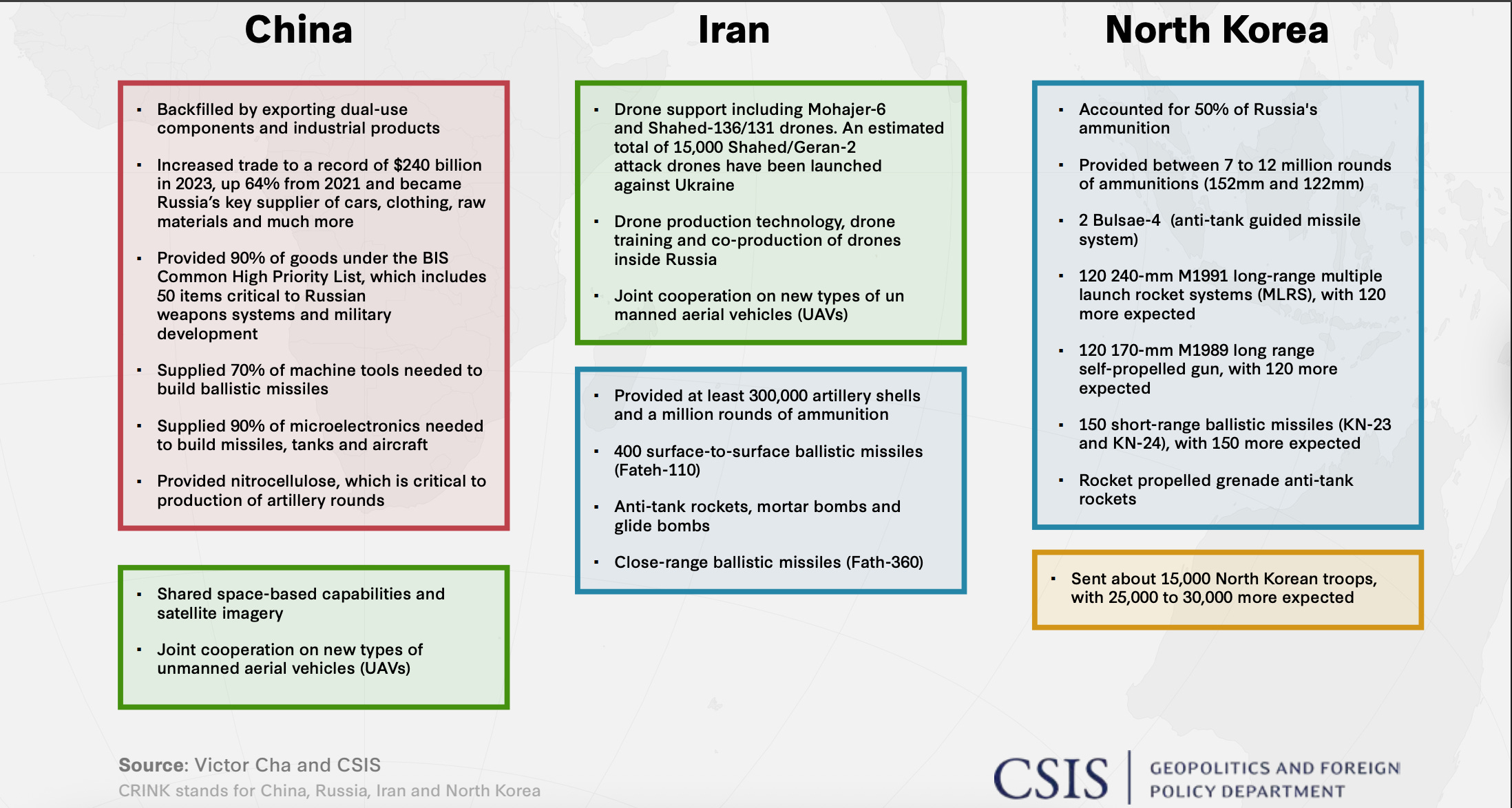
Using original data scraping analysis, infographics, and satellite imagery, CSIS experts assess the degree and substantive nature of changing alignment patterns among China, Russia, Iran, and North Korea (CRINK), and the challenges they pose to global governance.
CRINK's Support for Russia's War on Ukraine:
Additional developments:
Recently, a Russian Gerbera drone was found with a camera that contained test footage from a Chinese factory. The video showed workers checking the camera by filming passing cars. The discovery was reported by military technology specialist Serhii Beskrestnov (“Flash”).
Russia plans to expand its military-technical cooperation with India, according to the Defence Intelligence of Ukraine (DIU). From September 15 to 18, St. Petersburg is set to host the fourth meeting of the working subgroup of the Russian-Indian intergovernmental commission on military and military-technical cooperation.
According to intelligence, over the course of four days, the Indian and Russian delegations intend to develop and agree on plans for bilateral military cooperation activities between Russia and India for 2025–2026.
Russia is pressuring the Central African Republic (CAR) to phase out the Russian Wagner mercenary group and replace it with Moscow's state-controlled Africa Corps. The Africa Corps, a newly created unit under the Russian Defense Ministry, is part of Moscow's broader effort to centralize control over foreign military operations once handled by Wagner. The CAR government prefers Wagner, which they view as a more effective force with deep ties to local military and political structures. Read about Russian influence on Africa’s illicit economies post-Wagner here.
Russia plans to sign an intergovernmental agreement on military cooperation with Benin. Russia earlier signed a similar agreement with Togo and will participate in exercises and train military personnel.
North Korea may soon deploy about 6,000 soldiers and from 50 to 100 pieces of military equipment to Russia - HUR. Read more about Russia’s cooperation with North Korea here.
Defense Production and Innovations: MoD priorities
Russian Defense Minister Belousov gave an update on the ten priority directions for the Russian MoD. The main priorities of the State Armaments Program through 2036 are: strategic nuclear forces, space assets, air defense, electronic warfare systems, unmanned aerial vehicles, and robotics. The program has been structured in line with anticipated threats and new methods of warfare, based on the experience of the “special military operation” (war).
He announced a shift in MoD priorities toward light vehicles over heavy armour, reflecting battlefield tactics since winter 2024–2025. He reported 22,725 motorcycles, ATVs, and buggies already delivered to the front, with 12,186 more expected by August 2025. Russia reportedly purchased over 40,000 Chinese motorcycles in 2024 and may acquire up to 200,000 motorcycles and 60,000 other light vehicles in 2025. The reliance on light vehicles stems from their low cost and mobility compared to tanks, which remain vulnerable to Ukrainian drones amid shrinking Russian armour reserves.
Additional developments:
The Russian Center for Unmanned Systems Rubikon has adopted unmanned strike boats, conducted training, and rehearsed scenarios, and is now working on improvements. The video footage also shows a submersible boat. Their stated primary mission is to target Ukraine’s maritime infrastructure.
As for the threat posed specifically by surface drones, the Russians may attempt to replicate the Ukrainian tactic of launching FPV drones from them to strike high-value targets deep in the rear.
Ukrainian military intelligence is preparing countermeasures against enemy naval drones after one of Russia’s unmanned boats struck a Ukrainian Navy vessel in the Danube Delta.
One of Russia’s largest drone manufacturers, AO Kronstadt (the manufacturer of the Orion and Inokhodets drones—systems often compared to the American MQ-9 Reaper) is on the verge of bankruptcy after months of financial turmoil and mounting lawsuits, Russian media reported. Ukrainian strikes on Kronstadt’s production facilities added to the difficulties.
Kids with Drones: Russia Militarizes Education at Record Pace in 2025
This is a summary of the report by OpenMinds published in early September. You can access the full report here. OpenMinds is a cognitive defense tech company countering authoritarian influence in the battle for free and open societies.
Kremlin’s strategy is to attract children to the hottest topic of modern warfare — drones. Russia has been actively promoting this strategy since 2023.
Across dozens of regions, schools are being equipped with specialised classrooms for drone training, the Ministry of Education has issued a “UAV 101” textbook, and Kremlin-backed patriotic centres — often run by active war veterans — are teaching children war-related skills such as FPV piloting and firearms practice.
In January 2024, the Ministry of Education announced that schools and colleges in 30 pilot regions would be equipped with the necessary gear to conduct drone training.
In May 2025, the Russian education system introduced a textbook on UAVs for 8-9 grades in school. It contains general information on the history of drone development and how they are manufactured. Also, there is a chapter called “Foundations of FPV flights” with guides on how to control the FPV drones, currently one of the main types of weapons on the frontline.
In June, Putin instructed the Ministry of Sports to lower the minimum age for participating in drone piloting competitions. Since then, 7-year-old children are allowed to enter such tournaments.
There was another notable event in July — six kindergartens in Perm set up infrastructure for drone operations.
OpenMinds detected 30 000 posts across 4 000 channels related to the promotion of drones among children and youth through school curriculum or events such as workshops, competitions, and hackathons. During the 7 months of 2025, there were 8600 posts — a six-fold increase compared to the whole of 2022.
Sanctions Evasion and Arms Control
Japanese authorities conducted an investigation into the supply of high-precision equipment to Russia’s defense industry and uncovered large-scale sanctions violations. More than 300 machines produced by Tsugami went missing after being sold to seven Chinese companies, with around 30 of them already found in Russia.
Japan has ordered Tsugami to terminate contracts with the intermediaries involved. The company will cease providing support for machines already delivered to Russia and will also cut ties with other suspicious Chinese partners.
Another investigation concerned the company Ferrotec, which supplies chemicals and tools. The investigation confirmed that Ferrotec’s products had reached enterprises of Russia’s military-industrial complex, including companies such as Epiel, Mikron, and Vympel. In April, some of these contracts were terminated, and the supplies were placed under constant monitoring.
Additional developments:
The Russian arms manufacturer, the Research Institute of Applied Chemistry, is receiving components for RG-Vo chemical grenades—banned under international law—from two Russian companies which, despite supplying a sanctioned defense enterprise, have themselves not yet been subjected to Western economic restrictions. Both the Saransk Mechanical Plant and EuroChemInvest are supplying components, yet neither has been placed under Western sanctions.
Russian state-owned Biysk Oleum Factory acquired Siemens equipment via a Russian intermediary sourcing from Chinese resellers, circumventing Western sanctions, according to customs and procurement records reviewed by Reuters.
Russia declared that it no longer considers itself bound by a moratorium on the deployment of nuclear-capable intermediate-range missiles. Under the Intermediate-Range Nuclear Forces (INF) Treaty, the U.S. and Russia agreed not to deploy short- and intermediate-range ground-launched ballistic and cruise missiles. The U.S. withdrew from the INF in 2019.
In his Missile Matters Substack, Fabian Hoffmann says that Oreshnik is a missile system based on the Russian RS-26 Rubezh (SS-X-31), which was developed between 2008 and 2018. Oreshnik and the RS-26 are, to a large extent, the same missile; they likely share many features, including payload capacity, range, and function. The Oreshnik serves as further evidence that the INF Treaty was effectively dead long before the United States withdrew under Trump in 2019. From at least the mid-2000s, Russia ceased to view the INF Treaty as a genuine arms control tool. Instead, it treated the treaty as a means to create asymmetric advantages over NATO by developing restricted missile capabilities while ensuring NATO remained constrained.
According to an interactive chart published by Ukraine’s Defence Intelligence (HUR), Russia has 116 enterprises involved in the production of Kh-59M2/M2A air-launched missiles, nearly 50 of which are still not under sanctions from any country.
Despite this, Russia is already facing serious difficulties in fulfilling state defense orders. Ukrainian intelligence has documented cases where Kh-59 missiles were fitted with mass-dimensional mock-ups instead of active radar homing heads (ARH seekers).
The above examples demonstrate that sanctions are working. Further increasing pressure and expanding restrictions on enterprises supplying lower-tier components could reduce the production rate of Russia’s primary strike weapons even more.
Russia’s largest producer of tanks and armoured vehicles, Uralvagonzavod, uses hundreds of units of foreign equipment in its production. HUR’s database currently contains information on more than 260 CNC machines and machining centres, as well as other high-tech foreign equipment in use at the plant.
Most of this equipment was purchased during the rearmament of Russia’s military-industrial complex, which had been underway since 2007 in preparation for the full-scale invasion. Uralvagonzavod continues to expand production to sustain Russian aggression.
Russian Drones
Russian UAV adaptations appear to be achieving partial effects of battlefield air interdiction (BAI), the Institute for the Study of War reports. BAI refers to the use of air power to strike targets in the near rear of the frontline in order to disrupt battlefield operations in the short term. Such operationally significant targets typically include roads, railways, bridges (key ground lines of communication), command posts, ammunition depots, assembly areas, and training grounds.
Recent Russian drone innovations — including extended FPV flight ranges, limited AI/ML integration, the spread of fiber-optic UAVs, the use of thermobaric warheads, the deployment of sleeper drones, and other technological upgrades — are providing Russian forces with notable battlefield advantages in Ukraine.
Neither side has been able to carry out traditional BAI with manned aircraft or UAVs due to dense air defenses and sophisticated electronic warfare systems. However, Russian forces are increasingly achieving partial BAI effects through drones in support of offensive operations. Tactical UAVs are restricting Ukrainian movements in the immediate rear, complicating troop rotations and medical evacuations. Ukrainian sources report that the battlefield “kill zone” — the contested grey zone dominated by strike and reconnaissance drones — now extends up to 10 kilometers from the frontline. Russian forces are also targeting Ukrainian training grounds with precision missile strikes cued by reconnaissance UAVs.
Support from Russia’s allies, particularly China, has enabled the development and scaling of UAVs that are more resistant to electronic warfare and capable of operating over longer ranges, at higher speeds, and in more challenging conditions.
Additional developments:
Taras Chmut, founder of the Ukrainian Return Alive foundation, considers the Shahed kamikaze drone the best in the world in its niche. He noted that Ukraine has at least three analogous models with a similar appearance, but they remain inferior in both quality and cost. “Making the Shahed is like making an iPhone. We can take apart an iPhone, right? Why can't we make an iPhone?” he added.
On September 4, Ukrainian military radio technology specialist Serhiy “Flash” Beskrestnov informed that Russians have begun using new versions of the Shahed drones, the “Ь” series, which can be remotely controlled via the internet. According to him, this is a recent discovery. These drones have antennas mounted on the wingtips, which improve signal reception and transmission. Beskrestnov added that, unlike the Geran drones, the modems and antennas on these new models have so far proven difficult to locate, as they are destroyed and burned upon impact.
Other developments
The Kremlin is likely escalating its hybrid campaign involving GPS and communications jamming against NATO states bordering Russia - ISW. Bloomberg reported that European states along Russia's western border and the Baltic Sea, including the Baltic states, Finland, Poland, and Sweden, have raised concerns to international transport organizations over sharp increases in GPS and signal jamming and spoofing in recent months, as well as an increase in Russian electronic warfare (EW) installations in border areas.
In early September, the navigation system of a plane carrying Ursula von der Leyen was disrupted due to suspected Russian interference. Following this development, Italy considers keeping state flights secret.
Russia is transforming the Ukrainian territories it occupies into a vast military hub — and a potential springboard for future offensives. One of the clearest cases is Donetsk International Airport. Recent Planet Labs satellite images, obtained by the Kyiv Independent, reveal sudden construction activity on the ruins of the long-abandoned airport. The new facilities are serving as a launch site for Russia’s ever-growing fleet of long-range drones. Launches from Donetsk Airport may even allow Shaheds to fly armed with artillery shells that they can drop along the way to their final kamikaze attack.
Thank you for the update. More indications yet again that promoting détente by western state actors only encourages Russia's aggression. The sooner it is understood that Russia can only be contained by firm actions and strength, the better.