

In Ukraine and Russia, the value of human life differs. The loss of each servicemember is a profound tragedy for Ukrainian society. This is why many efforts, both on the battlefield and in innovation, are focused on saving as many lives as possible.
In this context, tactical medicine plays a particularly important role, and any country that seeks to build a capable, combat-ready army must strive to employ all available tools to train its personnel in this field.
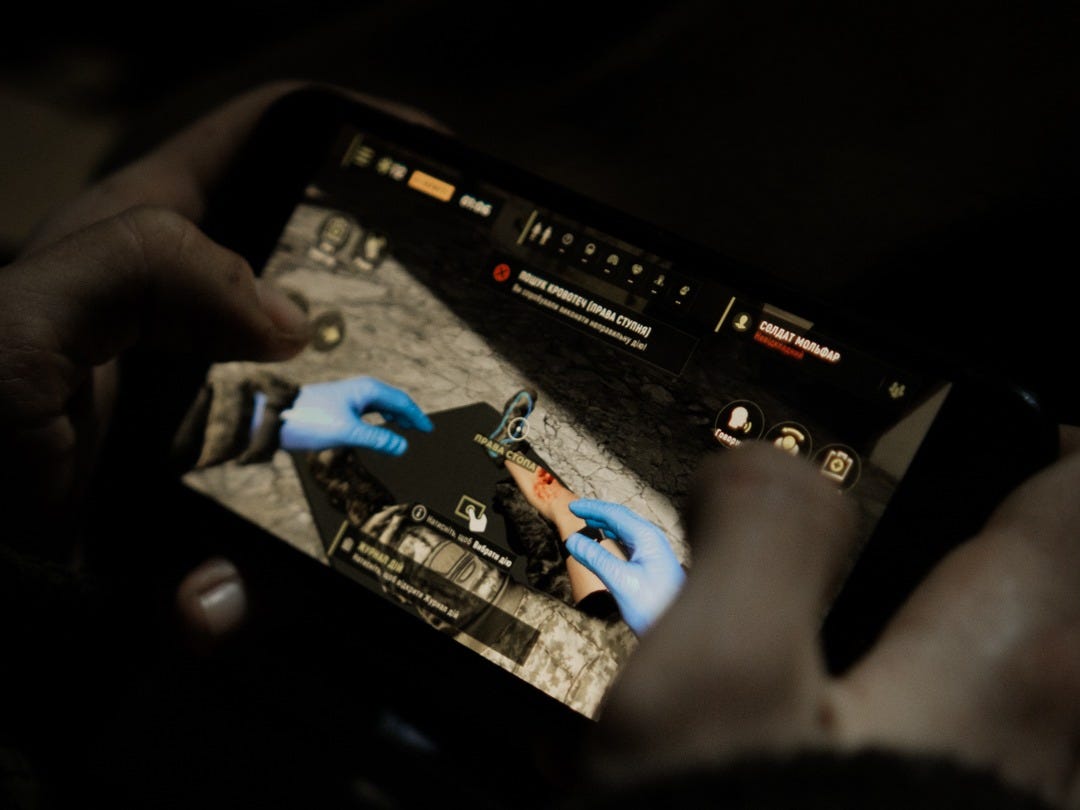
Innovation is also advancing in the field of tactical medicine, and today I will present one such example—the LifesaverSIM mobile simulator, developed by the Ukrainian team. It is based on TCCC protocols and strongly incorporates Ukraine’s battlefield experience.
Ukraine’s Arms Monitor is a reader-supported publication. The content in this newsletter is not sponsored by any individual or organization. If you wish to support my work, please consider a paid subscription.
Tactical Medical Training in Ukraine
In Ukraine, every service member must possess the skills required to stabilize a casualty until transfer to professional medical personnel. According to Ukraine’s MoD, tactical medical training is based on the international TCCC (Tactical Combat Casualty Care) protocol, a standardized training program for tactical battlefield casualty care, with the M.A.R.C.H. algorithm at its core.
M.A.R.C.H. represents a clear sequence of actions, where each letter corresponds to a critical life-threatening condition. The first priority (M) is controlling Massive hemorrhage, as it accounts for approximately 60% of preventable deaths. Soldiers are trained to apply a tourniquet to a limb within 20–30 seconds, acting almost automatically even under extreme stress.
The next steps include:
A (Airway): ensuring airway patency
R (Respiration): sealing penetrating chest wounds with occlusive dressings to support breathing
C (Circulation): monitoring blood circulation and signs of shock
H (Hypothermia): preventing hypothermia using thermal blankets
The use of a unified M.A.R.C.H. algorithm creates a shared “language” between the first responder and the combat medic receiving the casualty. This significantly reduces confusion and minimizes critical errors during handover.
The training process is structured in phases that reflect the realities of combat. Under simulated enemy fire, soldiers are taught only the most essential skills—self-aid and rapid tourniquet application. Training is based on the use of an individual first aid kit. A key rule is that aid is provided using the injured soldier’s own kit, ensuring that the responder does not deplete their own lifesaving resources.
A more comprehensive assessment following the M.A.R.C.H. algorithm is conducted in the cover. According to MoD, another important principle is the “two-hour rule”: a properly applied tourniquet can remain in place for up to two hours without causing irreversible tissue damage, providing a critical window for evacuation.
However, the co-founder of LifesaverSIM, Olesia Dyachyshyn, noted that in modern warfare, there is no such thing as a “golden hour”—not even two hours. “Evacuation may not be possible for two or even five days. That’s why a tourniquet saves lives,” she mentioned.
According to updated programs from the General Staff of the Armed Forces of Ukraine, starting in December 2025, the medical training component of basic military training tripled to 30 hours of intensive instruction.
In February 2026, the Cabinet of Ministers of Ukraine adopted an updated Military Medical Doctrine developed by the MoD. The document defines medical planning as an integral part of operational planning at all levels. The involvement of medical service personnel in the planning of combat operations and the sustainment of units is now mandatory.
What is LifesaverSIM?
LifesaverSIM is a Ukrainian-developed mobile training simulator for tactical medicine.
Training is delivered through realistic, mission-based scenarios on a smartphone or tablet, allowing users to practice providing medical aid to wounded personnel in combat conditions.
LifesaverSIM is developed in accordance with TCCC (Tactical Combat Casualty Care) protocols. The platform continuously monitors updates to these protocols and is rapidly updated to reflect any changes.
The simulator currently includes two tactical medicine training courses:
ASM (All Service Members)
CLS (Combat Lifesaver)
Both were originally designed exclusively for military use. However, given the realities of war in Ukraine, ASM-level knowledge is increasingly used by civilians as well.
In practice, CLS-level training is also becoming relevant for civilians: it is now taught to high school students (grades 10–11) as part of the National Resistance curriculum, and to university students within basic military training programs.
In addition, the simulator includes a civilian-focused section on pre-medical care, featuring the course “Stop Massive Bleeding.”
For military personnel, since February 2026, the platform has been available through a dedicated access system Army+. No personal data is required—profiles are created anonymously. Training is not limited by time or number of attempts and remains available offline after downloading the materials.
The LifesaverSIM team is actively expanding its civilian training, responding to growing demand—particularly from European countries. It is currently available for use in Europe, North America, and Australia.
Focus on Cognitive Skills
Within LifesaverSIM, users develop essential cognitive skills:
Thinking in line with TCCC and M.A.R.C.H. logic—understanding why actions are performed in a certain way
Rapid situation assessment—identifying critical threats in the first minutes
Decision-making under time pressure—executing the correct sequence of actions within seconds or minutes
Learning from mistakes—reviewing outcomes of correct and incorrect decisions, as well as time delays, through a personal Rescuer Log
Internalizing the algorithm—so that during instructor-led training, users can transition more quickly to hands-on practice.
For instructors teaching tactical medicine, this is a tool for managing training groups.
The company offers the development of customized training and simulation courses tailored to specific needs and requirements
User Feedback
To gather feedback on the use of the LifesaverSIM, I connected with two elite Ukrainian military formations—the Azov Brigade and the Third Army Corps.
“Yizhak”, a staff sergeant of the tactical medicine group within the medical department of the Third Army Corps, noted that Ukraine has a strong and resilient community of practitioners working in tactical medicine. When LifesaverSIM was still in development, he applied to join the beta testing phase and experimented with the early version. At the time, the simulator did not leave a strong impression on him.
However, later his unit reconnected with the developers and began piloting the application in training courses. After observing its effectiveness in practice, they worked with the LifesaverSIM team to create a version tailored to the Third Army Corps' training program.
Since 2026, LifesaverSIM has been formally integrated into all tactical medicine courses conducted by the Third Army Corps, where it is used as “homework” to reinforce learning outside the classroom.
“I’m not aware of any similar applications that run directly on a smartphone and can be used for training without the need to purchase VR headsets, computers, or laptops. We allow trainees to use the simulator directly on their own devices. That is its first key advantage over anything else I’ve seen.
The second advantage is that it is a Ukrainian-developed product. In our tactical medicine training, we rely heavily on international combat casualty care guidelines, particularly the American TCCC (Tactical Combat Casualty Care). At the same time, we incorporate Ukraine’s own combat experience. As a result, our treatment protocols do not fully align with Western guidelines in every aspect.
A Ukrainian developer can work closely with us and adapt the system to our needs—how we train personnel, how specific procedures are performed, and what indications we use for particular interventions or types of battlefield injuries. This course has been developed specifically for us, taking into account our operational experience,” Yizhak said.
He added that the simulator cannot replace an instructor or hands-on practice. No matter how many times you apply a tourniquet in LifesaverSIM, it is not the same as mastering the skill physically.
However, it reinforces previously learned material outside of formal training sessions. Step by step, users revisit and repeat what they have already been taught. From a learning perspective, this works particularly well for both skill retention and recall.
Serhii “Jedi,” commander of the instructor unit of the medical company of the Azov Brigade, shared with Ukraine’s Arms Monitor that LifesaverSIM is integrated into the Azov’s training system and forms part of its tactical medicine course. “At the early stages of training—once recruits have already acquired a basic foundation of knowledge and skills—we incorporate work with the LifesaverSIM simulator into the curriculum. This helps develop algorithms, sequences of actions, and decision-making processes,” he added.
According to Serhii, “The simulator gives trainees an unlimited number of “free” mistakes. Practicing sequences and working with indications and contraindications—an essential part of decision-making—is all enabled by the simulator. LifesaverSIM features excellent design and gameplay and is highly intuitive. I have personally seen how even older trainees, who often struggle with modern technology and devices, quickly mastered the simulator’s interface and enthusiastically “saved” everyone in sight”.
International Recognition and Cooperation
The simulator's effectiveness has also been validated by international researchers. A study conducted by a multinational team from the Karolinska Institutet, the Jagiellonian University, and the Swedish Armed Forces examined how gamified VPs can support TCCC training by analyzing the shared experiences of military medics and instructors. The researchers confirmed that the simulator creates a “safe failure” environment, lowering psychological barriers and enabling repeated practice, which in turn fosters correct medical decision-making. At the same time, the report's authors warn that designers and educators should consider which game elements support learning in high-stakes contexts and which may distract from it. Particular attention should be given to balancing potentially conflicting features, such as hints, scoring, and realism.
In addition, last year, Linköping University conducted a comparative study involving two groups: one trained using traditional methods, and the other using LifesaverSIM. The study found that participants training with LifesaverSim were significantly better at remembering and initiating actions included in the MARCH protocol than participants training with the established learning platform Deployed Medicine. At the same time, the group using Deployed Medicine reported that the lack of guidance negatively affected their learning experience, while participants playing LifesaverSim found that the game's tutorials were overly guiding, which negatively affected their learning experience.
The project’s international engagement extends beyond academic collaboration. Following its release in several NATO countries at the end of 2025, LifesaverSIM has already been piloted with military personnel in Scandinavian and Baltic countries. In Estonia, the simulator is currently undergoing pilot testing both within the Estonian Defence Forces and the Estonian Defence League.
Beyond Europe, the project has expanded globally. Last year, two pilot programs were conducted at the Higher Medical School of the Japan Self-Defense Forces.
The team is now moving toward deep-tech innovation. Planned developments include:
an AI-driven instructor capable of analyzing user performance and generating personalized training recommendations;
a hyper-realistic virtual patient with a full physiological model that responds dynamically to user actions;
an NLP-to-Simulation tool, allowing instructors to describe real combat scenarios in text, which the system then converts into interactive training missions.
In Search of Partnerships
The team is open to joint pilot projects with foreign military units, civilian emergency services, and humanitarian organizations to test the system in different operational environments.
Additionally, the Ukrainian team is seeking partnerships with research institutes and universities to study the impact of immersive, gamified learning on cognitive skill development, decision-making speed, performance in final practical assessments, and long-term knowledge retention.
Priority partners:
Academic institutions and research centers for joint studies;
Foreign military and civilian organizations for integration into training systems;
Industry partners, particularly manufacturers of tactical medical equipment (e.g., tourniquets, bandages), for co-development and integration into simulations;
Organizations with large user networks operating in high-risk environments (e.g., extreme sports, industrial climbing, rescue services, specialized security structures), where high-quality training is critical.
With the full-scale war entering its fifth year, and hybrid threats from Russia expanding across Europe, more and more states are investing in comprehensive national defence training programs and considering a “whole-of-society” approach to defence.
For example, in 2026, the Ministry of National Defence of Poland plans to train approximately 400,000 individuals across key areas such as security, survival, medicine, and cyber hygiene.
Europe increasingly recognizes that civil–military cooperation is essential for turning preparedness into action. This approach brings together a country’s armed forces, civilian institutions, and the broader population to address a wide spectrum of security threats and strengthen national resilience.
Tools such as LifesaverSIM present a clear opportunity to engage broad segments of society and equip them with essential knowledge of first aid and tactical medicine. There is no need to wait for conflict—education and preparedness must begin now.
Read similar articles on the topic:
Training Drone Operators in Wartime Ukraine: Dronarium Academy;
Turning Virtual Errors into Ukraine’s Battlefield Advantage: Drone Simulator Obriy;
(Un)Manned Warfare: 80% of Drone Success Depends on Pilot Skill;
Importance of Operator Training for Interceptor Drones: Kruk Drones UAV Training Center.
If you found this article useful or learned something new, I invite you to consider supporting my fundraiser for a Mavic 3T drone for my friend serving in the Armed Forces of Ukraine. We’ve already raised more than 80% of the target amount! Check PayPal!
Thank you 🇺🇦🇺🇦🇺🇦
Great work on the article. & it is amazing to see such innovation. Despite the circumstances that has triggered the need for it.
Excellent work Olena, and another brilliant idea 👍