

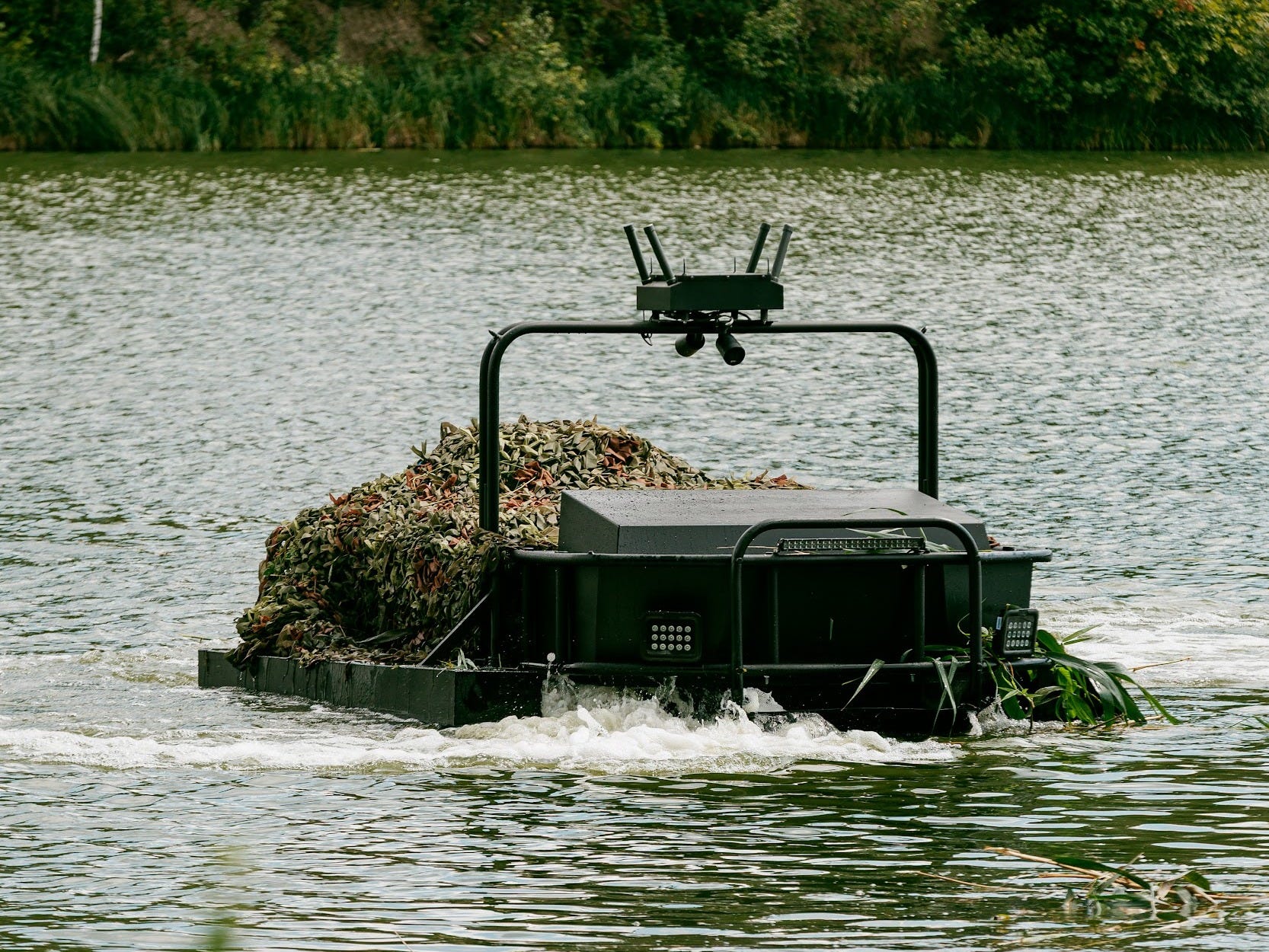
Ukraine recently saw its first amphibious drone logistics mission. Rather than an isolated case, it marks the emergence of a growing sector: amphibious drones that can cross both land and water. For now, they are designed for logistics and evacuation missions, with strike variants likely to follow.
For this article, I spoke with “Electric,” commander of the Alter Ego UGV unit that carried out the mission, and with NODRICS, a Ukrainian startup now part of Tencore, which recently unveiled its new amphibious drone, MAT1LDA.
A Country of Rivers
More than 63,000 rivers and streams flow across Ukraine. As UGVs take on a growing share of logistics and casualty evacuation missions on the battlefield, terrain is not always on their side.
In late September 2026, soldiers from the Alter Ego UGV unit of the 93rd Separate Mechanized Brigade publicly reported the first logistics mission using an amphibious drone. According to Ukraine’s Ministry of Defence, the vehicle covered a route of more than 40 kilometres.
On land, the platform kept the cross-country mobility of a conventional ground robot. On reaching water, it switched to swimming mode within seconds and kept moving. The mission delivered ammunition and food to frontline positions.
Water obstacles are a real problem for military logistics at the front. The MoD noted that the mission came after several months of close cooperation between developers and soldiers, who adapted the UGV to the actual terrain and the troops’ daily tasks.
In an interview with Ukraine’s Arms Monitor, the commander of the Alter Ego unit, call sign “Electric,” described amphibious UGVs as a new stage in the evolution of ground drones. Beyond that, he said, such systems are urgently needed in certain sections of the front.
In Ukraine, unlike many other countries, defence innovation often originates within military units and is subsequently scaled up through cooperation with the defence industry.
The idea of the amphibious drone, Electric explained, did not come from a single source. “It emerged across the armed forces at different stages, at different levels, in different units. A lot of people worked on it.” The task was considered important enough to be set at the level of the Commander-in-Chief. Eventually, units and senior leadership, through the senior directorate for innovation, approached the Alter Ego unit for help refining the concept and developing tactics for its use. “Many people worked on this idea, but many didn’t manage to make it successful.”
The unit took two existing systems that fell well short of battlefield requirements. “One could swim but couldn’t drive, and the other was the opposite. So we taught one to drive and the other to swim.” The unit refined both solutions. After receiving several vehicles from the manufacturer, they began testing them on ranges that closely replicated real conditions.
Electric sees this as typical of how Ukraine’s UGV sector has grown: a need appears, an unfilled niche emerges, and everyone works together to close it. He expects amphibious UGVs to follow the same path as ground robots: logistics first, then casualty evacuation, and later strike and engineering missions.
“We haven’t yet fully unlocked the potential of amphibious drones,” he said. “We haven’t even fully unlocked the potential of UGVs, although they’ve already become systemic. Amphibious ones have a lot of untapped potential ahead.”
How the mission worked
In a separate interview with The War Zone, Electric shared further details:
The whole process, from development to combat deployment, took less than three months.
The UGV travelled 40 kilometres one way and then returned, carrying food and other supplies.
The vehicle has two separate control systems, one for land and one for water, and switches to whichever the environment requires.
Navigation relies partly on satellite positioning, which is one component of a broader communication system.
The mission did not succeed on the first attempt. It required extensive planning, preparation and engineering.
The operator controlled the UGV fully manually.
How Manufacturers Are Filling the Gap
While the exact model used in this operation remains unknown, several Ukrainian companies have unveiled amphibious drones in recent months.
The clearest signal comes from Tencore, one of Ukraine’s leading UGV producers. The company launched the Tencore Ecosystem, which brings products from other manufacturers together with its own platforms. As part of this move, Tencore acquired NODRICS, the Ukrainian startup behind the MAT1LDA amphibious logistics drone. It is one of the first signs of consolidation in Ukraine’s UGV market.
According to its stated specifications, the MAT1LDA can carry payloads of up to 500 kg on land and 400 kg in water. It has an operational range of up to 160 km on land and 50 km on water.
The vehicle’s open-frame design allows it to be rapidly reconfigured for different missions, including the installation of cargo containers or evacuation stretchers.
Denys Hlushko, co-founder and CEO of NODRICS, told Ukraine’s Arms Monitor that he sees amphibious capability as one of the most promising directions in Ukraine’s ground robotics.
Until recently, amphibious systems remained fairly niche. Developing them means solving much harder engineering problems than building a conventional ground platform. A designer must ensure not only cross-country mobility, but also buoyancy, stability on water, system reliability, and payload protection.
“We are gradually moving from robotic platforms that can simply move to systems that can carry out missions where ground robotics used to be severely limited,” Hlushko says. “I am convinced that the future of this field lies not just in platforms that can swim, but in fully fledged multifunctional robotic systems. The ability to cross water obstacles is only one characteristic. What matters far more is how effectively the system can perform its mission before, during and after crossing that obstacle.”
He identifies four key directions of amphibious drones development:
Autonomy: gradually reducing the drone’s dependence on constant manual control by developing navigation, operator-assistance systems, and automation of individual processes.
Reliable communications and control: a UGV must remain as predictable and controllable as possible across different operating conditions.
Payload, energy efficiency and range: the system must be able not just to cross an obstacle, but to deliver its payload and continue the mission.
Versatility and modularity: a promising platform should be adaptable to different tasks without the need to build a fundamentally new product each time.
Hlushko also stresses ease of production, repairability and simplicity of operation. “In real conditions, these characteristics sometimes matter as much as technical specifications,” he says. “A manufacturer’s main task is to create not just a technologically sophisticated product, but a reliable tool that soldiers can use effectively every day.”
He sees the greatest potential in three areas:
Logistics: delivering ammunition, food, medical supplies, equipment and other cargo to places where conventional ground vehicles struggle to move.
Evacuation: using specially adapted UGVs to evacuate the wounded, including on routes with water obstacles.
Engineering and specialized support: transporting equipment, tools, special modules, and even other UGVs, for tasks in difficult terrain.
But he emphasizes something else. “In my view, the main advantage of amphibious robotic systems is not their ability to perform one unique operation, but their ability to ensure continuity of missions regardless of terrain,” he says. The point of amphibious drones is that soldiers should not have to choose a separate UGV for each type of terrain.
Other Amphibious Projects
Ukrainian media outlet Defense reported that the BI34G amphibious UGV, developed by Ukrainian Mavka Technology, was unveiled at the Brave1 Defense Tech Valley 2025 exhibition.
The robot can carry up to 500 kg of cargo and tow an additional 1,500 kg. With a full load, it has an operational range of 20 km and can reach speeds of 10 km/h on land and 15 km/h on water. It is electrically powered and uses 24 kW waterjets, similar to those found on jet skis, to cross rivers.
Its enclosed capsule also allows it to be used for medical evacuation. The vehicle features mounting points for protective netting designed to shield wounded personnel from drone-dropped munitions and FPV drone attacks.
The basic version is expected to cost between $25,000 and $30,000.
In mid-October, Defender Media published an article about an amphibious UGV, Toni, developed by an unnamed company. It is designed for logistics, evacuation, and special missions on both land and water. Toni can carry payloads of up to 380 kg on land and 280 kg on water. It reaches a maximum speed of 13 km/h on land and 2–4 km/h on water. It has an operational range of up to 50 km on land and 5 km on water at 50% battery charge. The development team is working to increase both speed and range.
The platform is controlled via ELRS and Starlink. LTE integration is in testing. The platform’s estimated price is roughly $45,000, and the developers are open to investment opportunities.
Another Ukrainian UGV manufacturer, Ratel Robotics, is also developing a new modification of its Ratel X unmanned ground vehicle that will be able to move not only on land but also on water.
Russian Innovations
Russia is also seeking to innovate in this sector. So far, Ukrainian developments appear to prioritize versatile logistics platforms, while Russian designs tend to focus on narrower but more technically complex tasks, such as rescue operations and deployment in extreme environments.
One example is the Chelnok, a wheeled amphibious UGV with a payload capacity of up to 500 kg and a range of 20 km on a single charge. Designed for military and rescue operations, according to the producer, it can transport ammunition, evacuate wounded personnel, and deliver fuel, including across rivers and streams.
Another example is the robotic systems developed by SKTB PR (Special Design and Technology Bureau of Applied Robotics), which are primarily tracked or hybrid platforms equipped with robotic manipulators. According to stated specifications, one of these systems can operate underwater at depths of up to 3.5–4 metres, including in flooded facilities, mines, and nuclear power plants. Its capabilities include reconnaissance, debris clearance, and the manipulation and movement of objects weighing up to 25 kg.
I have previously seen similar projects from Western innovators, particularly those in the NATO DIANA accelerator. Often, however, it was unclear what missions these systems would perform and in what context. Ukraine has now put such systems to their first battlefield use, giving developers around the world a clear picture of what these platforms are actually needed for, and where their development should go next.
Read other relevant articles: