

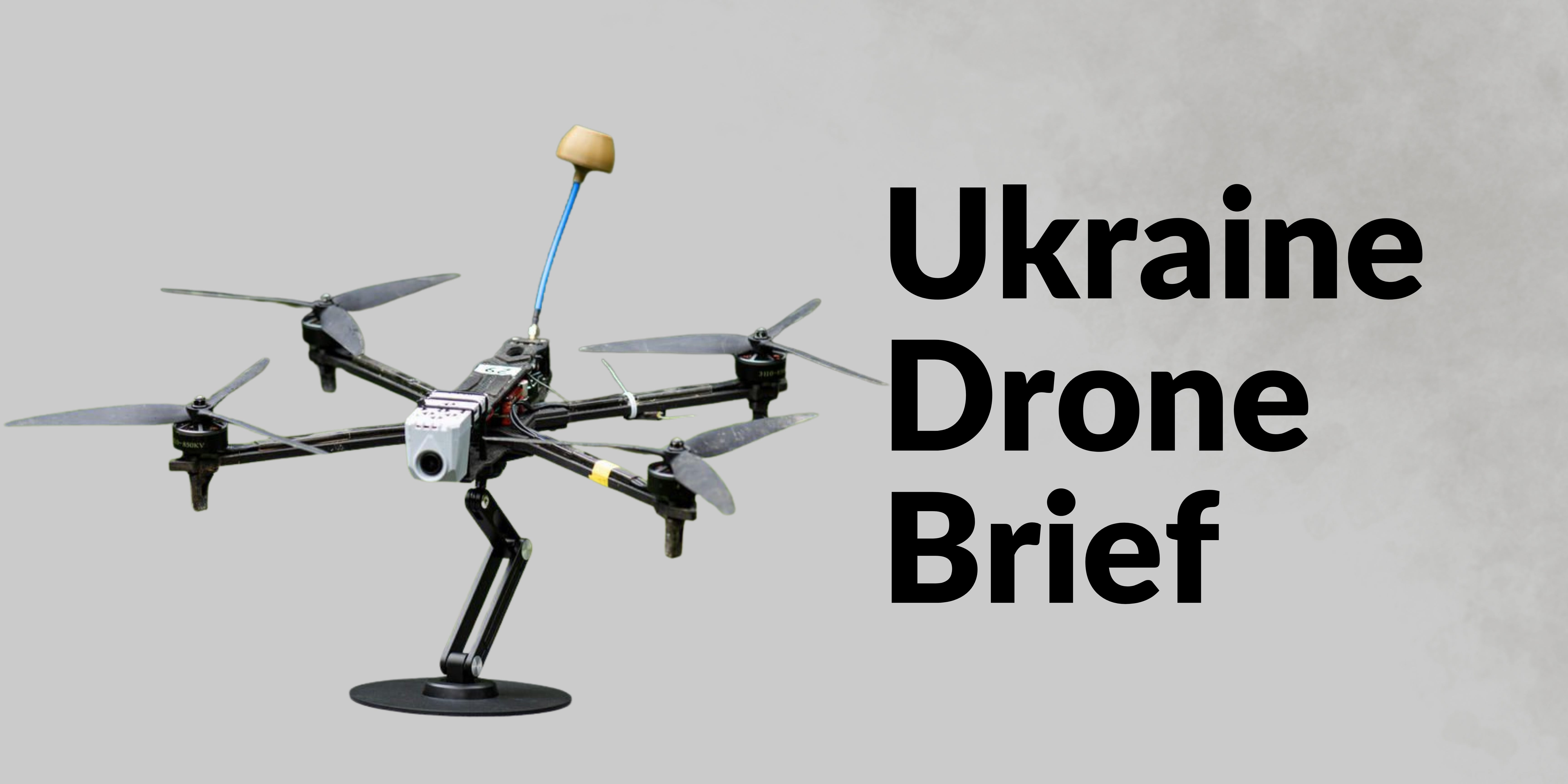
Not only drones, but also counter-drone systems are evolving rapidly in Ukraine and Russia — and NATO countries should take note.
This newsletter covers more than 20 weekly developments in drone warfare, with the majority focused on counter-UxS capabilities.
Since it’s the week of Ukraine’s Independence Day, I’m celebrating it with my audience by making much of my content freely available, including this edition of Ukraine Drone Brief.
Read earlier reports:
Free full edition of Arms Trends in Ukraine: 17 August - 23 August, 2026;
Drone Warfare in Ukraine newsletter with a free section: Korean Company Develops Battery Packs for Ukrainian Interceptor Drones.
Aerial Drones
President Zelensky said Ukraine should increase the number of long-range drones used to strike targets in Russia from the current level of more than 300 to 1,000 per day.
Russian forces attacked Ukraine with seven S8000 Banderol missile drones and 96 strike UAVs (70% of them were jet-powered) on 28 August. Most of them were targeting Kyiv.
Russia has shifted to a new air terror tactic in recent days – hitting Kyiv and other cities in small drone waves every 30–60 minutes around the clock. On August 27, Kyiv saw 13 air raid alerts totaling 14 hours.
On August 28, a Russian jet-powered Shahed covered a record distance of around 960 km before being shot down by Ukrainian air defenses.
Russian attacks have destroyed around 90% of modern storage facilities for goods in Ukraine.
Ground Drones (UGVs)
Ukrainian Defence Forces have begun combat testing UGVs armed with two Kalashnikov rifles. The project received grant funding and moved from concept to prototype in under six months. Its use of standard Kalashnikov rifles is intended to reduce costs and simplify scaling, while the four-wheel chassis, airless tires, and protected body are designed for operation in difficult terrain.
Ukrainian Tencore is developing a flamethrower module for its TerMIT 2.0 UGV. The new combat module integrates eight RPV-16 rocket-propelled infantry flamethrowers, originally designed as portable infantry weapons, allowing the UGV to engage enemy personnel while operators remain at a safer distance.
Naval Drones
Ukrainian Uforce has unveiled the new MV11 maritime drone. It is described as the largest platform in the Magura family and one of Europe’s largest USVs. Designed for open-sea operations, the MV11 can transport and launch other drones far from shore and is intended for reconnaissance, surveillance, maritime support missions, and carrying fuel or equipment for other unmanned systems.
AI
A Russian drone that attacked Zaporizhzhia on July 6 was reportedly equipped with an experimental AI system capable of autonomously identifying a target for attack. Three people were killed in the strike. Analysis of debris found that the drones had onboard minicomputers, sold commercially by Nvidia, that made their targeting decisions. Ukrainian expert said that the drone was a preprogrammed tool trained in virtual reality to track specific objects, such as a gas station.
A Ukrainian company told me that each of the technologies mentioned, including target identification and model training, has already been under development for some time.
However, operator-controlled missions still account for the overwhelming majority of drone operations, with the human operator remaining the primary decision-maker.
Russian state media claims that Russian forces are attacking Ukrainian units with AI-enabled drones that allegedly recognize Ukrainian military uniforms and vehicle license plates.
C-UAS
Russia has equipped some Shahed/Geran drones with an EW system designed to disrupt interceptor drones. When a Ukrainian interceptor approaches, the Shahed’s EW receiver detects the interceptor’s video-transmission frequency and activates a jammer on the same frequency. The Shahed’s jammer reportedly transmits at roughly five times the interceptor’s power, overwhelming the video link and preventing the pilot on the ground from seeing the drone’s feed.
Ukraine works on the “Mayachnia” project to support drone navigation and precise positioning in the Black Sea when satellite communications are unavailable. Deployment of an autonomous radio-beacon network based on the Skyline platform began late last year. The beacons operate independently, are equipped with backup power sources, and are integrated into a centralized network.
Ukrainian forces are testing the Spys interceptor drone, developed by WIY Drones to counter jet-powered UAVs. An initial batch of 50 drones has been delivered to military units for combat testing. The interceptor has a stated operational speed of up to 450 km/h, while testing recorded a maximum speed of 600 km/h.
Ukrainian Wild Hornets introduced an upgraded Hornet Vision VTX Pro video-transmission module for its interceptor drones. The new version more than doubles output power to 4 W, increasing video-link and control range by up to 50% under favorable conditions. It also improves the interception effectiveness against low-flying targets by more than 20% and provides greater resistance to electronic warfare and radio-frequency interference.
Russia has begun mass production of the domestic electronic warfare system “Volna Kupol Garant,” capable of countering the Starlink satellite system.
Russian state corporation Rostec has launched production of the SOKOL-08 mobile radar, which incorporates machine-learning algorithms. According to Russian sources, the system can track up to 100 targets simultaneously, identify small drones, and automatically filter out false detections.
A Ukrainian Mi-8 helicopter has been integrated with interceptor drones for engaging Russian UAVs. The helicopter can carry up to six interceptors, which are likely controlled either from onboard the Mi-8 or remotely via Starlink.
Ukrainian BlueBird Tech has launched an upgrade campaign for its Chuika 3.0 drone detectors, adding a fourth frequency band covering 6–8.8 GHz.
Ukrainian tech startup Zvook is conducting research and development into hydrophones engineered for passive underwater acoustic monitoring.
Cooperation Deals
Ukraine and Norway have signed a defence cooperation agreement under the Drone Deal format. This is the tenth country establishing a Drone Deal with Ukraine.
American Palladyne AI and Ukrainian-Estonian NORDA Dynamics, a developer of a drone autonomy ecosystem, announced a collaboration to integrate Palladyne AI’s SwarmOS™ decentralized, collaborative autonomy platform with the Underdog Autonomy Module, NORDA’s autonomous terminal guidance product for next-generation unmanned swarm operations.
Finnish Patria and Ukrainian General Cherry signed a LoI. Patria plans to initiate drone production in Finland, which would support the development of Europe’s defence capabilities
Ukraine would receive about 90% of the drones built by Finnish companies under a planned Finland–Ukraine framework agreement. The other 10% would stay in Finland.
Britain signed a partnership with Ukraine to jointly develop artificial intelligence tools for defence and security, giving British researchers access to a Ukrainian battlefield data platform used to train military AI systems.
Relevant Global Developments
Chinese drone manufacturers are focusing on low-cost interceptor drones produced using 3D printing and equipped with artificial intelligence. The technology is also being actively exported abroad, including to Russia.
An explosive drone found near a Ukrainian cargo aircraft at Leipzig airport in early August bore the hallmarks of devices typically employed by Russia's Military Intelligence Directorate, the GRU, a U.S. intelligence source told.
Slovak police thwarted a planned arson attack on the Ukrainian Skyeton production facility in the eastern part of the country, where unmanned systems are manufactured.
Japan’s defense procurement agency has signed a mass-production agreement for interceptor drones, selecting the Terra B1, a rocket-launched system developed by domestic industrial giant Terra Drone. The Terra B1 is the Japan-made counterpart to the Terra A1, which was fielded on Ukrainian battlefields earlier this year.
The UAE has built massive protective cages around fuel tanks at Dubai airport after one of those tanks was struck by an Iranian drone early in the war.
Work with Ukraine
The Ukrainian agency Calibrated organizes Defence Tech Comms Bootcamps, a training programme designed for Ukrainian defence-tech professionals. The programme provides insights into market opportunities and potential areas of cooperation across different regions and countries. The autumn edition will focus on opportunities in Asia. Calibrated is currently open to sponsorship partnerships. Contact them here.
The Ukraine Drone Brief is usually available exclusively to VIP subscribers, while all other newsletters are available to regular paid subscribers.
Thank you for considering supporting my work with a paid subscription. None of the content in this newsletter is sponsored, so your support helps me continue doing this work independently and dedicate more time to it.
Read earlier relevant reports: