

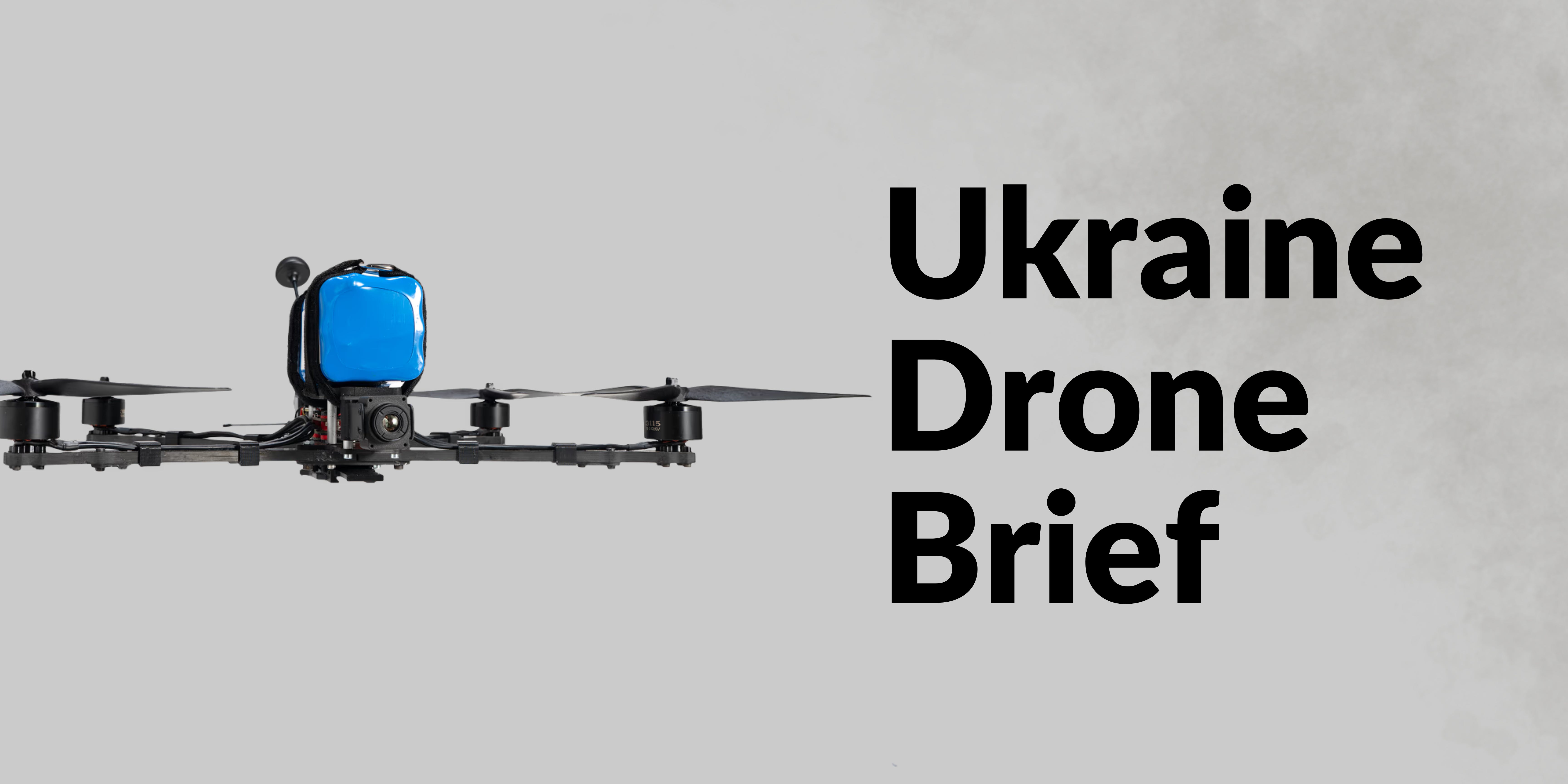
“Every day, 10 new drone models are created in Ukraine,” my friend in Ukraine’s Armed Forces joked. The truth is that Ukraine’s developers are innovating at lightning speed. Last year alone, more than 500 drone models were codified — and we can only imagine how many more were already being used by military units without formal codification.
My Ukraine Drone Brief has already been out for two months, and I’m making today's edition free so more people can read and enjoy it.
If you are a VIP subscriber, or are thinking of becoming one, let me know what kind of information you’d like to see in the Brief.
Check the previous sections here.
Aerial Drones
In the Brave1 Marketplace, the Kolibri FPV drone by TAF Industries ranked in the top three in two categories: “Most Hits” and “Most Orders.”
This information is accessible in the closed section of the catalogue, which is available to military personnel, manufacturers, and investors.
Ukrainian combat units are testing SLAVIK, a reconnaissance drone by Vyriy Industries, which can remain airborne for 1.5 hours. It is positioned as a Ukrainian alternative to DJI drones.
Ukraine’s ROBONEERS presented the WARDOG TRN relay drone. It can carry up to 3 kg of relay equipment and deploy an airborne communications node at altitudes up to 900 m.
Amid Russia’s persistent shortage of heavy multirotor drones, Defence Minister Belousov claimed that the domestic industry would deliver 20,000 heavy logistics and combat drones, capable of carrying 10–40 kg, to the front in 2026.
Putin said Russia is working on a satellite constellation to control heavy drones. This likely refers to the “Bureau 1440” satellite constellation. Russian milbloggers expect that once Russia expands its satellite fleet, it could enable Geran strikes far from the front line with higher precision.
For the context, the first of the 16 satellites recently fell back to Earth.
Ground Drones
Since the beginning of 2026, Ukraine’s MoD has officially codified 50 UGV models. Over the whole of last year, 60 ground drones were codified.
From January to early June 2026, Ukrainian forces conducted more than 50,000 logistics and evacuation missions using ground robotic systems.
Ukraine’s 60th Mechanized Brigade (Third Army Corps) received an AI-enabled ground-based air-defence robotic system capable of independently identifying, tracking, and destroying targets without human involvement.
Naval Drones
Magura USV by UForce made their Indo-Pacific debut during Exercise Balikatan 2026, destroying a decommissioned target ship in a live-fire maritime strike off Itbayat in the Batanes archipelago (Philippines) in April 2026.
Romania plans to ask Ukraine to reprogram its naval drones so they self-destruct far from Romanian waters.
C-UAS
Ukraine’s LITAVR interceptor drone has a declared maximum speed of 350 km/h and an operational radius of 40 km. There has been a recorded flight of more than 80 km from the launch point. The drone’s maximum flight altitude is 9 km. Its key feature is its automatic terminal guidance system (Last Mile or Pixel Lock).
Ukrainian Yartura unveiled the Dancer 4.5.0 interceptor, with a maximum speed of 450 km/h. The drone can engage targets at altitudes of up to 4.8 km and has an operational range of up to 30 km.
It is equipped with an automatic target-tracking system (ATTS), allowing it to re-engage a target if the first attack attempt fails.
General Cherry’s Bullet interceptor can now hunt jet-powered Shaheds.
Equipped with the STRIX chemical booster, Bullet launches faster and requires less operator effort. To support the upgrade, General Cherry redesigned and reinforced the lower section of the drone’s frame.
AI
More than 100 Ukrainian companies have gained access to Brave1 Dataroom, a secure platform designed to train AI models using real-world data. One of the key focus areas is the development of technologies for the automatic detection and interception of Russian drones.
Cooperation Deals
Ukrainian SkyFall and Airbus formed a strategic alliance. The parties plan to integrate Ukrainian P1-Sun interceptor drones with Airbus’s Air C2 airspace management system.
Germany’s INTEC and Ukraine’s Skyeton will partner to supply unmanned systems to European armies, with a primary focus on Raybird, a small tactical UAV designed for long-endurance reconnaissance missions.
Zelensky said that Ukraine could send expert teams to the Baltic states to help them defend against “stray” drones.
Norway will contribute €109 M (NOK 1.2 billion) to the development and procurement of maritime drones for Ukraine in 2026. This will involve deliveries from the Norwegian and Ukrainian industries.
Moldova wants to develop domestic UAV interceptors to protect its airspace. Chisinau is consulting with Kyiv on gaining access to the necessary technologies and Ukrainian expertise.
Ukrainian Unwave tested its tactical EW systems abroad for the first time, holding trials in the Czech Republic. The company tested how its EW works against DJI, Autel, and FPV drones using different control frequencies. The testing was made possible by a temporary export permit for military equipment.
Related Geopolitical Developments
Russia criticized Ottawa’s drone production deal with Ukraine, calling Canada a “warmonger” nation. It also threatened to publish the addresses of all Canadian facilities involved in drone production for Ukraine.
German Quantum Systems, which operates in Ukraine, will integrate its Jäger hit-to-kill interceptor drones with Airbus military helicopters.
Work with Ukraine
According to Defender Media, MaXon Systems, the company behind the recently presented nearly autonomous interceptor drone, is beginning to raise a seed round.
Can you believe it, Russia calling Canada a war mongering nation, while you look at what Putin and Russia have done to Ukraine. Given what I read, Putin is in trouble and may have more to deal with than the war in Ukraine, dethroned!! Great strategy
Slava Ukraine