

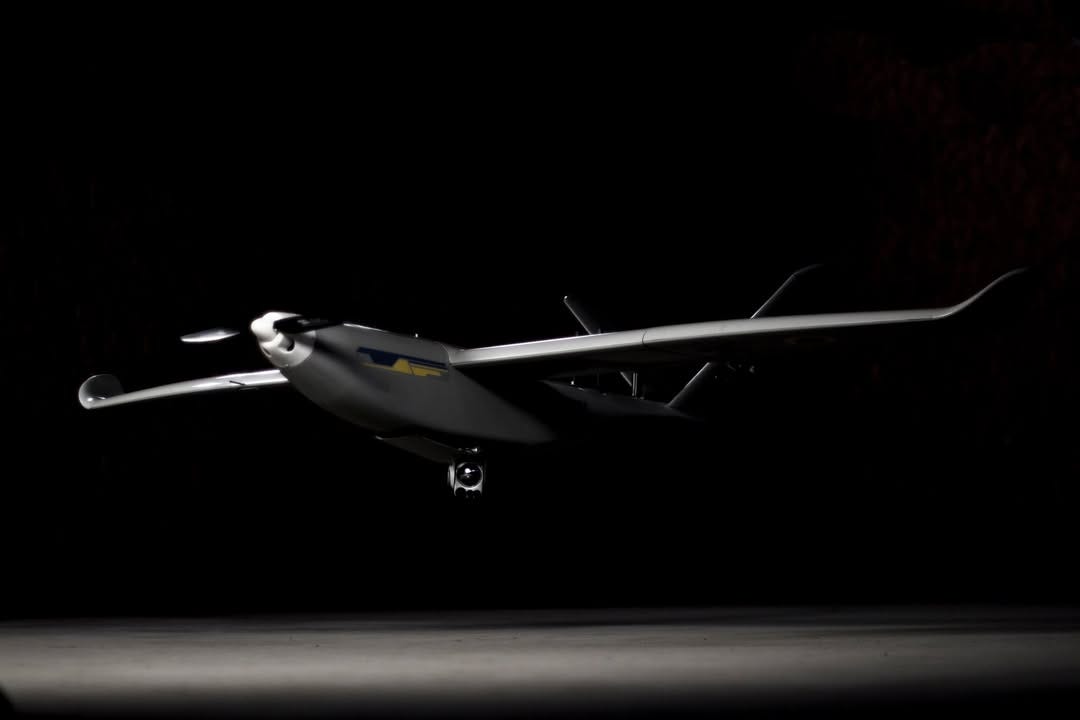
The Ukrainian reconnaissance drone GOR is in the spotlight of my newsletter this week. It has become one of the primary targets for Russian forces due to its success in helping Ukrainian troops locate enemy positions and equipment.
This publication holds special meaning for me, as I was lucky to meet personally with a representative from the producing company, Airlogix. We spent several hours discussing drones and the war in general. I share some of those insights in the newsletter. Meetings like this are very important for my professional growth, and I hope there will be many more to come!
Thank you for reading and supporting my work!
Reconnaissance drones are another type of unmanned aerial vehicles that Ukraine is actively using against Russia, which, however, do not receive the same media attention as FPV or deep-strike drones.
According to Russians, the reconnaissance drones are a top priority for destruction, as these vehicles try to detect their positions and equipment. Russians try to deal with these drones with extreme caution and care, so as not to be detected while locking onto a target with an air defense system.
Unmanned Aerial Complex “Gor”, produced by the Ukrainian company Airlogix, has become one of the primary targets for Russian forces, alongside other well-known reconnaissance UAVs such as the Leleka-100, Shark, and Furia. Thus, details about current projects in development, production capacity, and the level of production workload cannot be publicly disclosed.
Gor was adopted by the Ukrainian Armed Forces back in 2022, and since then has helped to destroy Russian equipment worth several million USD. Today, over 700 units are deployed at the frontline. Its main task now is to locate enemy equipment and adjust Ukrainian artillery fire accordingly.
The standard package includes:
3 UAVs with EO-IR camera NextVision Raptor;
tripod;
UAV control station;
catapult launcher;
6 battery sets of UAV;
ground control station;
antenna;
Payload control station;
communication equipment;
2 battery sets for GCS;
5 transportation packages;
spare parts, tools, and accessories.
The UAV can stay airborne for about 4 hours and cover a distance of 260 kilometers, while it is ideal for tactical and strategic reconnaissance at distances up to 100 km. The drone flies at altitudes ranging from 100 to 3,500 meters. It is protected against electronic warfare and transmits precise coordinates without relying on GPS.
The exact specifications of this drone, according to Brave1 Market, are as follows:
Cruising speed: 64 km/h
Maximum speed: 108 km/h
Flight duration: 4 hours
Camera type: Daytime/infrared
Tactical range: 100 km
Navigation: GNSS, INS
Launch type: Catapult
Engine type: Electric
“Speaking of the coolest features we have, our aircraft operates with two communication systems simultaneously. This means that if the Russians jam one system, the other continues to function.
They operate on different frequency bands, and most of the time, when we enter an electronic warfare zone, there's only one jammer in place, which can’t block both frequencies at once.
Secondly, we have an exceptional camera—an Israeli-made system (Raptor), considered the best in the world right now. It's used by top-tier European drones. The camera offers 80x zoom (40x optical and 2x digital) and allows for both day and night operations. It’s so powerful that you can see the expression on a Russian soldier’s face as an FPV drone flies straight toward him,” the company’s representative said during an interview with Telekanal Rada.
Earlier in May, fighters from the 68th Separate Rifle Brigade of the Armed Forces of Ukraine shared how they use the “Gor” drone in their operations.
Before launch, the operators check the integrity of the wings and tail, then place the drone on a catapult. After a few minutes, the drone is already hidden in the sky and flying toward the enemy. From that point, control of the drone is conducted from underground. “On a single flight, we locate 3-4 enemy artillery pieces,” they said. The unit’s team operating this system consists of four people: an operator who manages the camera and payload, a pilot who controls the drone itself, a driver, and a technician responsible for the catapult.
“We have a dedicated training base where we prepare military personnel. Our main goal is to ensure that the drone is not lost during operations. One of its key features is that it lands like an airplane—on its fuselage—which means the pilot needs to have excellent skills. We dedicate two weeks to hands-on training and one week to theory. In addition, we offer an online component that the pilot completes before arriving at our school,” the company’s representative said.
The company currently has only one product that is already operational and performing tasks on the front line. However, it is also working on developing around 10 other products, which will soon be in the hands of soldiers on the front lines.
Without going into production details, the topics discussed in the conversation also highlight broader trends in drone warfare in Ukraine, offering valuable insights for defense professionals worldwide.
According to the company representative, this year will be a turning point for Ukraine. Currently, there are numerous claims suggesting that Russia holds technological superiority, but these are part of a disinformation campaign. The Ukrainian state reacts correctly - it does not respond to these claims. The situation in Ukraine is not as dire as it seems.
“Laser weapons are not science fiction—they are currently the most effective air defense against FPV drones. These systems burn out drones’ brains, optics, and disable the control systems of FPV drones, making it impossible for them to continue flying”.
In early February, Ukraine announced its development and testing of a laser weapon called Tryzub. In April 2025, footage from the system’s trials was shown in a video during the conference “European Defense Industry: Prospects for Cooperation with the Ukrainian Defense Industry.”
This laser complex is designed to engage both ground and aerial targets. It can be used to destroy attack drones and aerial bombs at distances of up to 3,000 meters. Reports also indicate its capability to neutralize cruise and ballistic missiles at the same range. Additionally, the "Tryzub" system is capable of destroying helicopters and aircraft at distances of up to 5,000 meters. Beyond physical destruction, the laser system can also optically suppress (blind) drones, cruise missiles, helicopters, and aircraft at distances of up to 10,000 meters.
“The Ukrainian missile program was essentially neglected for many years. Previously, Ukraine focused on land-to-water systems; now it’s land-to-land, and the results are evident. Currently, Ukraine is developing ballistic and cruise missiles. Since 2023, Ukrainians have begun developing their own missiles, realizing that no one would provide them in the required quantity. Missiles are a game-changer in this war. Ukraine has access to high-quality components and is not under sanctions. We can purchase excellent components and produce large quantities”.
Recently, President Zelensky said that Ukraine has made significant progress in its missile program. However, further development requires additional funding that is not covered by bilateral agreements with partners. Ukraine needs $30 billion to fully launch production across its defense-industrial sector.
The President emphasized that Ukraine aims to secure financing and safety for new production lines, including by establishing some of them abroad: “After the war, partners will be able to access these technologies. Some of these facilities will already begin operating this year”.
“Ukrainian deep-strike drones are 3–4 times cheaper than Russian equivalents. The technology hasn’t peaked yet — the peak is expected in 2025. Russia has mid-range drones like Molniya and Lancet, with limited range (40–60 km) and small-scale production. Ukraine has developed mid-range drones with ranges up to 150 km — it’s also a game changer. Over 20 producers are currently active in Ukraine, and Russians are overwhelmed and unsure what to target; this will continue. The commercial sector of Ukraine’s defense industry is outperforming the state-run one. There’s no rivalry between Ukrainian firms. While they all use different software, now they are moving toward standardization. The government is now promoting software unification to make systems interoperable”.
Deep Strike drones are long-range systems designed to strike targets deep inside Russian territory. In 2022, Ukraine expanded production of Deep Strike drones 22-fold since 2022. In Ukraine, long-range strike drones such as "Liutyi" and "Bober," as well as missile-drones like "Peklo" and "Palianytsia," fall into the category of deep-strike systems. The Defense Forces are also deploying other classified deep-strike assets. Currently, Ukraine’s industry has managed to localize the production of over 50% of deep strike drones.
The success of such drones has led the United States to select four companies to participate in the Artemis long-range kamikaze drone program, including two that are collaborating with Ukrainian firms.
Defense is a new IT, where progressiveness will prevail over conservatism.
The nature of the Russian-Ukrainian war has shifted priorities in the defense industrial complex, from state-centered needs to the needs of military personnel. The military units are the end users of these products. As a result, the entire defense tech ecosystem in Ukraine revolves around the priorities set by these units, something the Brave1 Market effectively reflects.
“This war is about the soldiers, not just command structures. Countries need to focus on the needs of their troops and ensure that what they fight with—and how they fight—matches their real demands,” said the representative of Airlogix.
The state, as an employer, must provide the right conditions, not enforcing uniformity as before, but enabling individuals to realize their full potential. This is made possible through platforms like Brave1 Market.
"Brave1 is a brilliant project that addresses many challenges: it's about acquiring tools for eliminating enemies and distributing them among units. It’s a logical and fair system: the most effective units receive the most drones”.
As I reported in one of my previous newsletters, “Gamification of War: Point Systems for Shooting Targets”, military units in Ukraine receive points for each destroyed target, which can be exchanged for additional UAVs or electronic warfare (EW) equipment.
The top 5 units in April 2025 by combat points earned are:
Madyar’s Birds;
The Special Group "Alpha";
Lasar group (National Guard of Ukraine);
3rd Assault Brigade;
3rd Separate Air Assault Battalion "Phoenix".
In June, the commander of the Madyar’s Birds, Robert "Magyar" Brody, was appointed head of the Unmanned Systems Forces of Ukraine.
Thanks for the news, and Happy Canada Day.
It is so fantastic to see user-driven technology, and cooperation among developers.
This is the power of teamwork!
Together
Everyone
Achieves
More
I absolutely love the friendly yet deadly competition among Ukranian fighting forces.
What a great way to share wins and keep up one's spirits.
I'm also really encourage to see that "Magyar" was promoted to such a responsible position.
It shows how important it is to have the leadership include those that have recently faced the reality on the front line.
That makes military planning always super relevant, with the speedy iterative process of
Plan
Do
Check
Act
I, and many, are cheering Ukraine on, even if all we can do (location, personally abilities etc.) is share info so as to "populate the blogosphere", and hope that it helps motivate some, who are able, to do more.
Your post here left me feeling more informed and more hopeful.
Nicely done!
Thanks again.