

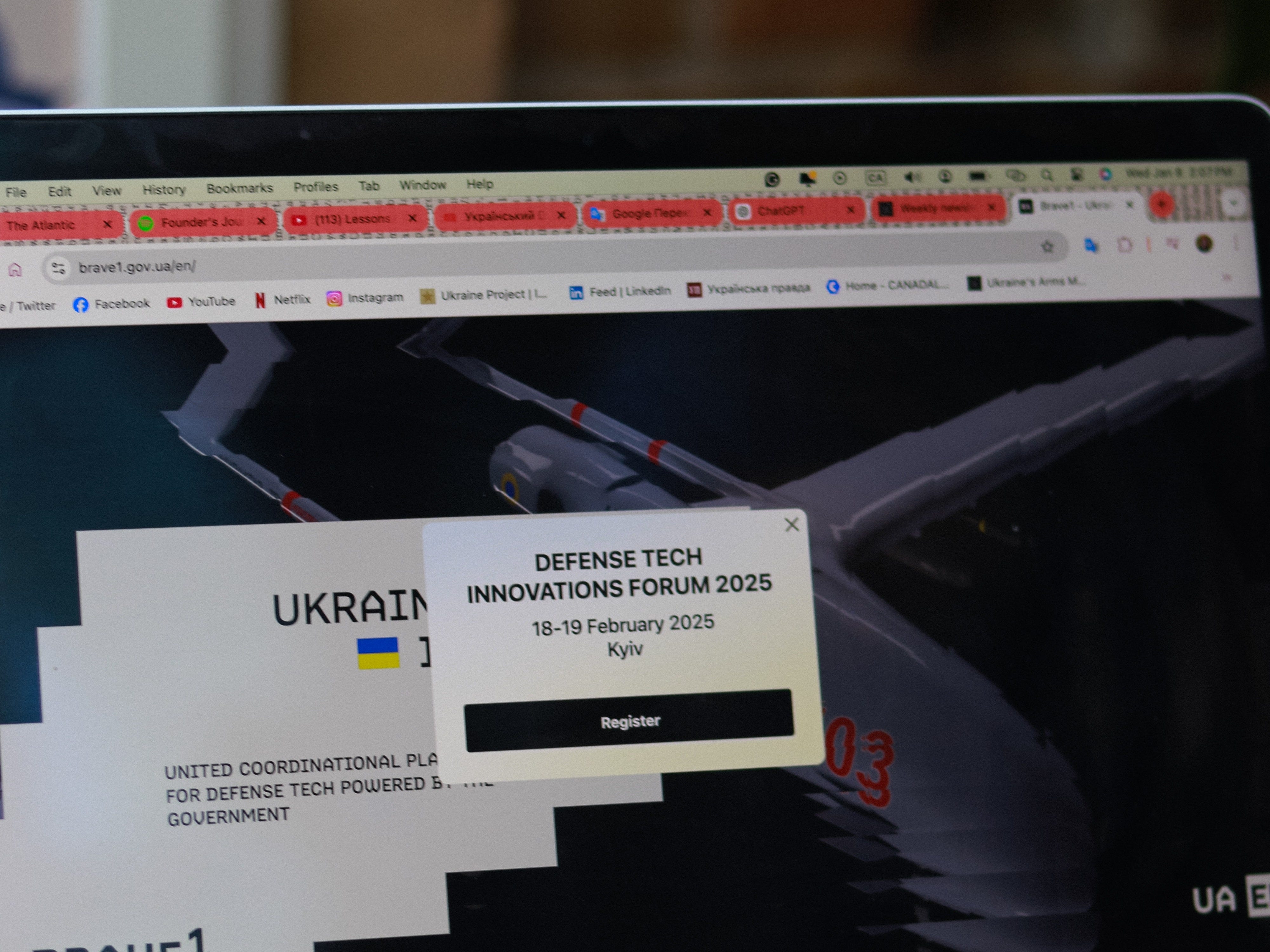
In 2025 and in the years to come, Ukraine has the potential to become the "defense valley" thanks to its highly skilled and creative human resources, as well as its technological capabilities tested on the battlefield. While Ukrainian Defense Tech was underfunded in 2024 and did not operate at its full capacity, Ukrainians are learning how to present their innovations to foreign investors. Additionally, several international initiatives are helping them find partners abroad.
I’ve summarized an insightful article titled “A Bunch of Ideas and a Lack of Money: Analysis of Ukrainian Defense Tech for 2024 and Prospects for 2025” published by AIN.UA, a leading media outlet covering finance, startups, business, and investments in Ukraine.
In 2024, investment in defense technologies was still considered an "underdeveloped industry" in Europe. For example, in July 2024, one of the largest European Defense Tech startups, Helsing, raised €450 million in a Series C round. However, the majority of investors were American, with only the Estonian-British venture fund Plural and the Swedish defense giant Saab among the European backers.
On the other hand, startups in Central and Eastern Europe within the Defense Tech sector attracted more attention from private European investors throughout 2024. This includes the Latvian startup Origin Robotics, which develops compact UAVs capable of delivering laser-guided strikes, and the Estonian company SensusQ, which is building a SaaS platform for management, control, communication, and intelligence.
Yaroslav Azhnyuk, the founder of the Ukrainian Defense Tech UAV startups The Fourth Law and Odd Systems, highlights the challenge of finding people with highly specialized expertise in this field. The labor market in Ukraine is likely to remain tense in 2025.
The situation with domestic weapon procurement remains challenging. The level of spending on defense technology is unlikely to increase significantly, meaning the production capacities of Ukrainian enterprises will continue to be underutilized, as they were in 2024.
Given Ukraine's limited capacity to purchase weapons, along with the steady flow of private donations to charity funds, an increase in the domestic procurement capacity is unlikely in 2025.
The attraction of foreign government funds for the production of Ukrainian weapons under the ZBROYARI: Manufacturing Freedom initiative did not meet expectations in 2024. Instead of the ambitious $10 billion, publicly known commitments totaled up to $1 billion.
A potential solution to this situation would be the production of defense products, including high-tech ones, for the armed forces of Ukraine’s partner countries. However, the export ban remains in place. Throughout 2024, the association of defense enterprises "Technological Forces of Ukraine" has been advocating for the lifting of this ban, and, according to unofficial sources, it is expected to be lifted in the coming months.
As of December 2023, around 800 Defense Tech startups were registered in Brave1. Over the course of the year, this number increased by approximately 75%, bringing the total to over 1,400 startups. However, according to predictions, only around 100 new startups are expected to emerge next year.
*Brave1 is a united coordinational platform for Defence Tech powered by the Government of Ukraine.
The key profiles of the participants of Brave1 include producers of UAVs, ground robotic systems, and electronic warfare systems.
It is believed that once the trend of new startups slows down, a phase of consolidation will begin. Ukrainian Defense Tech needs this consolidation for better access to European markets.
How can cooperation between Ukrainian Defense Tech startups and foreign partners be strengthened? Yaroslav Azhnyuk proposes the concept of a "defense valley," which could become a key element of the new national strategy. The goal is to make Ukraine indispensable to the North Atlantic Alliance in the field of Defense Tech, much like Taiwan is indispensable in the microchip industry.
In September 2024, the EU Defense Innovation Office opened in Kyiv. Hosted by the European Union Delegation to Ukraine, the Office will promote cross-border cooperation between the Ukrainian Defence Technological and Industrial Base (DTIB) and the European DTIB. It will act as a focal point for Ukrainian partners, as well as a coordination and information hub.
Defense Tech should become a strategic sector for Ukraine, one that not only defends the country but also strengthens its resources. The industry must continue to evolve, even if the intensity of hostilities decreases.
You can read the full article in Ukrainian here: A Bunch of Ideas and a Lack of Money: Analysis of Ukrainian Defense Tech for 2024 and Prospects for 2025