

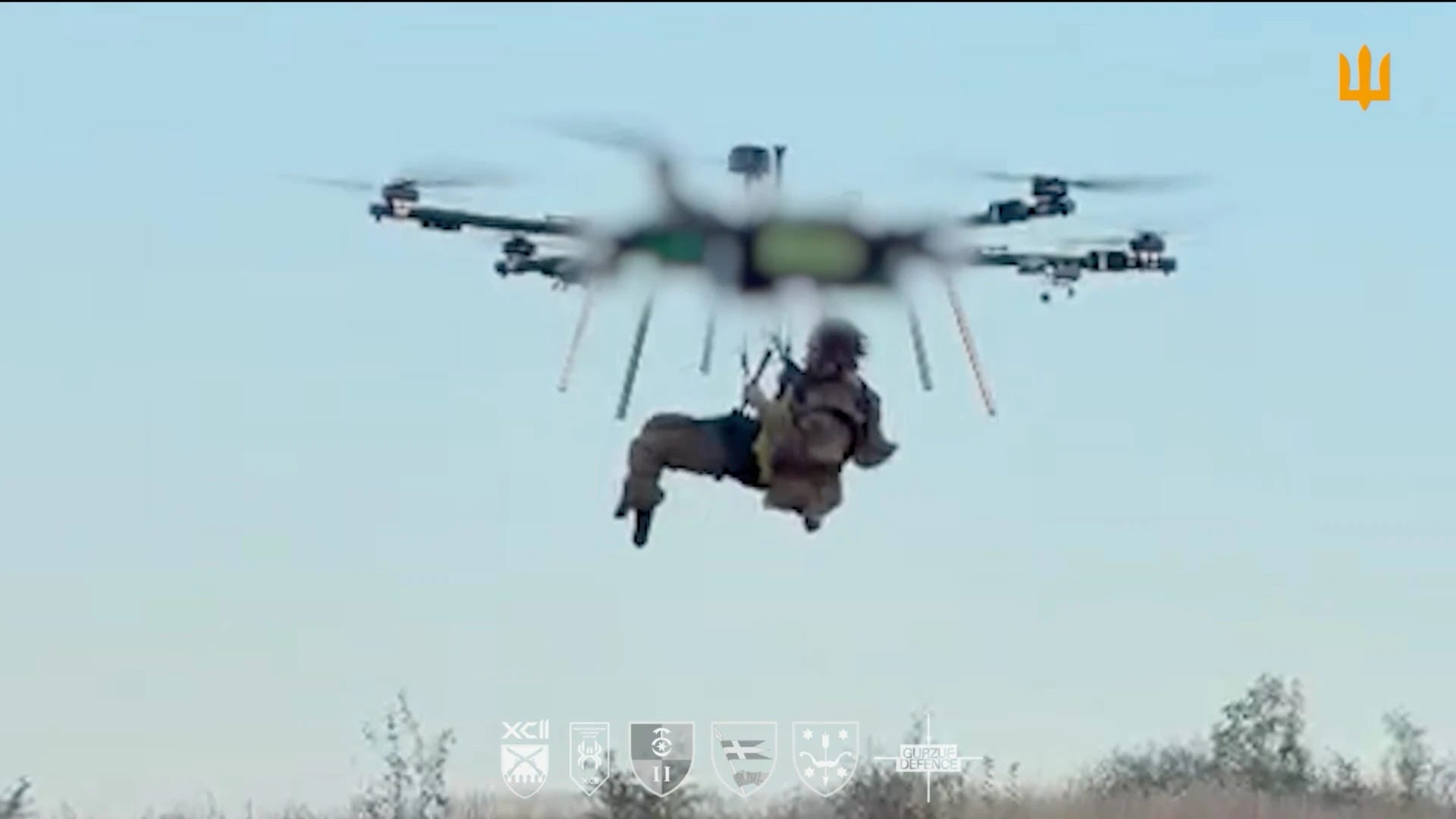
A heavy aerial drone in Ukraine did what human and UGV crews could not: it evacuated a wounded soldier who had spent 491 days at his position. The mission required coordination among several units, which covered the drone with artillery and electronic warfare support. It is another example of drones saving lives where other methods have failed, and another illustration of how differently Ukraine and Russia value the lives of their soldiers.
Heavy drones have recently been making headlines not only in their traditional role as “Baba Yaga,” striking Russian positions at night, but also for their important role in humanitarian and medical evacuation missions.
In the Kharkiv region, Ukraine conducted its first medical evacuation mission using an Ayu-Dag 6 hexacopter drone by domestic producer Gurzuf Defence. Their drones, Heavy Shot, had previously been used to deliver humanitarian aid to Russian-occupied Oleshky. Read about this operation in my report: Drones for Humanitarian Missions: Delivery to Occupied Oleshky.
After being wounded by a munition dropped by a Russian drone, a Ukrainian serviceman with the callsign Magura amputated his own legs and spent 491 days at his position. The wounded soldier survived until his evacuation thanks to drones that dropped food to him every four to five days, while communication with him was maintained by radio.
Evacuating him by conventional means was impossible because of Russian drone activity. Several earlier attempts to evacuate the soldier with UGVs failed. “If a drone of this type can fly at 60 kilometres per hour, a UGV manages 10. And when it comes to covering the distance, a drone flies in a straight line, while a UGV, like a vehicle, has to take detours, so the time increases significantly. And the longer you spend in the kill zone, the more dangerous it is,” said “Napalm,” a squad commander in the 92nd Separate Assault Brigade’s UGV company.
This “last-hope” evacuation mission took up to two months to plan.
The Ayu-Dag 6 Heavy Drone
The Ayu-Dag 6 hexacopter is a special modification of Heavy Shot drones by Gurzuf Defence. The number 6 indicates the number of engines. It was developed about a year ago as a multi-purpose platform. Its main purpose is logistics missions, but it was designed so the military could use it for different tasks. In an interview with Suspilne, Gurzuf Defence said the drone can lift 135 kg. “We even set a Ukrainian record for this class among manufacturers. Its working payload is 70–80 kg for distances of up to 20 km. We also have a platform of the same class in the final stage of development, for 150 kg, with a range of 15–20 km,” he said.
Unlike the best-known drone in this category, the Vampire, which can carry 15 kg, drones for such missions need to be much bigger to carry significantly heavier payloads.
To conceal the large drone’s flight, a diversion was organized: Vampire drones drew the enemy’s attention (one of them was shot down), while the Ayu-Dag 6 passed unnoticed.
There was no voice communication with the wounded soldier, so the day before the operation, the military sent him equipment and a video instruction on how to strap himself onto the drone. The flight was covered by Ukrainian troops from several units, and artillery, electronic warfare and air defence assets were involved in the planning.
The flight lasted more than an hour, during which the drone carrying the serviceman covered 15 km one way.
Here are its key specifications and the modifications made specifically for evacuation:
Weight of the drone: about 98 kg
Payload: up to 130 kg
Range: up to 25 km
Operating altitude: 150–300 metres
Configuration: modular, so the balance between range and payload can be adjusted depending on the task
What was added for the mission:
a cargo winch, which made it possible to lift the wounded soldier;
a jam-resistant Starlink communication system, which was critical;
a modular harness system to secure the person safely;
a thermal imager and night vision;
airframe modifications so the drone held altitude more steadily and the load didn’t sway too much in flight.
At an intermediate point, the wounded soldier was detached from the winch and then carried 8 km over rough terrain by the remotely controlled UGV Myrotvorets (“Peacekeeper”). The Myrotvorets was designed specifically for risky off-road conditions: crossing minefields or areas with heavy FPV drone activity, where conventional ground evacuation is too dangerous. The robot has a fastening system (a carabiner or strap) to secure the soldier firmly while moving. The vehicle does not operate autonomously: an operator drives it in real time, adjusting the route to avoid obstacles and danger zones.
The main challenge during this mission was coordinating all the units: radio intelligence, EW cover, air cover, and diversionary manoeuvres using UAVs. And, of course, there was enemy fire at the drone. “Dozens of people worked to save one. Every life saved is worth many, many hours of that work,” said the commander of the 10th Army Corps.
Russian sources analysing this mission acknowledged that both parts of the evacuation worked well: the heavy drone took on the most dangerous stretch by air, and the robot carefully delivered the soldier to a place where medics could take over. The success of such missions depends largely on adapting the equipment to the nature of the wounded person’s injuries and their build.
The StarGate Drone
Another Ukrainian company, Skyfall, known for its Vampire heavy bomber drone, has developed a medical evacuation drone, StarGate, and handed it over for testing. It can carry up to 150 kg, reach speeds of up to 105 km/h, and cover at least 15 km one way. The company says it can be prepared for flight in about 10 minutes. The design includes a protected stretcher module, allowing the drone to retrieve seriously wounded soldiers within minutes from isolated positions that vehicles and infantry cannot reach.
StarGate uses several communication channels, Starlink and L-Link, as well as AI-based navigation. It is controlled by an operator but has AI-based functions for operating when the GPS signal is unavailable or spoofed. If communication is completely lost, it can plot a route back to a safe area.
During testing, the drone also demonstrated protection against FPV drones using a net launcher. StarGate can operate in rain and snow and is equipped with thermal cameras for night operations.
The stated cost of one StarGate system is about $50,000, depending on configuration. The company plans to reach production of up to 1,000 units a month by the end of 2026.
Ukrainian service members stress that it is too early to draw conclusions regarding this drone. According to the Associated Press, they say at least a month of experience with StarGate is needed before its effectiveness can be assessed. Drawbacks they mention include the drone’s relatively low speed and some difficulty moving a wounded soldier into its capsule.
A large airframe carrying a 150 kg load is an easy target for small arms, MANPADS, and FPV interceptors, which makes evacuating soldiers from the red zone with such a system highly risky.
Even so, Ukraine’s 475th Assault Regiment used StarGate heavy drones to carry out two aerial evacuations of seriously wounded soldiers in one week. On one mission, the drone flew almost 30 km one way and returned under enemy electronic warfare, using AI-based navigation without GPS.
One soldier was handed over to a ground team just 30 minutes after the flight began. The unit is considering creating a dedicated unmanned medical evacuation element.
Currently, Ukraine is probably the only country in the world that is investing in heavy multicopter drones for medical evacuation missions. Ukraine’s MoD and the Brave1 defence innovation cluster are working together to integrate this technology further into military operations.
They have set the following requirements for aerial evacuation drones:
The aircraft must reliably carry 130 kg over a distance of at least 15 km;
It must have an integrated communication system (at least three alternative types) to ensure survivability under electronic warfare.
In these operations, Ukraine combined aerial evacuation with ground evacuation by UGVs, which is already widely used on the front line. Aerial evacuation can perform tasks that UGVs cannot, especially on dangerous, mined routes. However, the threat from the enemy remains, and such missions require additional personnel and resources.
If you want to follow unmanned developments in Ukraine regularly, I publish two weekly newsletters: Arms Trends in Ukraine every Monday, covering a broader range of military developments in Ukraine and Russia, and Ukraine Drone Brief every Saturday, a concise roundup of drone-related news.
For the best value, consider a group subscription. Available for two or more readers, it offers 20% off both the regular paid and VIP tiers.
Read other relevant reports:
Ukraine’s Alternative to the DJI Mavic: The Slavic Drone by Vyriy Industries;
How Russia Continues to Reinvent the One-Way Attack Drone (CSIS Podcast);
A few weeks ago, I was raising funds for a drone for my friend’s military unit. Thanks to your donations, we purchased a DJI Matrice 4!
What a courageous brave soldier! Can you imagine amputating your own limbs? Can you imagine what citizens in UKRAINE is/ has ( or Gaza ) is/has been going through? The cries of children, civilians, women, men, elderly, disabled - All live and real with the ability to feel real pain and trauma unlike a fetus. So many so called Prolife ( anti science ) believe in wars, hatred and control of women's bodies. President Trump's admin 2.0 under the biggest sickest richest people like Musk, Don Jr., Thiel, Palmer Lucky, Epstein Coconspirators, fake religious money serving hate preachers etc. making deals with Putin like the one for oil/ gas in Alaska- The main reason they have been verbally attacking and harassing Mary Peltola and brought a lawsuit for no wrongdoings is because of Don Jr.s deal w Putin for parts of Alaska. Vote 💙💙💙 because it's for the health of our world at this point.