

Every 41 seconds, Ukraine’s Unmanned Systems Forces (USF) strike a Russian target. In October, USF units alone inflicted 16,796 casualties on Russian troops, roughly a third of all Russian casualties that month, which hit a record 54,400. Yet the USF make up only about 2.5–3% of Ukraine’s Defence Forces. That shows how drones have transformed modern warfare.
Read nearly 30 developments in drone warfare in this week’s edition.
Ukraine Drone Brief is usually available only to VIP subscribers. Upgrade to receive it every Saturday.
Aerial Drones
Under last week’s continuous cloud cover over Ukraine, Russia launched dozens of conventional gasoline-powered Shaheds, counting on Ukrainian interceptor crews having difficulty detecting them. According to the Ukrainian Air Force, only 64 of the 433 attack drones launched since the evening of October 31 were jet-powered.
Russian forces are using jet-powered variants of the BM-35 and BM-70 strike drones, which Ukrainian forces are already intercepting. BM-35 UAVs can reach speeds of over 350 km/h, have a range of more than 200 km, and carry a 10 kg warhead.
On the evening of November 4, Ukrainian air defences shot down a “propaganda Shahed” heading for Kyiv. It was carrying leaflets with a QR code that led to a phishing trap.
Russian forces have begun placing so-called “waiting drones” (ambush drones) directly on high-voltage power lines, a tactic they adopted from Ukraine.
According to the Ukrainian drone pilot, if there’s a de-energized high-voltage line in the combat zone, right near the front, it makes sense to hang a drone there so it can wait for its target. A waiting drone can land on its legs in a field or on a roof, or it can hang from the wires. When it’s needed, it’s activated and flies off to strike. “You can’t see it from the ground, there’s nothing to climb up on, and if you throw a grenade over your head, it can roll right back down at your feet.”
In October, units of the Unmanned Systems Forces (USF) struck an enemy target every 41 seconds on average and hit a Russian soldier every 159 seconds. The month set a record for enemy personnel losses: in October, USF units struck 64,807 enemy targets and inflicted 16,796 casualties on Russian troops.
Total Russian casualties for the month are higher. Russian losses in October hit a record 54,400 personnel, a quarter of them in the Azov Corps’ area of responsibility in Donetsk Oblast. There, the enemy lost 13,624 troops over the month, about 440 a day on average, which is roughly a battalion.
Ukrainian company Ukrspetsdronprom has unveiled the RP7 Chomga, a new fixed-wing UAV designed as a modular platform for reconnaissance, strike and special missions. In its reconnaissance-strike variant, the drone carries a laser designator to guide RP7-10 SkyLoki FPV drones fitted with integrated optical seekers for autonomous engagement.
As a mothership, it can carry up to three RP7-10 strike drones with 1 kg warheads, or two with extended-capacity batteries. In its air-target interceptor configuration, it carries three high-speed RP7-Zenit anti-aircraft drones integrated with the SineLink system.
Ukrainian Vyriy Industries has exited the Blyskavka strike UAV project. Blyskavka’s team will continue developing the drone independently. Blyskavka is a fixed-wing strike drone that can carry a warhead of up to 9 kg. It was developed by a team of engineers, veterans and serving members of the 8th Separate Special Operations Forces Regiment.
Ukraine is working to expand the use of multi-drone control technology. It is already used to make cargo delivery to the front line more efficient. One operator controls a group of drones that take off in sequence and fly to a designated point on their own, without GPS, so they can complete missions even under enemy electronic warfare.
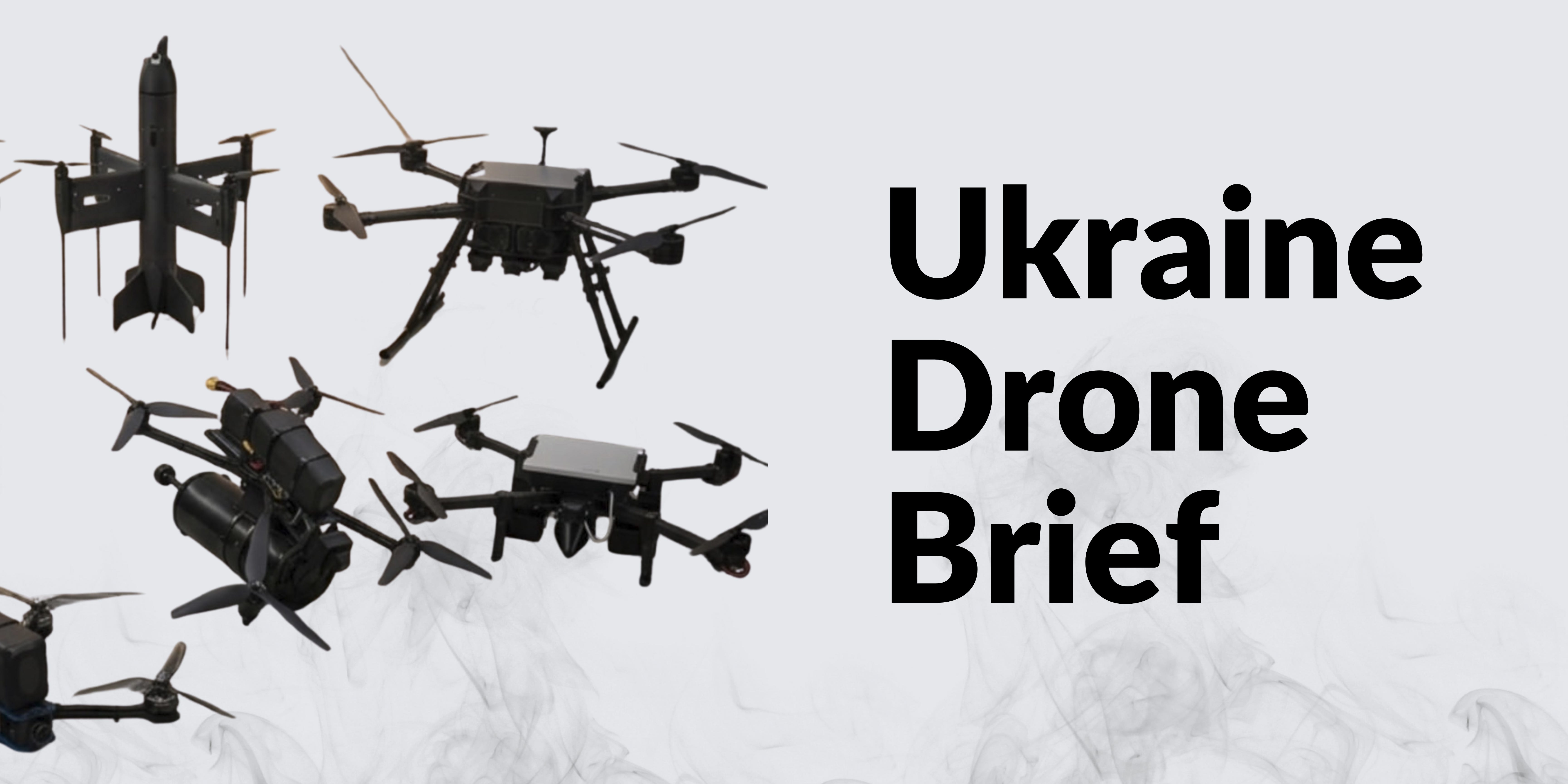
Ukrainian manufacturer Ratel Robotics has developed a lineup of seven UAV models, including strike FPV drones, reconnaissance drones and an interceptor drone.
Ground Drones (UGVs)
Ukraine’s Defence Intelligence (HUR) is testing a new UGV armed with flamethrowers. When a round hits, it generates extremely high temperatures across the blast radius, killing enemy personnel within it. The military has not disclosed which UGV or munitions are involved, but according to analysts, the vehicle looks very similar to the TerMIT 2.0.
Ukrainian company Vitrolom has unveiled the Krit (“Mole”), an ultralight tracked UGV designed to deliver explosives remotely into enemy trenches, basements and other shelters. It weighs about 4.6 kg, including the battery.
Ukrainian Phantom Defense is preparing to mass-produce the Mangal active protection system for UGVs, which automatically detects incoming FPV drones and intercepts them with a net before they reach the vehicle. Earlier versions were manual: the UGV operator had to spot the FPV drone and press a button to launch the net.
C-UAS
In October, Ukraine’s Defence Forces neutralized more than 8,000 missiles and drones, plus 43,000 tactical-level UAVs. According to the Air Force, air defences intercepted 4,455 Shahed-131/136, Gerbera and Parodiya decoy drones; 2,688 jet-powered Shahed-238s; 1,104 reconnaissance UAVs and 809 Lancets. Ballistic missiles remain an especially difficult threat.
An anti-mesh dome has been deployed over Kyiv to break the communication links between Shaheds. All major Ukrainian EW manufacturers took part, producing and installing the equipment.
Ukrainian Abacus-Tech has created an EW system that automatically jams drone frequencies detected by electronic intelligence (ELINT) sensors. Its NAMET-D system is built for round-the-clock operation from -40 to +60 °C. Instead of jamming the whole spectrum, it works selectively: an electronic intelligence sensor detects a threat signal and passes its coordinates to the station, which activates only the relevant channel at the required frequency and power. This cuts off the enemy drone’s control link without interfering with friendly drones and communications.
An upgraded ZIRKA interceptor drone by Zrk.Tech destroyed a jet-powered Geran-5 drone flying at about 400 km/h at an altitude of 3,500 metres. The specifications of the upgraded version have not been disclosed. The drone is reportedly fitted with a Raspberry Pi 5-based onboard computer running a trained computer vision model, which analyzes each video frame in real time to detect the visual signatures of Shahed-type UAVs.
Ukraine’s government has changed the rules for private air defence, allowing businesses to shoot down drones over other companies’ plants and warehouses. Authorized companies can now protect factories, warehouses and other facilities belonging to other firms under contract. The government has also allowed air defence equipment to be transferred for use between authorized companies, subject to a joint decision with the Ukrainian Air Force command.
Ukrainian company DattoTech is developing a new version of its Shcheznyk passive drone detector with expanded detection capabilities, including the ability to recognize mesh networks and digital communication channels.
A new, upgraded version of Ukraine’s Chuika drone detector extends its mid-band coverage to the 3.3 GHz range, covering frequencies from 2,870 to 4,500 MHz.
Components and Software
Ukrainian company Militech Group has developed the HRIM LTE modem to help control drones when Starlink access is restricted. The device boosts LTE transmit power to 1.5 W, six times that of a standard LTE modem, and keeps the link stable even with a very weak mobile signal.
Chinese company Jiangxi Guangbo Optoelectronic Technology is selling Russian customers fibre-optic cable up to 100 km long, as well as drones with AI-enabled guidance.
Cooperation Deals
Swedish company Scandinavian X has announced a partnership with one of Ukraine’s largest drone manufacturers. The Ukrainian partner, which has not been named, produces interceptor drones, strike drones and reconnaissance UAVs. The two companies plan to compete jointly for NATO procurement contracts and to offer production and maintenance at a plant in Sweden. Scandinavian X will serve as prime supplier and handle customer relations, while the Ukrainian partner will provide the products and technical expertise.
Ukrainian WINFLY is working with Taiwanese maritime platform manufacturer FORTMOSA on an uncrewed surface vessel (USV) that can carry various types of aerial drones. WINFLY is responsible for the USV technology, the software controlling the platform and its equipment, and the communication systems linking it to the aerial drones. The vessel will have an autopilot for long-endurance missions and an autonomy system that activates if the signal is lost. FORTMOSA is designing the hull and building the prototype, which WINFLY will then fit with autonomous control systems and drones.
Relevant Global Developments
In 2026, the Pentagon directed more than $115 million to unmanned ground vehicle projects, including for logistics, counter-drone missions and combat tasks.
Turkey’s Bayraktar TB2 can now carry up to 16 FPV drones and launch them against targets. The TB2 also acts as a communications relay for those FPV drones. Defense Express writes that, as a result, the TB2 becomes a platform that can patrol an area for long periods and, when needed, strike with one of the drones it carries. This configuration may find its biggest market in African countries, where air defences are less common and the TB2 could fly over enemy positions.
NATO launched a Counter-Unmanned Aircraft Systems (C-UAS) Marketplace under its Drone Edge initiative. The marketplace lets Allies buy proven counter-drone technologies directly, without separate tender procedures. The NATO Communications and Information Agency (NCIA) has already selected 16 static and mobile solutions from five companies, all of them already fielded in Allied countries and in Ukraine. NATO has also set aside €3.1 million for further testing of these systems, alongside Allies’ pledge to invest more than USD 40 billion in counter-drone capabilities over the next five years.
Taiwan’s military wants to acquire more than 1,400 coastal surveillance and reconnaissance drones, over 200,000 coastal attack drones and 1,320 one-way attack uncrewed surface vessels (USVs). Taiwan is also positioning itself as Asia’s hub for drones built without Chinese components, building on its leading role in AI technology and semiconductor manufacturing.
Canada plans to invest about $1.8 billion over five years to develop, procure and deploy military drones and counter-drone systems. The funding will come through the Defence Drone Initiative, starting in fiscal year 2027–28.
Work with Ukraine
If you’re attending the European Defence Innovation Forum (EDIF 2026) on November 11–12, look out for the Ukrainian companies taking part. The list includes industry leaders such as Fire Point, Sine Engineering, Vyriy, OKO Camera, TAF, Skyfall, and others.
Among them, AIDronesUA is ready to discuss robotic CASEVAC and ground robotics, and explore cooperation with defence industry representatives, manufacturers and potential partners.
Read related reports: